Ten countries with stronger democracies than the U.S. right now


April 9, 2026 · Updated April 24, 2026 · 7 min read
Here’s a sentence that would have sounded weird not too terribly long ago: the United States is no longer considered a liberal democracy.
The V-Dem Institute, which tracks democracy across 202 countries and territories, downgraded the U.S. in its 2026 report — dropping it from “liberal democracy” to “electoral democracy,” and from 20th place to 51st. It wasn’t alone. The Economist Intelligence Unit has demoted the U.S. to a “flawed democracy,” Freedom House rated U.S. democracy at 81 out of 100 (down 12 points from 2005), and Bright Line Watch dropped it to 57 on a 0–100 scale, from 67 just months ago.
The data isn’t great, and the reasons, sadly, aren’t a mystery. The second Trump administration has produced a pace and scale of democratic backsliding that analysts have called, per V-Dem, “unprecedented” for a Western democracy.
If, for whatever bizarre reason, living in a stable, functioning democracy matters to you, here are ten countries that have it, and that happen to be worth living in.
1. New Zealand
Best for: People who want a functioning liberal democracy with great outdoor access and a genuinely livable quality of life.
New Zealand consistently ranks among the world’s healthiest democracies — strong institutions, strong civil liberties, an independent judiciary, and a record of peaceful transfers of power. It’s also one of the more expat-friendly countries in the Pacific, with clear residency pathways and a culture that’s welcoming to outsiders. The trade-off is distance from everything. And housing costs in Auckland. Still worth it for many.
One of those residency pathways is the Skilled Migrant Category: score six points with a job from an accredited employer, and you land as a resident. If Auckland’s prices sting, Christchurch, the South Island’s hub, offers cheaper homes and more room.

2. Ireland
Best for: Americans of Irish descent, remote workers, and people who want Europe without giving up English.
Ireland scores exceptionally high on political rights, civil liberties, and institutional independence. It’s also a member of the EU, which means your rights travel well across the continent. English is the primary language, the culture has a lot in common with American culture (minus current American politics), and there are clear residency options for remote workers and investors alike. The weather is famously uninspiring, but the people are not.
Americans of Irish descent should start with the family tree, since an Irish-born grandparent can mean citizenship by descent and an EU passport. Most big employers are in Dublin, and Cork is the gentler-priced second city.
Which country fits you best?
This article is the same for every reader. The Expatsi Test ranks 100 countries on what matters to you: answer 25 questions and see your top 10.
Why do you want to move abroad?
Pick all that apply.
Free · 5 minutes · 400,000 people have taken it
3. The Netherlands
Best for: Professionals, families, and anyone who wants world-class infrastructure and a very high standard of living.
The Netherlands has a long history of democratic governance, strong rule of law, and strong protections for civil liberties. It’s also one of the most English-friendly non-English-speaking countries in the world, which is a real advantage for Americans who aren’t ready to commit to language immersion on day one. (We don’t have to tell you to learn the language anyway, though, right?) The Dutch take their rights seriously, and the country’s institutions reflect that.
It’s fitting that the international courts sit in The Hague, also home to the Dutch government and a favorite with expat families. Professionals hired by a recognized Dutch sponsor can move on a highly skilled migrant permit, with a salary floor that depends on your age.
4. Uruguay
Best for: Latin America enthusiasts, retirees, and people who want a democratic safe harbor without leaving the Western Hemisphere.
Uruguay is South America’s democratic outlier in the best possible way — politically stable, institutionally strong, and consistently rated as the most democratic country on the continent. It’s also affordable (relative to Europe or North America), has a strong healthcare system, and offers relatively accessible residency options. If your vision of “abroad” involves warm weather and a tranquilo pace of life, Uruguay deserves serious attention.
Both retirees and remote workers can qualify for residency by showing sufficient means and a clean record. For that slower pace, it’s hard to beat cobblestoned Colonia del Sacramento.

5. Australia
Best for: Outdoor-lovers who want a familiar culture, a strong economy, and actually functional democratic institutions.
Australia’s democratic credentials are solid: mandatory voting (which produces high participation and accountable representatives), an independent judiciary, and strong protections for civil liberties. It’s also an English-speaking country with a culture that feels familiar to Americans, minus some of the current American chaos. The cost of living in major cities can be high, and the immigration process is competitive, but for the right person, it’s an excellent fit.
That competition shows on the Skilled Independent visa, where a points test decides who gets invited. If big-city prices put you off, compact, walkable Adelaide rents for less than Sydney, with parkland ringing the center.
6. Costa Rica
Best for: Nature lovers, retirees, and people who want a peaceful, democratic Latin American country with a long track record of stability.
Costa Rica abolished its military in 1948 and has been one of the most stable democracies in Latin America ever since. Its human rights record is strong, its elections are clean, and its institutions have proven durable across political transitions. It also has one of the best-developed expat communities in the region, solid healthcare, and scenery that is, frankly, unfair. Residency pathways are multiple and clear.
Retirees, for one, can qualify for the pensionado visa on a pension of $1,000 a month. Nature lovers might look at La Fortuna, where waterfalls and hot springs sit at the foot of Arenal Volcano.
7. Portugal
Best for: Americans who want the European experience, a lower cost of living than most of Western Europe, and a warm, welcoming culture.
Portugal consistently ranks as one of Europe’s most stable democracies, with strong civil liberties, a free press, and accountable institutions. It also happens to be one of the more affordable Western European countries, with a relatively accessible path to residency and a culture that’s known for being welcoming to foreigners. Add the food, the wine, the Atlantic coastline, and the historic cities, and you understand why it’s become one of the most popular expat destinations in the world.
Food and wine lovers tend to fall hard for Porto and its riverfront. If your paycheck comes from outside Portugal, the digital nomad visa lets you bring your remote job along.
8. Switzerland
Best for: People who want maximum political stability and world-class infrastructure in a country where direct democracy is practically a hobby.
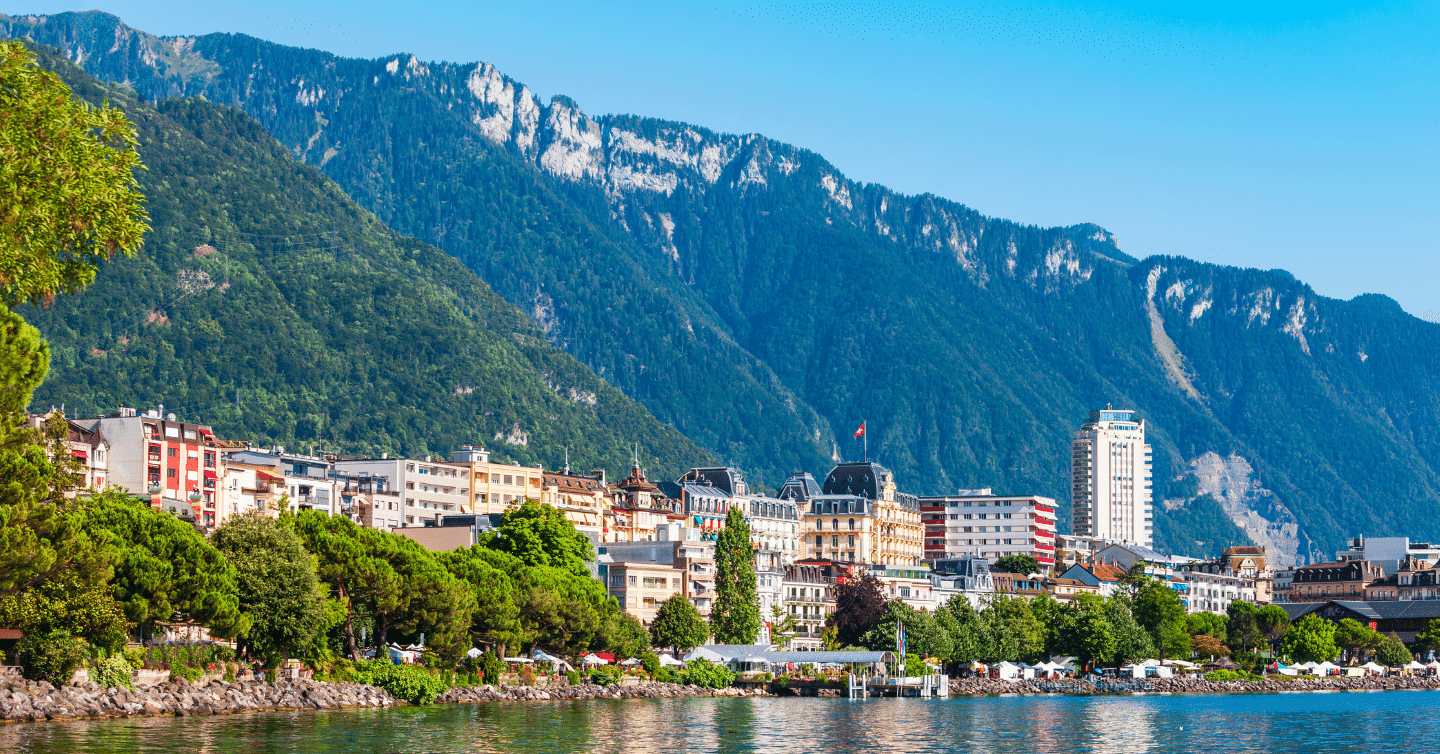
Switzerland’s democratic system is in a category of its own — citizens can call referendums and popular initiatives on virtually any issue, which produces a level of civic engagement and institutional accountability that most countries can’t match. It’s also famously stable, neutral, and meticulously well-organized. The cost of living is high, the immigration process is deliberate, and learning a local language is strongly advised, but the payoff is a country that takes its democracy more seriously than just about any other.
On the language front, English is widely used at work in Zurich, while French-speaking Lausanne will put your lessons to use. Either way, expect your Swiss employer to file the work permit.
9. Spain
Best for: Sun worshippers, food lovers, and Americans who want European democracy with a lower price tag than France or Germany.
Spain has built a stable, functioning democracy since its transition from dictatorship in the late 1970s — a transition that’s increasingly worth noting given current global trends. It has strong protections for civil liberties, an independent judiciary, and a free press. It also has a Non-Lucrative Visa that’s been popular among American retirees and remote workers, a lower cost of living than much of Western Europe, and one of the world’s great food cultures. The lifestyle is excellent. The siestas are not messing around.
Remote workers now have their own digital nomad visa, and the non-lucrative visa remains the retiree route. For a taste of all that, few cities feel more Spanish than Seville.
10. France
Best for: People who are serious about European culture and democratic institutions — and are prepared to learn French.
France has a long and occasionally complicated democratic history, but its institutions — an independent judiciary, a free press, robust civil liberties protections — are strong and tested. It’s also a founding member of the EU with some of the world’s most comprehensive social protections. The language barrier is real, and integration requires commitment. But for Americans who are serious about making a life in a country with deep democratic roots, France is worth the effort.
Democracy nerds can live next door to the European Parliament in Strasbourg, a city with plenty of international work. And if you want to learn French properly, a student visa lets you study in France and work part-time.
A note on all of the above: “More democratic than the U.S. right now” is a data point, not a judgment call. Just like any other country, these countries all have their own politics, their own challenges, their own occasional dysfunction. They just also happen to share a track record of democratic stability, functioning institutions, and strong civil liberties protections. (You know, things that might have felt easy to take for granted a few administrations ago.) Want to know what countries could be a good fit for you? Start with the Exptasi Test, and we can take it from there.