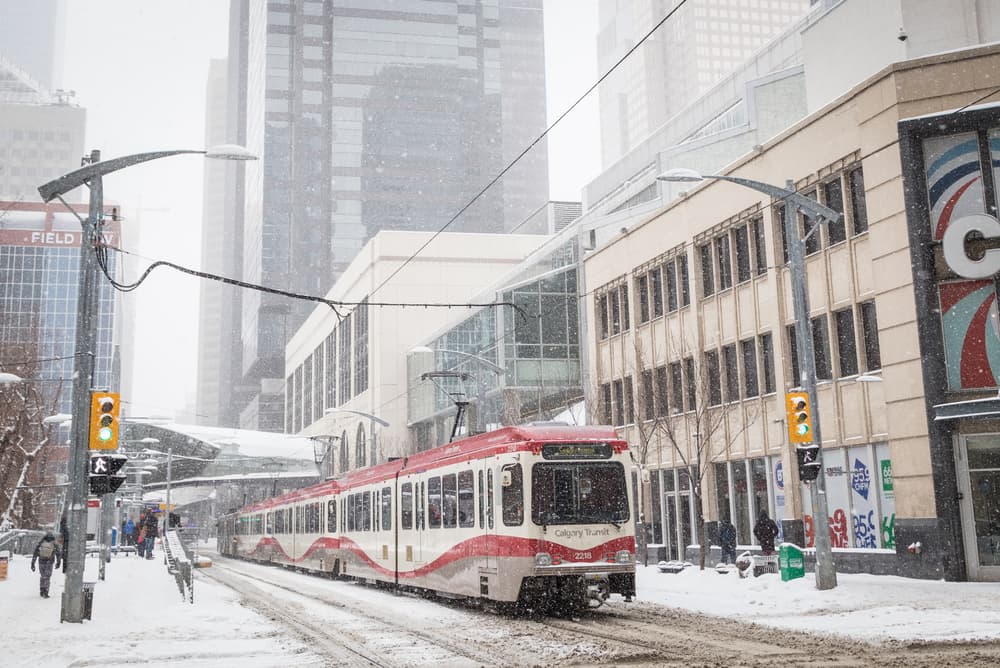
Living in Calgary: about $2,400 a month, with the Rockies an hour away
What it costs to live in Calgary, how safe it is, how people get around, and what Americans should know about moving to or retiring in Alberta's biggest city.
- 1,306,784
- Population (2021)
- $2,400/mo
- Monthly budget · single
- 41°F / 5°C
- Avg temperature
Calgary runs about $2,400 a month for one person and $3,700 for a couple, with a one bedroom in the central neighborhoods around $1,300 and closer to $1,100 further out. A family budget lands near $5,700. Those are U.S. dollars, and they buy a city of 1.3 million people with the Rocky Mountains an hour west.
It suits people arriving with a job in energy, tech or healthcare, outdoor types who want the mountains on a Saturday, and families wanting room without Toronto or Vancouver prices. English is the working language, Alberta charges no provincial sales tax, and the safety index of 72 sits above Toronto, Montreal and Vancouver.
The trade-off is winter. February averages 20F, January nights average 11F, and the local economy still tracks the price of oil. In return you get dry air, 16.2 inches of precipitation a year, and chinook winds that can push a February afternoon above freezing.

Reviewed and updated September 17, 2026 · 4 min read
At a glance
$2,400
Monthly budget · single person
$1,300/mo 1-bed rent, center
72/100
Safety index
$55
Internet / month
41°Fannual average
Feb 20° · Jul 64°
Climate
1,306,784
Population (2021)
Expatsi estimates, updated Aug 2026, based on rental listings, government statistics, and local reporting.
Cost of living
What it costs to live in Calgary
Single person
$2,100–$2,700/mo
about 25% below Austin, TX
Couple
$3,300–$4,200/mo
about 20% below Austin, TX
Family of four
$5,000–$6,400/mo
about 30% below Austin, TX
Compared with Austin, TX (Expatsi estimate, 2026).
- $20 ±0%
- Inexpensive meal
- $1,150–$1,450/mo −33%
- 1-bed rent, center
- $950–$1,200/mo −19%
- 1-bed rent, outside
- $55/mo −15%
- Internet
- $85/mo +106%
- Transit pass
- $321/sq ft −51%
- Buy price, center
Expatsi estimates, updated Aug 2026, based on rental listings, government statistics, and local reporting.
Daily life
How Calgary lives
- B+ grade, 69th percentile among the cities we track
- Dining & cafésstrong
- B+ grade, 57th percentile among the cities we track
- Arts & culturestrong
- B+ grade, 59th percentile among the cities we track
- Parks & outdoorsstrong
- B- grade, 32nd percentile among the cities we track
- Schools & educationtypical
- B grade, 47th percentile among the cities we track
- Healthcare accesstypical
- A- grade, 85th percentile among the cities we track
- Bike infrastructurestrong
- A- grade, 77th percentile among the cities we track
- Public transitstrong
- A+ grade, good physical accessibility
- Accessibilitygood
Graded on OpenStreetMap amenity density relative to the 298 cities we track. Accessibility is the exception: it's graded against a fixed standard (terrain steepness and sidewalk surfaces), not a curve.
Climate
Weather through the year
Annual average 41°F (5°C) · 16 in of rain a year · Source: Meteostat station normals (DHKZ6, 1991-2020; no sunshine data)
On the ground
Scenes from Calgary
Getting around
Transport in Calgary
Calgary is a car city with a good transit spine down the middle. The CTrain runs two light rail lines that cross downtown along 7th Avenue, the Red Line from the northwest to the south and the Blue Line from the northeast to the west. A monthly pass works out to about $85. Trains come every five to ten minutes at rush hour, all 45 stations are step free, and low floor buses cover the other 155 routes. Rides that start and end inside that downtown stretch are still free, though council revisits the zone in a 2027 fare review.
The inner city is where you can skip the car. The Beltline, Mission, Kensington and Inglewood are walkable in a way American downtowns rarely are, and the Beltline scores 91 on Walk Score. Downtown has the Plus 15, 86 enclosed bridges and more than 16 kilometres of heated walkway a storey above the street, which is how the office crowd gets to lunch in January. Cyclists get more than 1,000 kilometres of pathway along the Bow and Elbow rivers.
Live in the suburbs and you need a car. Budget for winter tires and a block heater, and expect chinook freeze and thaw to leave black ice behind.
- 53/sq mi
- Transit stops
- 70/sq mi
- Bike infrastructure
- 262/sq mi
- Wheelchair-accessible places
Mapped features per square mile from OpenStreetMap.
Keep exploring
Places like Calgary


Community
Community & practical notes
The expat scene: Calgary reads as an immigrant city rather than an expat one. More than 120 languages are spoken here, and Americans are a small thread in a much larger cloth, so there is no American enclave to land in and no real need for one. Newcomers sort themselves by neighborhood: young professionals into the Beltline and Mission, families into Signal Hill or Lake Bonavista, anyone wanting old brick and independent shops into Inglewood or Bridgeland. How fast you make friends depends on whether you ski, ride or volunteer.
Healthcare: Alberta coverage is called AHCIP, and the rule depends on where you move from. Arriving from outside Canada, you may be covered from the date you establish residency if you apply within three months with an immigration document such as a work permit or PR card. Arriving from another Canadian province, coverage starts the first day of the third month, so bridge that gap privately. AHCIP does not cover prescriptions, dental, vision or ambulance. The limit is access rather than coverage: about 16 percent of Albertans have no family doctor, and roughly half of those who do cannot get a timely appointment. Start at albertafindadoctor.ca your first week.
Remote work: Home internet runs about $55 a month. Coworking is easy to find, from Platform Calgary to Commons in the Beltline, cSPACE in a converted Marda Loop schoolhouse and Work Nicer downtown. Mountain Time puts you an hour behind Chicago and two behind New York, so East Coast calls are comfortable and West Coast ones early.
Limited mobility: Calgary is one of the easier North American cities to roll around. The terrain is close to flat, sidewalks are consistently paved, and all 45 CTrain stations are reachable by elevator, ramp or at ground level, with deployable ramps on every bus and train. Two gaps remain. Not every bus stop is accessible yet, and a few older train cars are still being phased out, so you can wave one past and wait. Winter is the real variable, since snow and ice bury curb cuts for days. Calgary Transit Access runs door-to-door service after an application and an in-person assessment, and free Travel Training teaches the system one-on-one.
Retirement: Calgary suits retirees on the daily measures, with flat ground, dry air and solid healthcare once you are in the system. Canada has no retirement visa and no passive-income route, though, so retiring here is a question of status rather than budget. The realistic paths are permanent residence another way, family sponsorship, or the Super Visa for parents and grandparents of citizens and permanent residents, which allows up to five years per entry on a visa valid up to ten. Super Visa holders stay visitors, with no provincial coverage and mandatory private insurance. See the retirement visa routes and the guide to moving to Canada.
Housing
Renting and buying
- 1-bed rent (center)
- $1,150–$1,450/mo
- 1-bed rent (outside center)
- $950–$1,200/mo
- Buy price (center)
- $321/sq ft
- Buy price (outside center)
- $274/sq ft
Expatsi estimates, based on rental listings, government statistics, and local reporting.
Good to know
Frequently asked questions
Is Calgary safe?
Calgary rates well by big-city standards, with a safety index of 72 that runs above Toronto, Montreal and Vancouver. Newcomers generally find daily life comfortable, including transit after dark in the central neighborhoods. The usual caveats apply downtown late at night, and safety on the CTrain is an active political debate here.
Can Americans retire in Calgary?
Not directly, because Canada has no retirement visa and no passive-income residency route. Americans who retire in Calgary qualify for permanent residence another way, come through family sponsorship, or use the Super Visa if their child or grandchild is a citizen or permanent resident. A Super Visa allows up to five years per entry but keeps you a visitor, which means private medical insurance and no provincial coverage.
Is Calgary wheelchair accessible?
Calgary is among the easier North American cities for wheelchair users. The terrain is close to flat and all 45 CTrain stations offer elevator, ramp or ground-level access, with ramps on every bus and train. The gaps are that not all bus stops are accessible, a few older train cars are still being phased out, and winter snow buries curb cuts. Calgary Transit Access runs door-to-door service after an application and assessment.
How do Americans move to Calgary?
Through a federal or Alberta immigration program, since there is no residency route based on income or buying property. Most people arrive on a job offer and work permit, through Express Entry, or through the Alberta Advantage Immigration Program, which runs draws aimed at demand in energy, healthcare, construction and technology. Students and spouses of permit holders are the other routes.
What is winter really like in Calgary?
Cold, dry and interrupted. February is the coldest month at an average of 20F and January nights average 11F, so a real parka is not optional. The compensation is only 16.2 inches of precipitation a year and roughly 25 chinook days a winter, when warm wind off the Rockies lifts the temperature 30F or more in a few hours and melts the snow off your street.
How much does it cost to live in Calgary?
Budget about $2,400 a month for one person, $3,700 for a couple and around $5,700 for a family, in US dollars. A one bedroom in the central neighborhoods runs about $1,300 and about $1,100 outside the core. An inexpensive meal is around $20, internet $55 and a monthly transit pass $85. Calgary costs less than Toronto or Vancouver and a little more than Montreal.
Do you need a car in Calgary?
You do not need one in the Beltline, Mission, Kensington, Inglewood or downtown, where the CTrain, buses and walkable streets cover daily life. Almost everywhere else, you do. Calgary sprawls, the suburbs are built around driving, and the mountains that make the city worth living in are hard to reach without one.
See how Calgary fits your life
Take the free Expatsi Test and compare Canada to nearly 200 countries on what actually matters: cost, healthcare, climate, and safety. About five minutes.
Why not you?