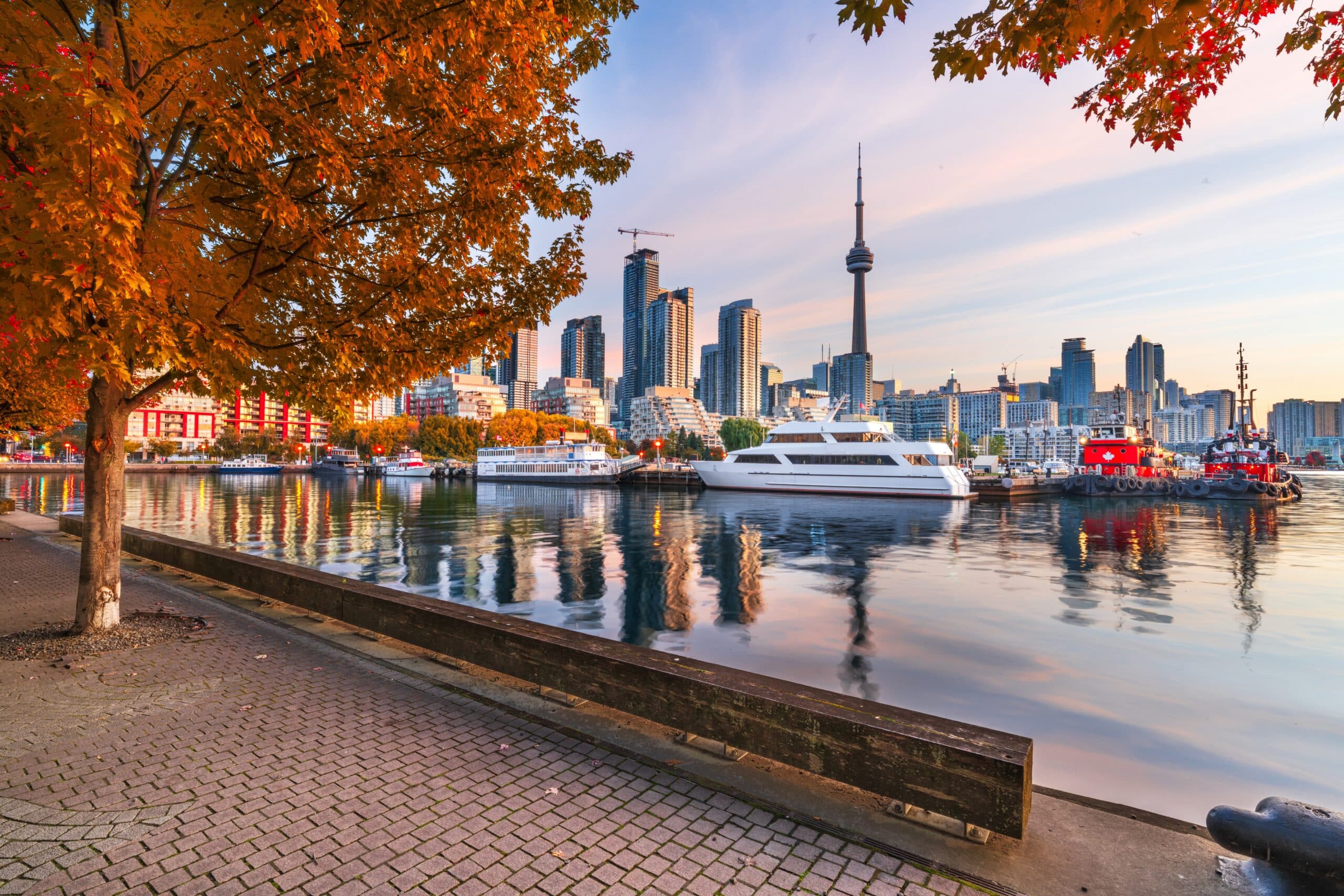
Toronto: Canada's biggest city, running in English
Canada's largest city, with daily life in English, transit that works, and a job market deep enough to move a career to.
- 2,794,356
- Population (2021)
- $2,900/mo
- Monthly budget · single
- 49°F / 10°C
- Avg temperature
Toronto runs about $2,900 a month for one person, $4,400 for a couple, and about $6,700 for a family of four, all in and in U.S. dollars rather than Canadian. A one bedroom in the center averages $1,700 a month, or about $1,500 outside the core.
That's roughly a quarter more per month than Montreal, and housing is most of the gap. What the money buys is Canada's biggest city: 2.8 million people, daily life running in English, and a job market deep enough to move a career to. Toronto suits people coming for work, families who want real transit, and anyone who wants a big multicultural city in a North American time zone.
Health coverage favors newcomers here. Ontario scrapped its three month OHIP waiting period, so if you're eligible, coverage starts once you're approved instead of after a quarter of paying out of pocket.
At a glance
$2,900
Monthly budget · single person
$1,700/mo 1-bed rent, center
71/100
Safety index
$55
Internet / month
49°Fannual average
Jan 26° · Jul 73°
Climate
2,794,356
Population (2021)
Expatsi estimates, updated Aug 2026, based on rental listings, government statistics, and local reporting.
Cost of living
What it costs to live in Toronto
Single person
$2,600–$3,300/mo
about 5% below Austin, TX
Couple
$3,900–$4,900/mo
about the same as Austin, TX
Family of four
$5,900–$7,500/mo
about 15% below Austin, TX
Compared with Austin, TX (Expatsi estimate, 2026).
- $19 −5%
- Inexpensive meal
- $1,500–$1,900/mo −13%
- 1-bed rent, center
- $1,300–$1,650/mo +11%
- 1-bed rent, outside
- $55/mo −15%
- Internet
- $115/mo +179%
- Transit pass
- $776/sq ft +19%
- Buy price, center
Expatsi estimates, updated Aug 2026, based on rental listings, government statistics, and local reporting.
Daily life
How Toronto lives
- B grade, 46th percentile among the cities we track
- Dining & caféstypical
- B- grade, 32nd percentile among the cities we track
- Arts & culturetypical
- A- grade, 81st percentile among the cities we track
- Parks & outdoorsstrong
- B grade, 51st percentile among the cities we track
- Schools & educationtypical
- B+ grade, 59th percentile among the cities we track
- Healthcare accessstrong
- B+ grade, 65th percentile among the cities we track
- Bike infrastructurestrong
- A- grade, 72nd percentile among the cities we track
- Public transitstrong
- A+ grade, good physical accessibility
- Accessibilitygood
Graded on OpenStreetMap amenity density relative to the 298 cities we track. Accessibility is the exception: it's graded against a fixed standard (terrain steepness and sidewalk surfaces), not a curve.
Climate
Weather through the year
Annual average 49°F (10°C) · 32 in of rain a year · Source: Meteostat station normals (71508, 1991-2020; sunshine from 1961-1990)
On the ground
Scenes from Toronto
Getting around
Transport in Toronto
You don't need a car downtown or in the older streetcar neighborhoods. The TTC runs three subway lines, a full streetcar network, and about 170 bus routes, and a monthly pass costs around $115. Two new light rail lines opened after years of delay, Line 6 Finch West in December 2025 and Line 5 Eglinton in February 2026, the one that finally gives midtown a fast east-west run.
The TTC drops the monthly pass on September 1, 2026 and switches to fare capping, so you tap as you go and once you hit 47 paid trips in a month the rest are free. One Fare also means your TTC trip transfers free onto Mississauga, Brampton, York, and Durham buses.
From Pearson, the UP Express reaches Union Station in 25 minutes and runs every 15 minutes. Downtown is stitched together underground by the PATH, about 30 km of climate-controlled tunnels that keep winter walking indoors, and Bike Share Toronto runs year round with more than 10,000 bikes.
A car makes sense in Scarborough, Etobicoke, or North York, or if you commute to the suburbs, though downtown it mostly buys a parking bill and time on the Gardiner.
- 48/sq mi
- Transit stops
- 20/sq mi
- Bike infrastructure
- 58/sq mi
- Wheelchair-accessible places
Mapped features per square mile from OpenStreetMap.
Keep exploring
Places like Toronto



Living here
Community and practical notes
Community: Toronto isn't a city with an expat scene to join, because almost half of it is foreign born and roughly 200 languages are spoken here, so Americans blend in fast and make up a very small slice of that. Everyday life runs in English, and the texture comes from the neighborhoods: Greektown on the Danforth, Little Italy and Corso Italia, several Chinatowns, Little Jamaica, Koreatown, Little India, and Roncesvalles for the Polish bakeries. The city gets smaller once you settle into the pocket that fits you.
Healthcare: Ontario makes this easier than most provinces. There's no OHIP waiting period anymore, so you can apply in person at a ServiceOntario counter the week you land with proof of status, proof of an Ontario address, and ID. Permanent residents qualify, as do people on a full time work permit of six months or more with an Ontario employer, along with their spouse and kids. The limit is access rather than coverage, since Ontario's family doctor shortage is real and close to a million Torontonians are projected to be without one. Sign up for Health Care Connect once you have a card, and lean on Health811, walk-in clinics, and virtual care while you wait.
Limited mobility: Toronto is one of the easier big cities to get around on wheels, and Ontario's AODA requires businesses and services to be accessible. The ground is close to flat, sidewalks are paved and in good shape, every TTC bus and streetcar is low floor with a ramp, subway trains board level, and the two new LRT lines were built accessible. Two gaps are worth planning around. Most of the 70 subway stations have elevators but not all, and the TTC missed its January 2025 deadline to finish the work. Plenty of older storefronts still sit behind a single step, which is why the Toronto-founded StopGap Foundation builds brightly painted ramps for them. Check venues on AccessNow, register for Wheel-Trans door-to-door service if you qualify, and expect snow to bury curb cuts in winter.
Remote work: Home internet runs about $55 a month, and coworking is easy to find downtown and along the King and Queen West strips. Finance, tech, film, and health research do most of the hiring.
Retirement: Retiring here is the hard part. Canada has no retirement visa and no passive income or golden visa route. If your child or grandchild is a Canadian citizen or permanent resident, the Super Visa lets you stay up to five years per entry on a visa good for up to ten years, provided your host meets an income floor and you carry CAD $100,000 in private medical coverage. Parent and grandparent sponsorship has been closed to new applications since January 2026. Otherwise you're a visitor at six months per entry, with no provincial health coverage and a 183 day line that can make you a tax resident. Start with the retirement visa options and our guide to moving to Canada.
Housing
Renting and buying
- 1-bed rent (center)
- $1,500–$1,900/mo
- 1-bed rent (outside center)
- $1,300–$1,650/mo
- Buy price (center)
- $776/sq ft
- Buy price (outside center)
- $604/sq ft
Expatsi estimates, based on rental listings, government statistics, and local reporting.
Good to know
Frequently asked questions
Do you need a car in Toronto?
You don't need a car downtown or in the streetcar neighborhoods. Three subway lines, two new LRT lines, streetcars, buses, and a monthly pass around $115 cover most lives, and Bike Share runs year round. A car earns its keep in Scarborough, Etobicoke, North York, or if you commute out to the suburbs.
How much does it cost to live in Toronto?
Living in Toronto costs about $2,900 a month for one person and $4,400 for a couple, all in and in US dollars. A family of four runs about $6,700. A one bedroom in the center averages $1,700, or about $1,500 outside the core. A meal at an inexpensive restaurant is around $19 and home internet is about $55.
Can Americans retire in Toronto?
Retiring in Toronto is difficult, since Canada has no retirement visa. The realistic routes are the Super Visa if you have a Canadian child or grandchild, which allows up to five years per entry, family sponsorship, or plain visitor status at six months per entry. Parent and grandparent sponsorship has been paused to new applications since January 2026, and visitors get no provincial health coverage.
How do Americans move to Toronto?
Americans move to Toronto through a federal or Ontario program, since there's no city-level route. The common ones are Express Entry for skilled workers, the Ontario Immigrant Nominee Program, an employer-backed work permit, a study permit, or family sponsorship. A passport only covers a visit, so you'll need status to live and work here.
How cold do Toronto winters actually get?
January is the coldest month, averaging 26F (-3.4C), with typical highs near 32F and lows near 20F. July highs run about 81F (27.4C). Across the year Toronto averages 49F (9.7C) and roughly 32 inches of precipitation. It's noticeably milder and drier than Montreal, and the PATH tunnels get you through the worst of it.
Is Toronto safe?
Toronto scores 71 on the safety index and 29 on the crime index, which puts it among the safer big cities in North America. Walking alone downtown at night is ordinary, and the everyday risks are bike theft and break-ins to parked cars rather than violence.
Is Toronto wheelchair accessible?
Toronto is mostly accessible, and better than most cities its age. It's flat, the sidewalks are smooth, and Ontario's AODA law requires accessible service. Every TTC bus and streetcar is low floor with a ramp and the new LRT lines are fully accessible, though a handful of older subway stations still have no elevator and plenty of small storefronts sit behind one step. Wheel-Trans handles door-to-door trips, and locals check venues on the AccessNow app first.
How do I get health insurance in Toronto as a newcomer?
Newcomers apply for OHIP in person at a ServiceOntario centre as soon as they arrive. Ontario dropped its three month waiting period, so eligible newcomers are covered once approved. Bring proof of status, proof of an Ontario address, and ID, and carry a short private policy for the few weeks of processing. Then register with Health Care Connect to get on a family doctor's roster.
See how Toronto fits your life
Take the free Expatsi Test and compare Canada to nearly 200 countries on what actually matters: cost, healthcare, climate, and safety. About five minutes.
Why not you?