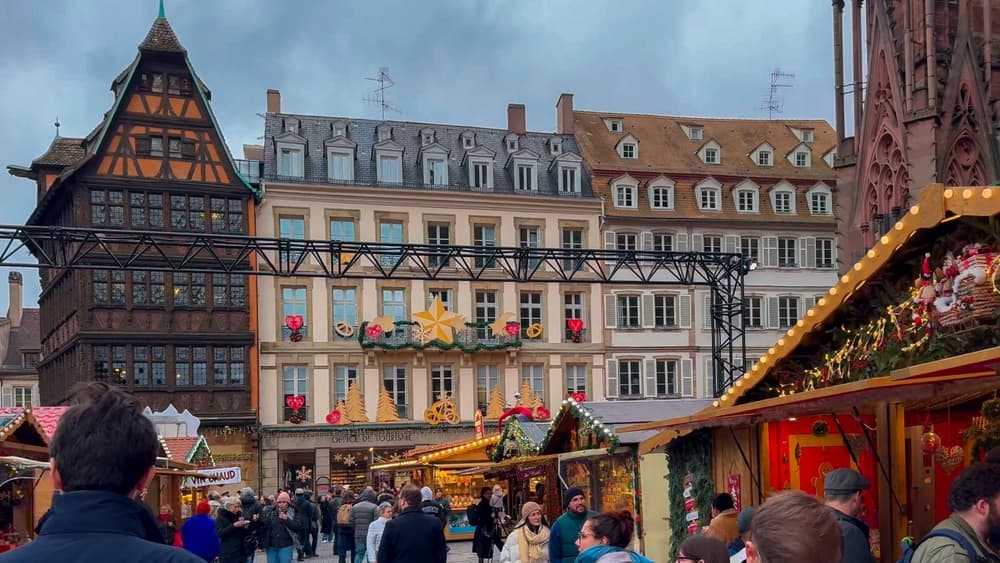
Living in Strasbourg: France with German edges
What it costs, how safe it is, what winter really feels like, and whether Strasbourg works for retirement or remote work.
- 293,771
- Population (2023)
- $2,200/mo
- Monthly budget · single
- 53°F / 11°C
- Avg temperature
Strasbourg runs about $2,200 a month for one person, $3,500 for a couple and $5,400 for a family. A one-bedroom in the center is around $1,000 and about $750 further out, a cheap restaurant meal is $16, internet is $35 and a monthly transit pass is $60. That buys a Western European city with a UNESCO old town, the European Parliament and the Council of Europe inside it.
Who it suits: people who want a mid-size French city they can cross on foot or by bike, with a big university hospital and fast trains to Paris and Germany. Who it doesn't: anyone who needs a warm, bright winter, or who expects to handle the paperwork without French.
The trade-off is that winter. January averages a high near 41F with nights right around freezing, December is the darkest month of the year, and the year as a whole averages about 53F. About 25 inches of rain falls a year, most of it from May onward, so the cold months are dry, dark and genuinely cold.

Reviewed and updated September 23, 2026 · 4 min read
At a glance
$2,200
Monthly budget · single person
$1,000/mo 1-bed rent, center
63/100
Safety index
$35
Internet / month
53°Fannual average
Jan 37° · Jul 69°
Climate
293,771
Population (2023)
Expatsi estimates, updated Aug 2026, based on rental listings, government statistics, and local reporting.
Cost of living
What it costs to live in Strasbourg
Single person
$2,000–$2,500/mo
about 30% below Austin, TX
Couple
$3,100–$3,900/mo
about 25% below Austin, TX
Family of four
$4,400–$6,400/mo
about 30% below Austin, TX
Compared with Austin, TX (Expatsi estimate, 2026).
- $16 −20%
- Inexpensive meal
- $850–$1,100/mo −49%
- 1-bed rent, center
- $650–$800/mo −44%
- 1-bed rent, outside
- $35/mo −46%
- Internet
- $60/mo +45%
- Transit pass
- $451/sq ft −31%
- Buy price, center
Expatsi estimates, updated Aug 2026, based on rental listings, government statistics, and local reporting.
Daily life
How Strasbourg lives
- A- grade, 82nd percentile among the cities we track
- Dining & cafésstrong
- A- grade, 80th percentile among the cities we track
- Arts & culturestrong
- A- grade, 84th percentile among the cities we track
- Parks & outdoorsstrong
- A- grade, 82nd percentile among the cities we track
- Schools & educationstrong
- B+ grade, 69th percentile among the cities we track
- Healthcare accessstrong
- A grade, 93rd percentile among the cities we track
- Bike infrastructurestandout
- A- grade, 73rd percentile among the cities we track
- Public transitstrong
- A+ grade, good physical accessibility
- Accessibilitygood
Graded on OpenStreetMap amenity density relative to the 369 cities we track. Accessibility is the exception: it's graded against a fixed standard (terrain steepness and sidewalk surfaces), not a curve.
Climate
Weather through the year
Annual average 53°F (11°C) · 25 in of rain a year · Source: Meteostat station normals (07190, 1991-2020)
On the ground
Scenes from Strasbourg
Getting around
Transport in Strasbourg
You don't need a car in Strasbourg. A monthly CTS pass covers the trams and buses for about $60, most lines meet at Homme de Fer in the center, and the Grande Île that holds the old town is compact and largely closed to traffic. The ground is flat, so walking and cycling are the default.
Tram line D is the unusual one. It crosses the Rhine into Kehl, Germany, which residents use for groceries and cheap shopping; thousands of people commute the other way to German jobs. Gare Centrale puts Paris under two hours away by TGV and runs direct German trains. The airport at Entzheim is a shuttle train of under 10 minutes from that same station.
The city calls itself France's cycling capital and has the country's largest network of bike routes behind the claim, plus Vélhop rentals by the month if you'd rather not buy. If you do keep a car, park-and-ride lots sit on the tram lines, and be ready for December, when the city closes center car parks and rewrites the traffic rules for the weeks of the Christmas market.
- 46/sq mi
- Transit stops
- 151/sq mi
- Bike infrastructure
- 226/sq mi
- Wheelchair-accessible places
Mapped features per square mile from OpenStreetMap.
Keep exploring
Places like Strasbourg
Community
Community & practical notes
The expat scene: English speakers here have somewhere to land. ESC Alsace has been going since the mid-1970s, when it started as coffee mornings around the U.S. Consulate, and still runs coffee, a book club and walks; Americans in Alsace is the more specifically American and Canadian group. The European Parliament and the Council of Europe keep a steady international population in the city. Associations recruit at the Village des Associations in the Parc de la Citadelle every September, the easiest week of the year to join something.
Healthcare: The Hôpitaux Universitaires de Strasbourg run the public hospitals, with the Nouvel Hôpital Civil downtown and Hautepierre to the west; adult emergencies go to the first, children's to the second. The routine is the French one: register with CPAM for Assurance Maladie, get a carte vitale, declare a médecin traitant and book through Doctolib. Alsace also keeps its own régime local, which reimburses doctor and dentist fees at 90% instead of the national 70% and covers hospital board in full. The catch is that it follows French salaried work rather than residence, so employees and their families qualify but someone on a long-stay visitor visa doesn't.
Schools: The European School of Strasbourg sits in Robertsau near the European quarter, teaches in German, English and French sections, charges no tuition as a public school and leads to the European Baccalaureate. International School Strasbourg, on rue de Soultz, takes ages 3 to 18 in a bilingual program ending in the IB Diploma. Some public lycées run international sections, too.
Remote work: Internet is $35 a month and fiber is standard, so working from a flat here is uneventful. The time zone is the real constraint, six hours ahead of New York, which leaves your mornings quiet and your afternoons on East Coast calls.
Limited mobility: The flat ground does half the work here while the trams do the rest. CTS trams are low-floor and step-free; every bus carries a ramp that the driver deploys; both have priority wheelchair spaces. Mobistras books door-to-door trips between addresses across the Eurométropole and into central Kehl, once you register and are approved. The exception is the historic island, where the cobbles around the cathedral and through Petite France are rough going, while Neustadt and the riverbanks by the European Parliament are smooth modern paving. Check your daily route in person before you sign a lease.
Retirement: Strasbourg suits a retiree who wants a walkable European city rather than a warm one. A couple's budget of $3,500 a month, a $60 transit pass, flat streets and a university hospital in the center add up well, and the way in is the long-stay visitor visa covered on our France retirement visa page, with the wider picture in our France moving guide and our retirement visa guide. Test the winter first, and note that the régime local's better reimbursements won't reach you. For the mild version of France, our Nice and Montpellier guides cover the Mediterranean side.
Housing
Renting and buying
- 1-bed rent (center)
- $850–$1,100/mo
- 1-bed rent (outside center)
- $650–$800/mo
- Buy price (center)
- $451/sq ft
- Buy price (outside center)
- $297/sq ft
Expatsi estimates, based on rental listings, government statistics, and local reporting.
Good to know
Frequently asked questions
How do Americans move to Strasbourg?
The same way as anywhere in France: apply for a long-stay visa before you leave, then validate it into a residence permit once you land. Two local quirks are worth knowing. Alsace still runs on its own local law in places, including two public holidays the rest of France doesn't get, and German is genuinely useful here alongside French.
Is Strasbourg safe?
Strasbourg scores 63 for safety and 37 for crime in our data, above Montpellier at 62 and Paris at 55. Violent crime against foreigners is uncommon, and theft is the real risk: the main station, the cathedral square, crowded trams and the Christmas market. France sits at Level 2 on the US travel advisory, and the State Department rates Strasbourg a medium-threat location for terrorism, as it does Paris and Lyon.
Do you need a car in Strasbourg?
No. Trams and buses cover the city for about $60 a month, the old town is compact and mostly car-free, the ground is flat enough that people cycle year round, and one tram line runs over the border into Germany. A car earns its keep for the Vosges and the wine villages, and park-and-ride lots sit on the tram lines.
Is Strasbourg wheelchair accessible?
Largely yes, with one exception. The ground is flat, trams are step-free, every bus has a ramp the driver deploys, and Mobistras books door-to-door trips across the metro area and into Kehl. The cobbles on the historic island, worst near the cathedral and in Petite France, are the exception; the newer quarters are smooth.
Can you retire in Strasbourg?
Yes, and the practical case is good: a couple can live on about $3,500 a month, the streets are flat, a transit pass is $60 and the university hospital sits in the center. Americans usually arrive on France's long-stay visitor visa. The trade-off is the winter, plus the fact that Alsace's better health reimbursements are tied to French salaried work rather than residence.
What is the weather like in Strasbourg?
Cold winters, warm summers and a real spring and fall in between. The year averages about 53F. July averages a high near 79F, January a high near 41F with nights right around freezing, and December is the darkest month. About 25 inches of rain falls in a year, most of it from May onward rather than in winter.
How much does it cost to live in Strasbourg?
Figure about $2,200 a month for one person, $3,500 for a couple and $5,400 for a family. A one-bedroom in the center runs around $1,000 and about $750 outside it, a meal at an inexpensive restaurant is $16, internet is $35 and a monthly transit pass is $60. Rent is the figure that moves most.
See how Strasbourg fits your life
Take the free Expatsi Test and compare France to nearly 100 countries on what actually matters: cost, healthcare, climate, and safety. About five minutes.
Why not you?