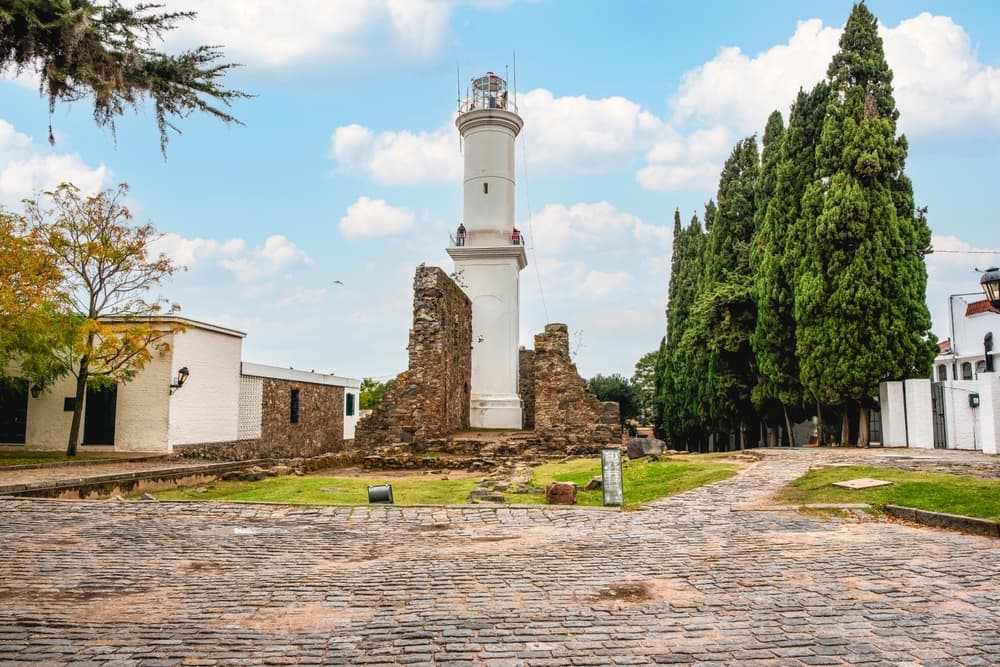
Colonia del Sacramento: cobblestones, river sunsets, and calm
A UNESCO-listed old town of roughly 32,000 people on the Río de la Plata, an hour by ferry from Buenos Aires and a quiet two-and-a-half-hour drive from Montevideo.
- 32,159
- Population (2023)
- $1,600/mo
- Monthly budget · single
- 63°F / 17°C
- Avg temperature
Budget about $1,600 a month in U.S. dollars to live in Colonia del Sacramento as one person, around $2,300 as a couple, and roughly $3,300 for a family. Rent is the light part of that math: a one-bedroom averages about $600 in the center and around $450 outside it, which is unusual for a town this photogenic. Keep in mind these are lower-confidence estimates than we have for bigger cities, so leave yourself some margin.
Colonia suits people who want Uruguay's stability at small-town scale: retirees, remote workers who like quiet, and anyone who wants Buenos Aires an hour away by ferry without living in it. The historic quarter, the Barrio Histórico, is a UNESCO World Heritage site of cobblestones, sycamores, and river sunsets. The rest of town is a calm grid of low houses and everyday shops.
The honest drawback is that it's small. With about 32,000 residents, there's no real job market on the ground. Nightlife winds down early. Specialty shopping or serious medical care means a trip to Montevideo. Some people find the pace restorative; others find it runs out of surprises within a year.
At a glance
$1,600
Monthly budget · single person
$600/mo 1-bed rent, center
71/100
Safety index
$35
Internet / month
63°Fannual average
Jul 52° · Jan 75°
Climate
32,159
Population (2023)
Expatsi estimates, updated Aug 2026, based on rental listings, government statistics, and local reporting. Coverage here is thin, so treat these as a rough guide.
Cost of living
What it costs to live in Colonia del Sacramento
Single person
$1,200–$2,000/mo
about 50% below Austin, TX
Couple
$1,700–$2,900/mo
about 50% below Austin, TX
Family of four
$2,600–$4,000/mo
about 60% below Austin, TX
Compared with Austin, TX (Expatsi estimate, 2026).
- $13 −35%
- Inexpensive meal
- $450–$750/mo −69%
- 1-bed rent, center
- $350–$550/mo −67%
- 1-bed rent, outside
- $35/mo −46%
- Internet
- $223/sq ft −66%
- Buy price, center
Expatsi estimates, updated Aug 2026, based on rental listings, government statistics, and local reporting. Coverage here is thin, so treat these as a rough guide.
Daily life
How Colonia del Sacramento lives
- C+ grade, 16th percentile among the cities we track
- Dining & cafésmodest
- B grade, 41st percentile among the cities we track
- Arts & culturetypical
- C+ grade, 24th percentile among the cities we track
- Parks & outdoorsmodest
- C+ grade, 15th percentile among the cities we track
- Schools & educationmodest
- C grade, 13th percentile among the cities we track
- Healthcare accessmodest
- C- grade, 0th percentile among the cities we track
- Bike infrastructuremodest
- C+ grade, 22nd percentile among the cities we track
- Public transitmodest
Graded on OpenStreetMap amenity density relative to the 298 cities we track. Accessibility is the exception: it's graded against a fixed standard (terrain steepness and sidewalk surfaces), not a curve.
Climate
Weather through the year
Annual average 63°F (17°C) · 46 in of rain a year · Source: Meteostat station normals (86560, 1991-2020; sunshine from 1961-1990)
On the ground
Scenes from Colonia del Sacramento
Getting around
Transport in Colonia del Sacramento
Colonia is a town you cross on foot. The historic quarter and commercial center along Avenida General Flores sit within a compact area. Most errands, restaurants, and the ferry terminal are a walk or a short bike ride apart. Many residents get around by bicycle or scooter, and rental shops near the port lease golf carts and buggies to visitors. This tells you how flat and low-traffic the streets are.
There's a modest local bus service and inexpensive taxis for trips across town or out to the bull-ring end of the rambla, but nobody moves here for the transit system. The infrastructure worth knowing is intercity: COT and other coach lines run frequent, comfortable buses from the terminal next to the port to Montevideo in three hours. Buquebus and Colonia Express ferries cross to Buenos Aires in about an hour and 15 minutes on the fast boats.
Whether you need a car depends on how you'll live. For daily life in town, you genuinely don't require one. If you plan to explore the beaches and small towns along the coast, visit wineries in the Carmelo area, or make regular Montevideo runs on your own schedule, a car earns its keep. Note that cars in Uruguay are heavily taxed and cost noticeably more than in the U.S.. Many expats hold off and rent when needed.
One practical upside of the ferry: Colonia works as a base for people who split time between Uruguay and Argentina, since the crossing is a routine commute rather than a trip.
- 3.6/sq mi
- Transit stops
- 0.0/sq mi
- Bike infrastructure
- 0.8/sq mi
- Wheelchair-accessible places
Mapped features per square mile from OpenStreetMap.
Keep exploring
Places like Colonia del Sacramento


Community
Community & practical notes
Community: The expat presence here is small and mostly older, a mix of American and European retirees plus Argentines who moved across the river, folded into a town where daily life runs in Spanish. There's no expat district; newcomers meet people through the handful of cafés in the historic quarter, language exchange, and simply being a regular. If you want a large English-speaking social scene, Montevideo's the better fit.
Healthcare: Uruguay runs on the mutualista system, private nonprofit health plans where a monthly membership covers most care with small copays; residents can join one directly. Colonia has local clinics and a public hospital adequate for routine care, but complicated cases get referred to Montevideo, about two and a half hours away by road, so factor that into any serious health planning. Expect paperwork in Spanish and some waiting to enroll once your residency is moving.
Limited mobility: Mixed. The town is genuinely flat, with no hills to work against you. The newer streets outside the old quarter are smooth going, too. The Barrio Histórico is the hard part: its signature cobblestones are rough under wheels, and curb cuts come and go from block to block. There's also very little accessible transit to lean on, so anyone with mobility limits should look at specific streets and buildings in person before signing a lease.
Remote work: Home internet runs about $35 a month. Uruguay's fiber coverage through Antel is strong for the region, so connectivity isn't the problem. Coworking is essentially a café-and-spare-room affair; there's no real coworking industry in a town this size. Local employers are limited to tourism, the port, and services. Remote workers here bring their income with them, usually on U.S. hours, which line up conveniently with Uruguay's time zone.
Retirement: Uruguay is one of the more straightforward residency countries in the Americas. There's no fixed minimum income written into law; you apply for legal residency after arriving, show stable income that supports you (pensions and Social Security qualify), and live in the country while the paperwork processes. This commonly takes a year or more, so work with a professional to minimize delays. Retirees can also access the mutualista health system rather than paying U.S.-style private premiums. Compare retirement visa options and see our full Uruguay guide for the residency process end to end.
Housing
Renting and buying
- 1-bed rent (center)
- $450–$750/mo
- 1-bed rent (outside center)
- $350–$550/mo
- Buy price (center)
- $223/sq ft
- Buy price (outside center)
- $177/sq ft
Expatsi estimates, based on rental listings, government statistics, and local reporting. Coverage here is thin, so treat these as a rough guide.
Good to know
Frequently asked questions
Is Colonia del Sacramento a good place to retire?
It's a strong fit for retirees who want quiet, safety, and affordability: about $2,300 a month covers a couple, residency accepts pension and Social Security income, and the mutualista health plans keep medical costs modest. The trade-off is that serious hospital care means a two-and-a-half-hour trip to Montevideo, and the town's small size isn't for everyone.
How does healthcare work for expats in Colonia del Sacramento?
Residents join a mutualista, a private nonprofit health plan with a monthly membership fee and small copays that covers most care. Colonia has clinics and a public hospital for routine needs, while complex specialty care is referred to Montevideo. Many newcomers carry private or travel insurance during the residency waiting period, then enroll in a mutualista.
How do Americans move to Colonia del Sacramento?
Uruguay lets you apply for legal residency from inside the country. Most Americans arrive on a tourist entry, start the residency application in Uruguay, and show stable income plus documents like an FBI background check and birth certificate, apostilled. Processing commonly takes a year or more, but you can live in the country while it runs. See our Uruguay guide for the full process.
Can I do a day trip or commute to Buenos Aires from Colonia?
Yes, that's one of the town's defining features. Buquebus and Colonia Express ferries cross the Río de la Plata to Buenos Aires in about an hour and 15 minutes on the fast boats, making day trips routine. Some residents effectively split their lives between the two sides of the river.
Is Colonia del Sacramento safe?
Yes, by the numbers. It scores 71 on our safety index with a crime index of 29. It's a small, prosperous, tourism-dependent town in one of Latin America's most stable countries, and ordinary care against petty theft around the tourist quarter covers most of what residents run into.
Do I need a car in Colonia del Sacramento?
Not for daily life. The town is compact, flat, and walkable, and taxis and a small bus service fill the gaps. A car becomes worthwhile if you want to explore the coast and countryside regularly, but cars are heavily taxed in Uruguay and cost more than in the U.S., so many expats rent one only when needed.
How much does it cost to live in Colonia del Sacramento?
Plan on about $1,600 a month for one person, around $2,300 for a couple, and roughly $3,300 for a family, all in U.S. dollars. A one-bedroom rents for about $600 in the center and around $450 outside it, and a meal at an inexpensive restaurant runs about $13. These are lower-confidence estimates than for large cities, so budget toward the higher end of the range at first.
What's the weather like in Colonia del Sacramento?
Temperate and four-seasoned, averaging about 63°F (17.5°C) across the year with roughly 46 inches (1,158 mm) of rain and no real dry season. January is the warm end, averaging about 75°F with highs near 84°F, and July is the cool end, averaging about 52°F with overnight lows around 45°F. Central heating is uncommon, so winter comfort depends on how well your place is heated.
See how Colonia del Sacramento fits your life
Take the free Expatsi Test and compare Uruguay to nearly 200 countries on what actually matters: cost, healthcare, climate, and safety. About five minutes.
Why not you?