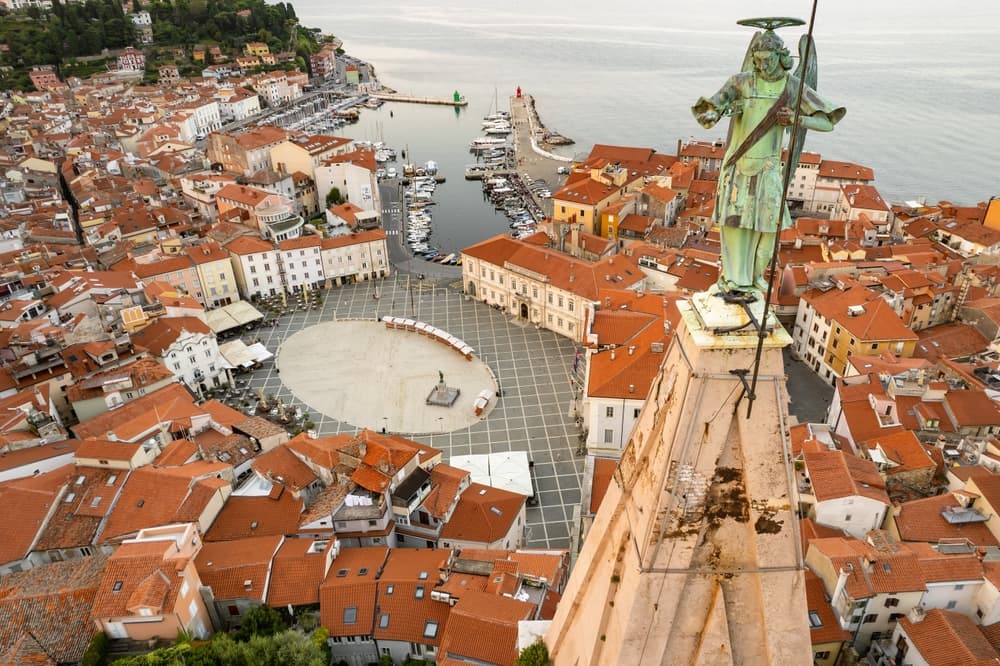
Piran: a small Adriatic old town where the car stays outside
What it costs to live in Piran, how safe it is, and what daily life looks like in a bilingual seaside town of about 3,800 that runs on foot and a shuttle bus.
- 3,787
- Population (2023)
- $1,700/mo
- Monthly budget · single
- 60°F / 15°C
- Avg temperature
Budget about $1,700 a month in U.S. dollars if you're living alone in Piran, or about $2,600 for a couple. A one-bedroom in the center rents for around $800, and about $650 farther out. A family of four should plan on roughly $3,800. Treat these as rough estimates: one person's month can land anywhere from about $1,300 to $2,100, and rent is what moves it.
Piran suits people who want a small, walkable town on the Adriatic and are happy with a quiet winter. About 3,800 people live here, in a bilingual town where you'll hear Slovene and Italian, and a safety index of 86 means crime is unlikely to be your main worry. Summers are hot, with July and August average highs near 84F. Winters are mild, with January highs near 48F, and snow is rare.
It's a harder fit if you want a car at your door, a local job market, or plenty of year-round rentals to choose from. Day-trippers fill the town in summer, and long-term housing is tight.

Reviewed and updated October 22, 2026 · 4 min read
At a glance
$1,700
Monthly budget · single person
$800/mo 1-bed rent, center
86/100
Safety index
$30
Internet / month
60°Fannual average
Jan 44° · Aug 77°
Climate
3,787
Population (2023)
Expatsi estimates, updated Oct 2026, based on rental listings, government statistics, and local reporting. Coverage here is thin, so treat these as a rough guide.
Cost of living
What it costs to live in Piran
Single person
$1,300–$2,100/mo
about 45% below Austin, TX
Couple
$2,000–$3,200/mo
about 45% below Austin, TX
Family of four
$3,100–$4,500/mo
about 50% below Austin, TX
Compared with Austin, TX (Expatsi estimate, 2026).
- $14 −30%
- Inexpensive meal
- $600–$1,000/mo −59%
- 1-bed rent, center
- $500–$800/mo −52%
- 1-bed rent, outside
- $30/mo −54%
- Internet
- $557/sq ft −14%
- Buy price, center
Expatsi estimates, updated Oct 2026, based on rental listings, government statistics, and local reporting. Coverage here is thin, so treat these as a rough guide.
Daily life
How Piran lives
- C+ grade, 19th percentile among the cities we track
- Dining & cafésmodest
- B- grade, 28th percentile among the cities we track
- Arts & culturetypical
- B- grade, 33rd percentile among the cities we track
- Parks & outdoorstypical
- C grade, 13th percentile among the cities we track
- Schools & educationmodest
- C grade, 6th percentile among the cities we track
- Healthcare accessmodest
- B grade, 43rd percentile among the cities we track
- Bike infrastructuretypical
- C+ grade, 22nd percentile among the cities we track
- Public transitmodest
- A- grade, good physical accessibility
- Accessibilitygood
Graded on OpenStreetMap amenity density relative to the 436 cities we track. Accessibility is the exception: it's graded against a fixed standard (terrain steepness and sidewalk surfaces), not a curve.
Climate
Weather through the year
Annual average 60°F (15°C) · 39 in of rain a year · Source: Meteostat station normals (16110, 1991-2020)
On the ground
Scenes from Piran
Getting around
Transport in Piran
Inside Piran, you walk. The old town is largely closed to visitor traffic, and residents, permit holders and deliveries each have their own access rules, so ask your landlord what applies to your street before you bring a car. Visitors get 15 minutes to drive in and drop off bags.
Most cars stay in the Fornače garage at the edge of town, which has 838 spaces and is open around the clock, or at the smaller Arze lot on the hill above. A municipal minibus runs from Fornače to Tartini Square about every 15 minutes, and both shuttle lines run on weekends and holidays. You pay with a rechargeable city card or a contactless bank card; the buses don't take cash.
Municipal Line 1 loops from Piran through Portorož and Lucija and back, and the Lucija bus station sells the city card. For longer trips, Arriva, Nomago and FlixBus run intercity buses, with FlixBus going on to Trieste. The bus from Ljubljana takes about two and a half hours or a little longer. The closest train stations are in Koper and across the border in Trieste.
For flights home, Trieste's airport is about 47 miles (75 km) from Portorož, next door to Piran, and Ljubljana's is about 96 miles (155 km). Living here without a car is realistic. A car still helps for weekend trips inland, as long as you're ready to pay to park it.
- 2.9/sq mi
- Transit stops
- 2.2/sq mi
- Bike infrastructure
- 4.1/sq mi
- Wheelchair-accessible places
Mapped features per square mile from OpenStreetMap.
Keep exploring
Places like Piran
Community & practical notes
Day-to-day life on the coast
Expat community: Small and informal. A town of about 3,800 doesn't have the numbers for English-language clubs or an American network, and a lot of the summer crowd are day visitors who leave by evening. Some Slovene goes a long way here, and Italian helps too. For a bigger international scene, you're looking at Ljubljana.
Healthcare: The Piran Health Centre runs its emergency service out of its Lucija unit in Portorož, and the nearest hospital is Izola General Hospital, up the coast in Izola. In an emergency, call 112. If you have ongoing conditions, find out before you move how you'll register with a family doctor and get to specialist appointments.
Remote work: Home internet runs about $30 a month. We couldn't confirm a dedicated coworking space in Piran itself, so plan on working from home and check what's open nearby before you count on a desk.
Schools: The University of Ljubljana's Faculty of Maritime Studies and Transport is based in Portorož. We couldn't verify an English-language or international school on this stretch of coast, so families with school-age kids should look into options before committing.
LGBTQ expats: Same-sex marriage has been legal in Slovenia since July 2022, when the Constitutional Court ruled the old definition unconstitutional and also found the ban on joint adoption by same-sex couples incompatible with the constitution. In the 2023 Eurobarometer, 62% of Slovenians supported same-sex marriage. Piran is a quiet small town; For bars and community events, expect to head to Ljubljana.
Black Americans: Slovenia is not a diverse country, and in a town this size you'll likely stand out. One Black American writer living in Slovenia described strangers asking to touch her hair, alongside a warm welcome from the family who hosted her. That's one person's account, not data on Piran, so talk with Black expats already in Slovenia before you decide.
Limited mobility: Hard in the old town. Piran is a tangle of narrow medieval streets, with its main church and the Arze parking lot up on the hill, so many everyday routes involve slopes. If stairs or hills are an issue, use the Fornače minibus, ask about elevators and step-free entrances, and walk your daily routes before you sign a lease.
Retirement: Piran suits active retirees who want a mild coastal climate, low crime and errands on foot, and a couple's budget of about $2,600 a month leaves room for travel. Weigh the summer crowds, the shortage of long-term rentals, and a hospital in the next town over. Our retirement visa guide compares your options, and our Slovenia moving guide walks through the residence permit.
Housing
Renting and buying
- 1-bed rent (center)
- $600–$1,000/mo
- 1-bed rent (outside center)
- $500–$800/mo
- Buy price (center)
- $557/sq ft
- Buy price (outside center)
- $465/sq ft
Expatsi estimates, based on rental listings, government statistics, and local reporting. Coverage here is thin, so treat these as a rough guide.
Good to know
Frequently asked questions
Is Piran safe for Americans?
Yes, by most measures. Piran scores 86 out of 100 on the safety index in our data, which points to low crime. The emergency number in Slovenia is 112.
What is the weather like in Piran year-round?
Summers are hot, with July and August average highs near 84F. Winters are mild, with January average highs near 48F, and snow is rare, usually a trace on a few days a year. Fall is the wettest stretch, peaking in November.
What languages are spoken in Piran?
Piran is a bilingual town where both Slovene and Italian are spoken. Learning some Slovene makes daily life and paperwork much easier.
How do you get from Piran to an airport?
Trieste's airport in Italy is about 47 miles (75 km) from Portorož, next to Piran, and Ljubljana's airport is about 96 miles (155 km) away. Buses connect the coast with both Ljubljana and Trieste.
Can you live in Piran without a car?
Yes. The old town is largely closed to visitor traffic, and you can walk most of it. A municipal minibus links the Fornače garage with Tartini Square about every 15 minutes, and a local bus line loops through Portorož and Lucija. Intercity buses reach Koper, Ljubljana and Trieste.
Is Piran a good place to retire?
It can be, for active retirees who want a walkable seaside town with mild winters and low crime. A couple should budget about $2,600 a month. The trade-offs are crowded summers, few long-term rentals, and a hospital in neighboring Izola rather than in Piran itself.
How much does it cost to live in Piran, Slovenia?
Plan on about $1,700 a month in U.S. dollars for one person, about $2,600 for a couple, and about $3,800 for a family of four. A one-bedroom apartment in the center rents for around $800 a month. These are low-confidence estimates, and rent is the biggest variable.
Where is the nearest hospital to Piran?
The nearest hospital is Izola General Hospital in Izola, the next town up the coast. The Piran Health Centre runs an emergency medical service from its Lucija unit in Portorož.
See how Piran fits your life
Take the free Expatsi Test and compare Slovenia to over 100 countries on what actually matters: cost, healthcare, climate, and safety. About five minutes.
Why not you?