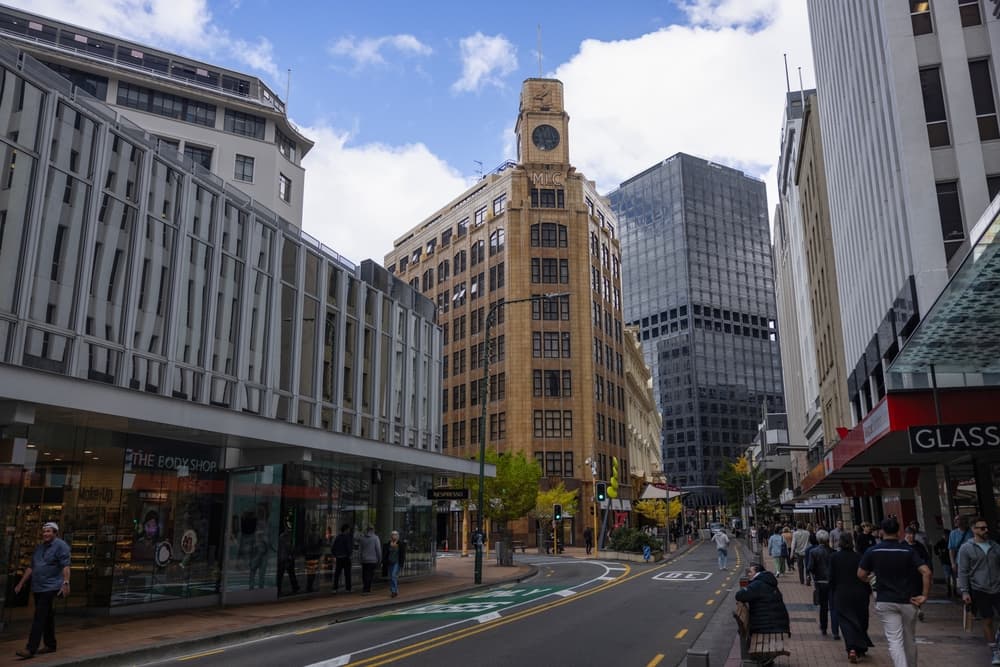
Wellington: a walkable capital wrapped around a harbor
The government and film town at the bottom of the North Island, where a walkable center, good public transport, and steep green hills shape daily life.
- 216,200
- Population (2023)
- $2,500/mo
- Monthly budget · single
- 57°F / 14°C
- Avg temperature
In U.S. dollars, one person needs about $2,500 a month in Wellington, a couple roughly $3,800, and a family around $6,000. Rent is the biggest line item: a one-bedroom runs about $1,300 downtown and about $1,150 further out. That gap is narrow by New Zealand standards, because the whole city holds only about 216,000 people, wrapped around a harbor and stacked up green hillsides.
Wellington suits people who want a capital city's institutions (Parliament, Te Papa museum, a serious film industry anchored by Weta) without capital-city sprawl. The center is genuinely walkable, coffee culture is among the best anywhere, and neighborhoods like Mount Victoria, Aro Valley, and Newtown each have distinct personalities within a short bus ride of downtown.
The honest drawback here is the weather, specifically the wind. Locals call it Windy Wellington for a reason: southerlies funnel through Cook Strait and can flatten an umbrella in seconds. Summer is mild rather than hot, with February highs averaging about 70F. If you need reliable beach weather, this is not your town.
At a glance
$2,500
Monthly budget · single person
$1,300/mo 1-bed rent, center
69/100
Safety index
$55
Internet / month
57°Fannual average
Jul 49° · Feb 64°
Climate
216,200
Population (2023)
Expatsi estimates, updated Aug 2026, based on rental listings, government statistics, and local reporting.
Cost of living
What it costs to live in Wellington
Single person
$2,200–$2,800/mo
about 20% below Austin, TX
Couple
$3,400–$4,300/mo
about 15% below Austin, TX
Family of four
$5,300–$6,700/mo
about 25% below Austin, TX
Compared with Austin, TX (Expatsi estimate, 2026).
- $15 −25%
- Inexpensive meal
- $1,150–$1,450/mo −33%
- 1-bed rent, center
- $1,050–$1,300/mo −15%
- 1-bed rent, outside
- $55/mo −15%
- Internet
- $100/mo +142%
- Transit pass
- $581/sq ft −11%
- Buy price, center
Expatsi estimates, updated Aug 2026, based on rental listings, government statistics, and local reporting.
Daily life
How Wellington lives
- B+ grade, 64th percentile among the cities we track
- Dining & cafésstrong
- B+ grade, 66th percentile among the cities we track
- Arts & culturestrong
- B+ grade, 57th percentile among the cities we track
- Parks & outdoorsstrong
- B grade, 46th percentile among the cities we track
- Schools & educationtypical
- B- grade, 35th percentile among the cities we track
- Healthcare accesstypical
- A- grade, 80th percentile among the cities we track
- Bike infrastructurestrong
- B+ grade, 69th percentile among the cities we track
- Public transitstrong
- B+ grade, moderate physical accessibility
- Accessibilitymoderate
Graded on OpenStreetMap amenity density relative to the 298 cities we track. Accessibility is the exception: it's graded against a fixed standard (terrain steepness and sidewalk surfaces), not a curve.
Climate
Weather through the year
Annual average 57°F (14°C) · 39 in of rain a year · Source: Meteostat station normals (93439, 1961-1990; no sunshine data)
On the ground
Scenes from Wellington
Getting around
Transport in Wellington
Wellington has the highest public transport use of any region in New Zealand, and living here without a car is genuinely normal. Metlink runs the region's buses, commuter trains, and harbor ferry as one network. Budget about $100 a month if you commute daily.
Payment is mid-change. The Snapper card covers buses and trains; since April 2026, adults can also tap on and off with a contactless bank card, phone, or watch on the same readers. Concession fares still need a Snapper card. Cash is being phased out over the following year, and free transfers do not arrive until the national Motu Move system reaches Wellington, which is expected in 2027. The harbor ferry takes bank cards but neither Snapper nor cash.
Buses are the workhorse inside the city, running the central Golden Mile along Lambton Quay, Willis Street, and Courtenay Place. Trains matter more if you settle in the Hutt Valley, Porirua, or on the Kapiti Coast, and they carry much of the region's morning commute.
The center is compact enough that many residents simply walk. The waterfront promenade connects the railway station to Oriental Bay, and the Wellington Cable Car, a funicular run separately from Metlink, climbs from Lambton Quay to Kelburn. The catch is terrain: many residential streets are steep, and some hillside houses are reached by public stairways rather than roads.
Weekend trips to the Wairarapa wine region, and life in the outer suburbs, are where a car earns its keep. Inside the city it is more burden than asset, since parking is scarce and expensive, and plenty of central households keep none.
- 46/sq mi
- Transit stops
- 50/sq mi
- Bike infrastructure
- 57/sq mi
- Wheelchair-accessible places
Mapped features per square mile from OpenStreetMap.
Keep exploring
Places like Wellington

Community
Community & practical notes
Community: Wellington's expat scene skews professional. Government agencies, tech companies, and the film industry pull in workers from the UK, the U.S., Australia, and across Asia and the Pacific, so foreign accents are unremarkable downtown. Americans tend to connect through workplaces, meetup groups, and sports clubs rather than any single expat district; the city is small enough that social circles overlap quickly. Newtown and Aro Valley draw the more bohemian crowd, while families cluster in suburbs like Karori, Khandallah, and across the harbor in the Hutt Valley.
Healthcare: Health New Zealand covers most hospital and emergency care at little or no cost, and eligibility reaches past residents to anyone whose work visa runs two years or more. The friction for newcomers is primary care: you enroll with a general practice, and popular Wellington practices sometimes close their books. It's worth sorting this out early. GP visits carry a co-pay even once you're enrolled; non-urgent specialist care can involve waits; and adult dental is not publicly funded, which is why many expats add private coverage. Accident injuries are covered for everyone, visitors included, through the national ACC scheme.
Limited mobility: Mixed. The flat waterfront and central streets work well. Metlink reports most of its buses take wheelchairs and mobility aids, and all of its trains do. The gaps are specific: a small share of older buses cannot take larger mobility devices and don't show as accessible on the real-time signs. The replacement buses used when trains are cancelled often can't carry a wheelchair, and the ferry gangway gets steep at high tide. Hills are the bigger obstacle, since stairways substitute for sidewalks on the slopes and many older houses have stepped access. Plan on the flat core, Kilbirnie, or the Hutt Valley. A free mobility scooter scheme operates around the city, including at the railway station.
Remote work: Home fiber runs about $55 a month and coverage is excellent. Coworking clusters in the CBD around Lambton Quay, in Te Aro, and on the waterfront. The job market hires in government, software, film and visual effects, and public sector consultancies. The time zone is the real adjustment for anyone on a U.S. team, because the working day here barely overlaps the American one.
Retirement: New Zealand is one of the harder countries for American retirees, because it has no ordinary retirement visa. The Temporary Retirement Visitor visa is really a wealth test aimed at people 66 and over who can lock up a large investment for two years; it leads neither to residence nor to public healthcare; Active Investor Plus asks for more again. Our NZ golden visa partner can advise on this process. Working-age Americans have a more realistic path through skilled work visas that can lead to residence. Compare the alternatives on our retirement visa options page, and see the full picture in our New Zealand guide.
Housing
Renting and buying
- 1-bed rent (center)
- $1,150–$1,450/mo
- 1-bed rent (outside center)
- $1,050–$1,300/mo
- Buy price (center)
- $581/sq ft
- Buy price (outside center)
- $367/sq ft
Expatsi estimates, based on rental listings, government statistics, and local reporting.
Good to know
Frequently asked questions
What is the weather like in Wellington?
Mild and windy year-round, with an annual average of about 57F (13.6C) and roughly 40 inches (1,003 mm) of rain a year. Winter is the wetter half of the year here, and July days average about 54F with nights near 44F. Snow reaches the city rarely rather than never, most recently in August 2026.
Is Wellington safe?
Reasonably, though it is not the safest city in New Zealand. Wellington scores 69 on the safety index with a crime index of 31. Across the ten New Zealand cities we track, scores run from Auckland's 58 to Queenstown's 82, so Wellington sits mid-band. The usual city habits apply around Courtenay Place late on weekends.
How can an American move to Wellington?
Most Americans arrive on a work visa, typically the Accredited Employer Work Visa tied to a job offer, or through the skilled migrant residence pathway. Government, tech, and the film industry are Wellington's main employers of foreign talent. There is no digital nomad residence route, so a local job offer is usually the practical first step.
How much does it cost to live in Wellington, New Zealand?
Budget about $2,500 a month in U.S. dollars for a single person, around $3,800 for a couple, and roughly $6,000 for a family. A one-bedroom apartment averages about $1,300 in the central city and about $1,150 outside it. An inexpensive restaurant meal runs about $15.
Do I need a car in Wellington?
Not if you live centrally. Metlink buses and trains cover the region for about $100 a month, and the compact center is very walkable. A car becomes useful in the outer suburbs and for weekend trips, but downtown parking is scarce and many central residents go without one.
How does healthcare work for expats in Wellington?
Residents and most people on work visas valid for two years or longer qualify for the public system, which covers hospital care at little or no cost. You enroll with a local GP practice and pay a co-pay per visit; some Wellington practices have waitlists for new patients. Many expats add private insurance to skip queues for elective specialist care.
Is Wellington a good place to work remotely?
The infrastructure is strong: fiber internet is about $55 a month and widely available, and coworking space is easy to find in the CBD and Te Aro. The hard part is the time zone, since Wellington runs 16 to 18 hours ahead of U.S. Eastern time, which pushes live meetings with American colleagues into your early morning or their late evening.
Can I retire in Wellington?
Only with substantial assets. New Zealand's Temporary Retirement Visitor visa requires applicants to be 66 or older and to invest NZD 750,000 for two years, on top of separate maintenance funds and annual income, and it does not lead to permanent residence or public healthcare. There is no modest-income retirement visa like Portugal's.
See how Wellington fits your life
Take the free Expatsi Test and compare New Zealand to nearly 200 countries on what actually matters: cost, healthcare, climate, and safety. About five minutes.
Why not you?