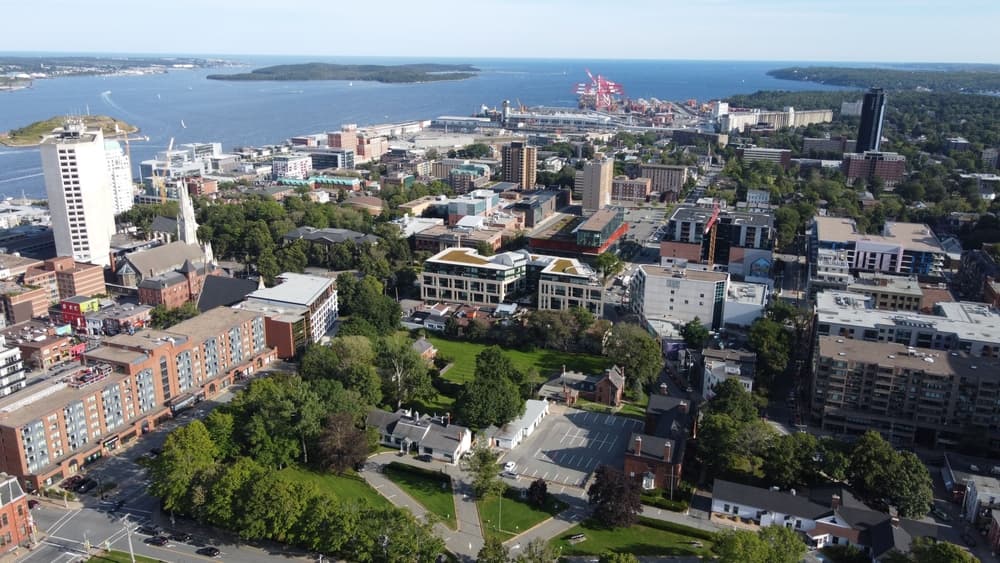
Halifax: an ocean city from $2,500 a month
What it costs to live in Halifax, how safe it is, how people get around without a car, and what Americans should know before moving to Nova Scotia.
- 440,072
- Population (2021)
- $2,500/mo
- Monthly budget · single
- 45°F / 7°C
- Avg temperature
A single person can live in Halifax on about $2,500 a month, a couple on roughly $3,800, and a family on around $6,000. A one-bedroom in the center runs about $1,450, or $1,250 farther out. That lands Halifax below Toronto and Vancouver but above Montreal and Calgary: a small city charging rent a much bigger one would charge.
It suits you if you want saltwater at the end of the street, a downtown you can cross on foot, six universities' worth of bookshops and music, and a slower week than Toronto without losing good restaurants or a real airport. Most Americans who land here come for a job in healthcare, the port or the universities, or because they turned out to be Canadian already.
The trade-off is housing. Rents climbed fast and have not come back down, so finding an apartment is the hard part of moving to Halifax, not the paperwork.

Reviewed and updated September 17, 2026 · 4 min read
At a glance
$2,500
Monthly budget · single person
$1,450/mo 1-bed rent, center
67/100
Safety index
$70
Internet / month
45°Fannual average
Jan 26° · Aug 66°
Climate
440,072
Population (2021)
Expatsi estimates, updated Aug 2026, based on rental listings, government statistics, and local reporting.
Cost of living
What it costs to live in Halifax
Single person
$2,200–$2,900/mo
about 20% below Austin, TX
Couple
$3,400–$4,300/mo
about 15% below Austin, TX
Family of four
$4,900–$7,100/mo
about 25% below Austin, TX
Compared with Austin, TX (Expatsi estimate, 2026).
- $18 −10%
- Inexpensive meal
- $1,300–$1,600/mo −26%
- 1-bed rent, center
- $1,100–$1,400/mo −7%
- 1-bed rent, outside
- $70/mo +8%
- Internet
- $65/mo +58%
- Transit pass
- $339/sq ft −48%
- Buy price, center
Expatsi estimates, updated Aug 2026, based on rental listings, government statistics, and local reporting.
Daily life
How Halifax lives
- B grade, 50th percentile among the cities we track
- Dining & caféstypical
- B+ grade, 60th percentile among the cities we track
- Arts & culturestrong
- B grade, 41st percentile among the cities we track
- Parks & outdoorstypical
- B- grade, 31st percentile among the cities we track
- Schools & educationtypical
- B grade, 44th percentile among the cities we track
- Healthcare accesstypical
- B+ grade, 61st percentile among the cities we track
- Bike infrastructurestrong
- B+ grade, 59th percentile among the cities we track
- Public transitstrong
- A grade, good physical accessibility
- Accessibilitygood
Graded on OpenStreetMap amenity density relative to the 298 cities we track. Accessibility is the exception: it's graded against a fixed standard (terrain steepness and sidewalk surfaces), not a curve.
Climate
Weather through the year
Annual average 45°F (7°C) · 51 in of rain a year · Source: Open-Meteo Historical Weather API (temps: ERA5-Land 0.1°; precip/sunshine: ERA5 best-match; 1991-2020 normals)
On the ground
Scenes from Halifax
Getting around
Transport in Halifax
Halifax Transit runs buses and two harbour ferries, and there is no subway, streetcar or light rail anywhere in the region. A monthly pass costs about $65, among the cheapest of the Canadian cities we cover, and a single fare transfers between bus and boat.
The ferries are the good part. The Alderney boat reaches downtown Dartmouth in about 12 minutes and runs all day, and the crossing has operated since 1752, the oldest saltwater ferry service in North America. The Woodside route is commuter-only, with no weekend or holiday service. Buses cover everything else, though frequency thins toward the suburbs.
Downtown and the peninsula are genuinely walkable, with the boardwalk, Argyle Street and the universities within a few blocks of each other. It is not flat, though: the city climbs from the harbour to Citadel Hill.
You can skip a car on the peninsula or in downtown Dartmouth. In Bedford, Sackville, Spryfield or most of suburban Dartmouth you'll want one, and both bridges back up at rush hour. The airport sits about 22 miles out on the Route 320 bus.
- 34/sq mi
- Transit stops
- 14/sq mi
- Bike infrastructure
- 113/sq mi
- Wheelchair-accessible places
Mapped features per square mile from OpenStreetMap.
Keep exploring
Places like Halifax





Community
Community & practical notes
Work routes: This is how most Americans get here, and the province's shortage works in your favour. Federal Express Entry runs draws limited to health care and social services, plus a separate one for physicians, at cut-offs far below the general rounds. Nova Scotia also picks its own: the nominee program consolidated ten streams into four in February 2026, and a provincial nomination adds 600 points to an Express Entry profile, which effectively settles it. The Atlantic Immigration Program is the other route, but it needs a job offer from a province-designated employer. Two catches: nomination spots were cut, and recent draws favour people already working in Nova Scotia, sometimes outside Halifax itself. Retirement is the one thing Canada has no route for, as our retirement visa guide explains.
Canadian ancestry: The quieter route and shortest for many Americans. Bill C-3 took effect in December 2025 and removed the limit that cut citizenship off after the first generation born abroad; if you were born before that date and can trace an unbroken line to a Canadian ancestor, there's no cap on how many generations back it goes. A great-grandparent can be enough, with no residency, language or test requirement. You aren't applying for status; you are proving one you already hold. The catch is the queue: more than 136,000 people are waiting. As of September 2026, a certificate takes close to three years for processing, so consider easier countries like Mexico or Albania if a quick exit matters to you. Our citizenship by descent guide covers the document chain, and the guide to moving to Canada compares the routes.
The expat scene: Halifax isn't an expat bubble. Newcomers arrive through the universities, hospitals and the naval base rather than a retirement circuit, so Americans blend into a wider immigrant population. ISANS, the province's settlement agency, works with over 14,500 newcomers from more than 170 countries a year, in English plus 46 other languages.
Healthcare: MSI, the provincial plan, starts the day you become a resident if you arrive from outside Canada as a permanent resident or on a 12-month-plus work permit or job contract. Come from another Canadian province, you'll wait until the first day of the third month. Students on a study permit wait until the first day of the 13th month. The limit is a family doctor, not coverage: 52,771 Nova Scotians were on the Need a Family Practice Registry on 1 September 2026, about 4.8 percent of the province, down from roughly 66,800 in January. While you wait, there's 811, VirtualCareNS and urgent treatment centres.
Remote work: Atlantic time runs an hour ahead of New York, so your whole American workday lands before dinner. Internet is the cost, at $70 a month, the most expensive of the ten Canadian cities we cover. Volta downtown is the coworking and startup hub.
Limited mobility: The transit fleet is better than the streets. Every Halifax Transit bus is low-floor and all the ferries are accessible, but the stops are the weak point: those without a proper concrete landing pad are flagged as usable at your own risk. Access-A-Bus runs door-to-door once you register, and 311 books free sessions on getting a chair or scooter onto a bus. The climb to Citadel Hill and a winter that buries curb cuts will shape your route. Nova Scotia's Accessibility Act set a goal of an accessible province by 2030, though the province has since conceded it will not be barrier-free by then.
Housing
Renting and buying
- 1-bed rent (center)
- $1,300–$1,600/mo
- 1-bed rent (outside center)
- $1,100–$1,400/mo
- Buy price (center)
- $339/sq ft
- Buy price (outside center)
- $269/sq ft
Expatsi estimates, based on rental listings, government statistics, and local reporting.
Good to know
Frequently asked questions
What is the weather like in Halifax?
Cool, grey and wet rather than brutally cold. The year averages 45F. August is the warmest month, not July, with average highs near 71F, because the ocean drags the seasons late. January averages highs of 32F and nights near 20F. Roughly 51 inches of rain and snow fall a year, and October through December is the wettest stretch.
Do you need a car in Halifax?
Not on the Halifax peninsula or in downtown Dartmouth, where buses, the ferries and your own legs cover daily life. Almost everywhere else in the municipality, including Bedford, Sackville and the Dartmouth suburbs, assumes you drive. There is no rail transit of any kind, and bus frequency drops off noticeably away from the core.
How do Americans move to Halifax?
Two routes do most of the work. Skilled workers use federal Express Entry, where the health care and physician draws run well below the general cut-offs, or a Nova Scotia nomination, which adds 600 points and usually needs a local job offer. Separately, anyone with an unbroken line to a Canadian ancestor may already be a citizen under the December 2025 rule change, no generation cap.
Is Halifax wheelchair accessible?
Partly, and the vehicles are ahead of the sidewalks. Every Halifax Transit bus is low-floor and every ferry is accessible, though many bus stops lack a proper landing pad. Access-A-Bus runs door-to-door for registered riders. The waterfront boardwalk and the Public Gardens, which lends wheelchairs, are the easy outings; the peninsula's hills and winter ice on curb cuts are the daily obstacles.
How much does it cost to live in Halifax?
Budget about $2,500 a month for one person, $3,800 for a couple and $6,000 for a family. A one-bedroom in the center averages $1,450 and $1,250 outside it. A cheap restaurant meal runs $18, home internet $70 and a monthly transit pass $65. That makes Halifax pricier than Montreal or Calgary and well under Toronto or Vancouver.
Is Halifax safe?
Middling by Canadian standards. Halifax scores 67 on our safety index against a crime index of 33, which puts it below Quebec City, Victoria and Calgary, just under Toronto and Montreal, and safer than Vancouver, Winnipeg or Saskatoon. It is neither the safest city in the country nor anywhere close to the least safe.
Can I retire in Halifax?
Not on a retirement visa, because Canada does not have one and offers no passive-income route. Realistically you either qualify as a skilled worker, claim citizenship through a Canadian ancestor, or come as a visitor for up to six months at a time. Parents and grandparents of Canadians can use the Super Visa, which keeps you a visitor with no MSI coverage.
See how Halifax fits your life
Take the free Expatsi Test and compare Canada to nearly 200 countries on what actually matters: cost, healthcare, climate, and safety. About five minutes.
Why not you?