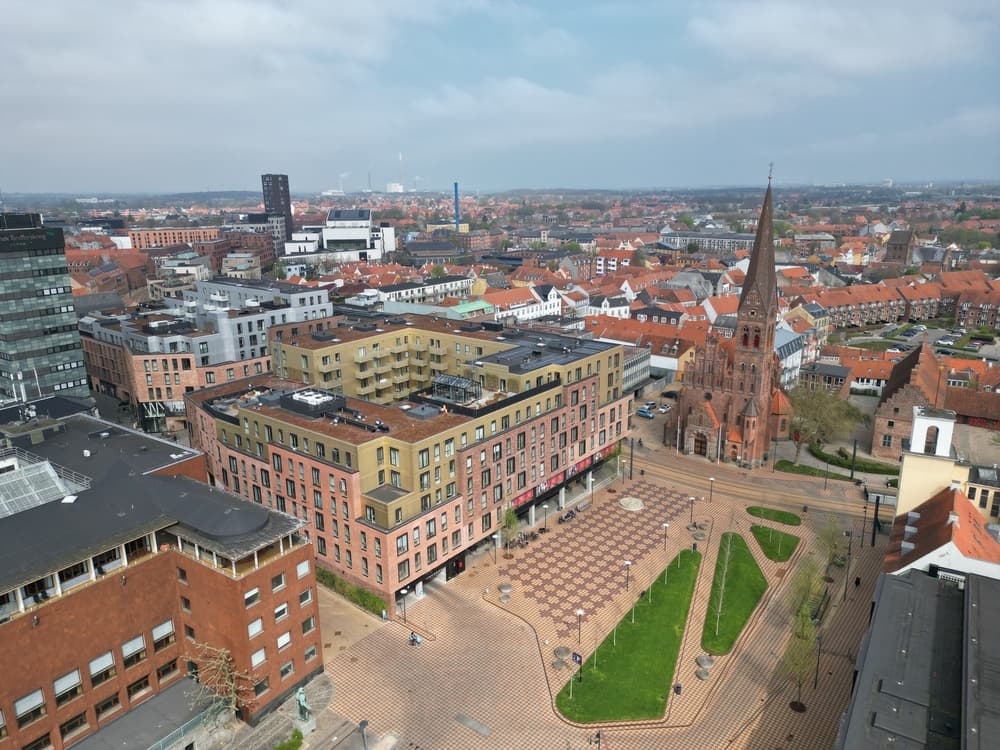
Living in Odense, Hans Christian Andersen's hometown on the island of Funen
What it costs in U.S. dollars, how safe it is, getting around without a car, and which Americans can get a permit to move or retire here.
- 185,480
- Population (2025)
- $2,300/mo
- Monthly budget · single
- 49°F / 9°C
- Avg temperature
Budget about $2,300 a month to live alone in Odense, rent included, with most people landing somewhere between $1,900 and $2,700. A couple should plan on about $3,700 and a family of four about $5,400. A one-bedroom near the center averages $1,000 a month, and about $800 farther out. Those are our October 2026 estimates in U.S. dollars.
That's roughly $1,000 a month less than Copenhagen for one person, and a central one-bedroom costs about half what it does in the capital. You get a city of about 185,000 people with a mostly pedestrian center, a light rail line, a university and one of Denmark's four university hospitals.
Odense suits people with a job at the University of Southern Denmark, the hospital or the robotics companies that cluster here, plus families who want an English-language school in a calmer city. Here's the catch: the job market and the night scene are smaller, and Copenhagen is about 1 hour and 10 minutes away by train.

Reviewed and updated October 15, 2026 · 5 min read
At a glance
$2,300
Monthly budget · single person
$1,000/mo 1-bed rent, center
75/100
Safety index
$40
Internet / month
49°Fannual average
Jan 35° · Jul 64°
Climate
185,480
Population (2025)
Expatsi estimates, updated Oct 2026, based on rental listings, government statistics, and local reporting.
Cost of living
What it costs to live in Odense
Single person
$1,900–$2,700/mo
about 25% below Austin, TX
Couple
$3,000–$4,400/mo
about 20% below Austin, TX
Family of four
$4,400–$6,400/mo
about 30% below Austin, TX
Compared with Austin, TX (Expatsi estimate, 2026).
- $20 ±0%
- Inexpensive meal
- $800–$1,200/mo −49%
- 1-bed rent, center
- $650–$950/mo −41%
- 1-bed rent, outside
- $40/mo −38%
- Internet
- $60/mo +45%
- Transit pass
- $409/sq ft −37%
- Buy price, center
Expatsi estimates, updated Oct 2026, based on rental listings, government statistics, and local reporting.
Daily life
How Odense lives
- B grade, 41st percentile among the cities we track
- Dining & caféstypical
- B+ grade, 61st percentile among the cities we track
- Arts & culturestrong
- B+ grade, 66th percentile among the cities we track
- Parks & outdoorsstrong
- B+ grade, 62nd percentile among the cities we track
- Schools & educationstrong
- B- grade, 29th percentile among the cities we track
- Healthcare accesstypical
- A- grade, 85th percentile among the cities we track
- Bike infrastructurestrong
- B grade, 48th percentile among the cities we track
- Public transittypical
- A+ grade, good physical accessibility
- Accessibilitygood
Graded on OpenStreetMap amenity density relative to the 369 cities we track. Accessibility is the exception: it's graded against a fixed standard (terrain steepness and sidewalk surfaces), not a curve.
Climate
Weather through the year
Annual average 49°F (9°C) · 25 in of rain a year · Source: Open-Meteo Historical Weather API (temps: ERA5-Land 0.1°; precip/sunshine: ERA5 best-match; 1991-2020 normals)
On the ground
Scenes from Odense
Getting around
Transport in Odense
Plenty of people in Odense live without a car. The center is compact and mostly pedestrian, bikes handle most short trips, and the light rail covers the long north-south run. Budget about $60 a month for public transit.
Odense Letbane opened in May 2022 and runs between Tarup in the northwest and Hjallese in the south. Along the way it stops at Odense Station, the city center, the University of Southern Denmark and the area around the new hospital. There's no ticket machine habit to learn: you scan the red QR code at the stop with your phone and pay by card, Apple Pay or MobilePay. An adult Odense NOW ticket costs DKK 15 (about $2.30) and works on both the light rail and the city buses inside Odense Municipality for 1 hour and 15 minutes. Stops and trams are step-free.
For the rest of Denmark, the train is the easy answer. DSB runs more than 50 departures a day to Copenhagen, and the trip takes about 1 hour and 10 minutes. A Standard ticket also covers the connecting buses, metro and local trains at the other end.
A car earns its keep if you'll work in a smaller town on Funen or want easy weekends along the coast. If you drive in from outside, the Odense South Park and Ride has 800 free spaces, and the light rail gets you to the center in about 20 minutes.
- 20/sq mi
- Transit stops
- 69/sq mi
- Bike infrastructure
- 16/sq mi
- Wheelchair-accessible places
Mapped features per square mile from OpenStreetMap.
Keep exploring
Places like Odense


Living here
Community and practical notes
Finding your people: International Community Odense, the city's service for newcomers, helps skilled international employees of Odense companies and their families with registration, daycare, language classes and, through its First Home Service, the apartment hunt. Most of its events are free and open to anyone. Partners get a Partner Career Adviser and seasonal job cafés, and the University of Southern Denmark runs a twice-monthly spouse café with the city. For English-speaking social life outside work, people also use the SDU International Club, Odense International Toastmasters and the Internationals in Odense Facebook group.
LGBTQ+ life: The scene is smaller and quieter than Copenhagen's. Odense Pride was first held in May 2021. Lambda, the local LGBTQ association, has long been the main meeting point. Young LGBTQ+ locals interviewed that year said the city lacked the visible role models the capital has, so expect to build community through associations rather than a gay district.
Black Americans: Odense's Black community is small, and we didn't find a group for Black Americans in the city's list of international networks. A Black American living in Copenhagen told Travel Noire in 2020 that he still feels Black everywhere he goes, but being American made Danes warm up to him faster, and he credited stricter gun laws for feeling safer. The International Community calendar and university networks are the practical place to start.
Seeing a doctor: You join the public health system once you register your address and get a CPR number, and you pick your family doctor at registration. Your yellow health insurance card comes by mail, so put your name on your mailbox. Family doctor visits, emergency wards and public hospitals are free; adult dental care isn't, and prescriptions are only partly subsidized. After 4 p.m., overnight and on weekends, call the Southern Denmark out-of-hours line at 70 11 07 07. Odense University Hospital has every medical specialty on one site. Its replacement next to the university is behind schedule: as of August 2026, patients won't move in by autumn 2027 as planned, and no new date has been set.
School options: Odense International School, founded in 2011, shares a city-center site with Henriette Hørlücks School and teaches children ages 5 to 16 in English. It charges tuition. Public school is free from the year a child turns 6, and newcomers get Danish lessons in an integration class until they're ready for regular classes.
Working remotely: Internet runs about $40 a month, and Spaces and Regus both have coworking in the city. Denmark is six hours ahead of New York, so East Coast calls land in your afternoon and evening.
Limited mobility: Getting around is workable with some planning. The light rail is step-free at stops and on board, which helps with wheelchairs and walkers, and the center's pedestrian streets mean less fighting with traffic. Before you sign a lease, check the buildings and places you'll use on God Adgang, the Danish register that certifies venues for accessibility and lets you filter by wheelchair use.
Retiring here: A gentler pace, free public healthcare once you're registered, and costs well under Copenhagen's make Odense appealing to retirees. Getting a permit is the hard part. Denmark has no retirement visa and no permit for financially independent people from outside the EU, so most American retirees qualify only through a partner. See our Denmark family reunification guide, the full guide to moving to Denmark, and our retirement visa hub for countries with a retiree route.
Housing
Renting and buying
- 1-bed rent (center)
- $800–$1,200/mo
- 1-bed rent (outside center)
- $650–$950/mo
- Buy price (center)
- $409/sq ft
- Buy price (outside center)
- $297/sq ft
Expatsi estimates, based on rental listings, government statistics, and local reporting.
Good to know
Frequently asked questions
Is Odense cheaper than Copenhagen?
Yes. A single person spends about $2,300 a month in Odense versus about $3,300 in Copenhagen, based on our October 2026 estimates. The biggest gap is rent: a central one-bedroom averages about $1,000 in Odense and about $1,950 in Copenhagen.
Is Odense safe?
Odense scores 75 out of 100 on our safety index, with a crime index of 25 out of 100, so day-to-day safety is good. Normal city habits still apply, like locking your bike and watching your bag in busy spots.
How far is Odense from Copenhagen?
About 1 hour and 10 minutes by train. DSB runs more than 50 departures a day between the two cities, and a Standard ticket also covers connecting buses, the metro and local trains.
What is the cost of living in Odense, Denmark?
One person should budget about $2,300 a month in U.S. dollars, rent included, as of October 2026, and most people land between $1,900 and $2,700. A couple needs about $3,700 and a family of four about $5,400. Rent is the biggest line: a one-bedroom near the center averages about $1,000 a month.
What is the weather like in Odense?
Mild and damp. Average highs run near 70°F in July and near 39°F in January, with an annual average around 49°F and about 25 inches of rain and snow a year. Winter days are short and gray, so plan for that if you're coming from the Sun Belt.
Can Americans retire in Odense?
Not on retirement income alone. Denmark has no retirement visa and no permit for financially independent people from outside the EU, so most American retirees qualify through a Danish or settled partner under family reunification. Without that, you can visit for up to 90 days at a time.
Can you get by in English in Odense?
Yes, for most daily life. Denmark placed 7th of 123 countries in the 2025 EF English Proficiency Index, and the city's International Community Odense service runs in English. Learning Danish still matters for jobs outside international firms and for permanent residence later.
Do you need a car to live in Odense?
Usually not. The center is compact and mostly pedestrian, bikes cover most short trips, and the light rail runs from Tarup to Hjallese past the main station and the University of Southern Denmark. A car helps mainly if you work in a smaller town on Funen.
See how Odense fits your life
Take the free Expatsi Test and compare Denmark to over 100 countries on what actually matters: cost, healthcare, climate, and safety. About five minutes.
Why not you?