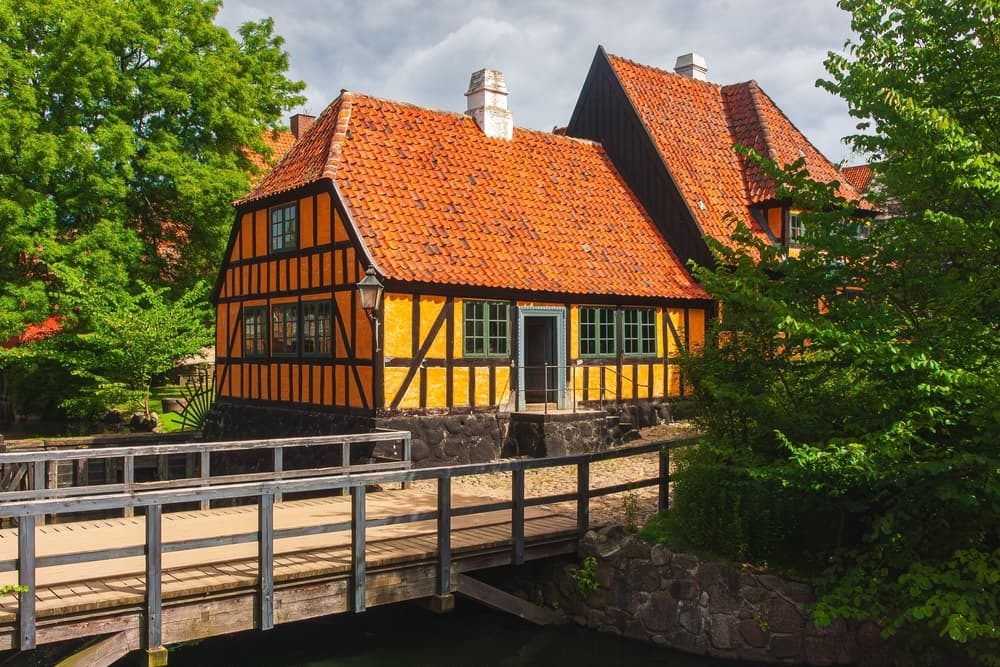
Aarhus: Denmark's second city, sized for bikes and built around a university
A compact harbor city with light rail, an English-language IB school, and beaches a short ride from downtown.
- 290,598
- Population (2023)
- $2,500/mo
- Monthly budget · single
- 48°F / 9°C
- Avg temperature
Budget about $2,500 a month for one person in Aarhus, rent included, or about $4,000 for a couple. A one-bedroom near the center averages $1,200 a month, and around $950 a little farther out. A family of four should plan on roughly $5,800. Those are our estimates in U.S. dollars as of October 2026.
That's about $800 a month less than Copenhagen for one person, in a city that still has a major university, a working harbor, the ARoS art museum and beaches within easy reach. The center is small enough that a bike gets you almost everywhere.
Aarhus suits people coming for a job at the university, the hospital or a tech company, and families who want an English-language school without capital-city rents. Here's the catch: the job market is narrower than Copenhagen's, and Danish matters more once you step outside university and tech circles.

Reviewed and updated October 14, 2026 · 4 min read
At a glance
$2,500
Monthly budget · single person
$1,200/mo 1-bed rent, center
76/100
Safety index
$40
Internet / month
48°Fannual average
Jan 35° · Jul 63°
Climate
290,598
Population (2023)
Expatsi estimates, updated Oct 2026, based on rental listings, government statistics, and local reporting.
Cost of living
What it costs to live in Aarhus
Single person
$2,000–$3,000/mo
about 20% below Austin, TX
Couple
$3,200–$4,700/mo
about 15% below Austin, TX
Family of four
$4,700–$6,800/mo
about 25% below Austin, TX
Compared with Austin, TX (Expatsi estimate, 2026).
- $21 +5%
- Inexpensive meal
- $1,000–$1,400/mo −38%
- 1-bed rent, center
- $800–$1,100/mo −30%
- 1-bed rent, outside
- $40/mo −38%
- Internet
- $65/mo +58%
- Transit pass
- $697/sq ft +7%
- Buy price, center
Expatsi estimates, updated Oct 2026, based on rental listings, government statistics, and local reporting.
Daily life
How Aarhus lives
- B+ grade, 65th percentile among the cities we track
- Dining & cafésstrong
- A- grade, 81st percentile among the cities we track
- Arts & culturestrong
- B+ grade, 56th percentile among the cities we track
- Parks & outdoorsstrong
- B+ grade, 61st percentile among the cities we track
- Schools & educationstrong
- B grade, 48th percentile among the cities we track
- Healthcare accesstypical
- A grade, 85th percentile among the cities we track
- Bike infrastructurestandout
- B+ grade, 60th percentile among the cities we track
- Public transitstrong
- A grade, good physical accessibility
- Accessibilitygood
Graded on OpenStreetMap amenity density relative to the 369 cities we track. Accessibility is the exception: it's graded against a fixed standard (terrain steepness and sidewalk surfaces), not a curve.
Climate
Weather through the year
Annual average 48°F (9°C) · 26 in of rain a year · Source: Open-Meteo Historical Weather API (temps: ERA5-Land 0.1°; precip/sunshine: ERA5 best-match; 1991-2020 normals)
On the ground
Scenes from Aarhus
Getting around
Transport in Aarhus
You can live in Aarhus without a car. Distances are short, the center is walkable, and a bike is often the quickest way across town. Budget about $65 a month for public transit.
Midttrafik runs the yellow city buses and Letbanen, Denmark's first light rail. The light rail runs from the central station past Dokk1, the library on the harbor, north to Aarhus University Hospital in Skejby, and out to Odder and Grenaa. Blue buses cover the wider region. One thing that catches newcomers: on city buses and the light rail you buy your ticket before you board, usually in the Midttrafik app. You can bring a bike on the light rail.
For longer trips, trains leave hourly for Copenhagen and Copenhagen Airport. The bus from Aarhus Airport takes about 50 minutes to reach downtown.
A car earns its keep if you'll commute to a smaller town or want easy weekends along the coast. The E45 motorway runs right past the city.
- 31/sq mi
- Transit stops
- 69/sq mi
- Bike infrastructure
- 49/sq mi
- Wheelchair-accessible places
Mapped features per square mile from OpenStreetMap.
Keep exploring
Places like Aarhus



Living here
Community and practical notes
Finding your people: International Community is the main network for newcomers in the Aarhus region. It counted more than 4,000 people in 2022 and keeps the biggest calendar of events for internationals in the city. Partners who came along for someone else's job have Spouse Community Aarhus, and Aarhus University runs its own club for international staff and their families.
LGBTQ+ life: Aarhus Pride has run every year since 2012 and is the largest LGBTQ+ event in Denmark outside Copenhagen, with funding from the city. LGBTQ+ Huset, open since 2019, is the year-round meeting place. Much of the community runs through sports and culture clubs in the Danish association style. Expect some local politics: Pride's former board was replaced after a public conflict in 2025; Aarhus University has since declined to take part.
Black Americans: Denmark's Black community is small, and research on Black Danes describes being the only Black person in many settings as a common experience. One Black American who has lived in Denmark for years told Travel Noire he still feels Black everywhere but being American made people warm up to him faster. We didn't find an Aarhus group specifically for Black Americans, so the International Community calendar and university networks are the practical place to start.
Seeing a doctor: Once you register your address and get a CPR number, you're in the public system and receive a yellow health insurance card naming your family doctor. GP visits and public hospital care are free; dental care and glasses aren't covered, and prescriptions are only partly subsidized. The card arrives a few weeks after you register, so carry private coverage until then. Aarhus University Hospital's new campus in Skejby is the largest single hospital in Denmark, with its own light rail stop.
School options: Aarhus International School teaches the IB curriculum in English to children ages 3 to 16. Kochs School, a private Danish school, has an international section, public schools offer reception classes for newly arrived children, and there's an IB gymnasium in Tilst for older students.
Working remotely: Internet runs about $40 a month. Spaces has coworking downtown and on the Aarhus Ø harbor front, and INCUBA runs a coworking hub in the Skejby business park on the light rail. Denmark is six hours ahead of New York, so East Coast meetings land in your afternoon and evening.
Limited mobility: Getting around is workable with some planning. Wheelchairs ride free on the city buses and the light rail when there's room, but a bus usually fits only one wheelchair, and Midttrafik expects riders to manage on their own or with a helper. The local tourism board says most attractions in the region have good access, with some harder spots, and the Access Denmark register lists venues that have been checked. Tours on Wheels runs city tours by wheelchair, which make a useful scouting trip before you sign a lease.
Retiring here: Free public healthcare once you're registered, life without a car, and a budget well under Copenhagen's all appeal to retirees. Getting in is the hard part. Denmark has no retirement visa and no permit for financially independent people from outside the EU, so most American retirees qualify only through a partner. See our Denmark family reunification guide, the full guide to moving to Denmark, and our retirement visa hub for countries that do offer a retiree route.
Housing
Renting and buying
- 1-bed rent (center)
- $1,000–$1,400/mo
- 1-bed rent (outside center)
- $800–$1,100/mo
- Buy price (center)
- $697/sq ft
- Buy price (outside center)
- $465/sq ft
Expatsi estimates, based on rental listings, government statistics, and local reporting.
Good to know
Frequently asked questions
Do I need to speak Danish to live in Aarhus?
Not to get started. English goes a long way at Aarhus University and in tech workplaces, and the municipality publishes practical information for internationals in English. Danish matters more for jobs outside those circles, and Aarhus University offers Danish courses to its international employees.
Can Americans retire in Aarhus?
Only in limited cases. Denmark has no retirement visa and no residence permit for financially independent people from outside the EU. Most American retirees qualify only through a partner who is Danish, an EU citizen, or a Danish residence permit holder, under family reunification rules that are strict. Without that, Americans can stay up to 90 days in any 180-day period in the Schengen area.
Is Aarhus safe?
Yes. Aarhus scores 76 out of 100 on Expatsi's safety index, and its crime index is 24, where lower means less crime. Ordinary precautions at night and a good bike lock cover most day-to-day concerns.
What does it cost to live in Aarhus?
Plan on $2,000 to $3,000 a month for one person in Aarhus, depending mostly on where you rent. Couples typically land between $3,200 and $4,700 a month, and a family of four between $4,700 and $6,800. A one-bedroom in the center rents for about $1,000 to $1,400 a month. These are Expatsi estimates in U.S. dollars as of October 2026.
Do you need a car in Aarhus?
No. Yellow city buses and the Letbanen light rail cover the city, and distances are short enough to bike. Buy bus and light rail tickets before you board, usually in the Midttrafik app. A car mainly helps if you commute to a smaller town.
What is the weather like in Aarhus?
Cool and fairly damp. July and August average highs are near 69F, January highs average about 38F, and winter lows sit right around freezing. Aarhus gets about 26 inches of precipitation a year, spread across every season and a little heavier in summer.
Is Aarhus less expensive than Copenhagen?
Yes. Expatsi estimates that one person needs about $3,300 a month in Copenhagen as of October 2026, and a central one-bedroom there averages about $1,950. Aarhus comes in roughly a quarter lower on the overall budget and well below Copenhagen on rent. What you give up is job choice, since Copenhagen has the bigger job market.
Is there an international school in Aarhus?
Yes. Aarhus International School teaches the IB Primary Years and Middle Years Programmes in English to children ages 3 to 16, and it is recognized by the Danish education authorities. Kochs School, a private Danish school, runs an international section, and there is an IB gymnasium in Tilst for older students.
See how Aarhus fits your life
Take the free Expatsi Test and compare Denmark to over 100 countries on what actually matters: cost, healthcare, climate, and safety. About five minutes.
Why not you?