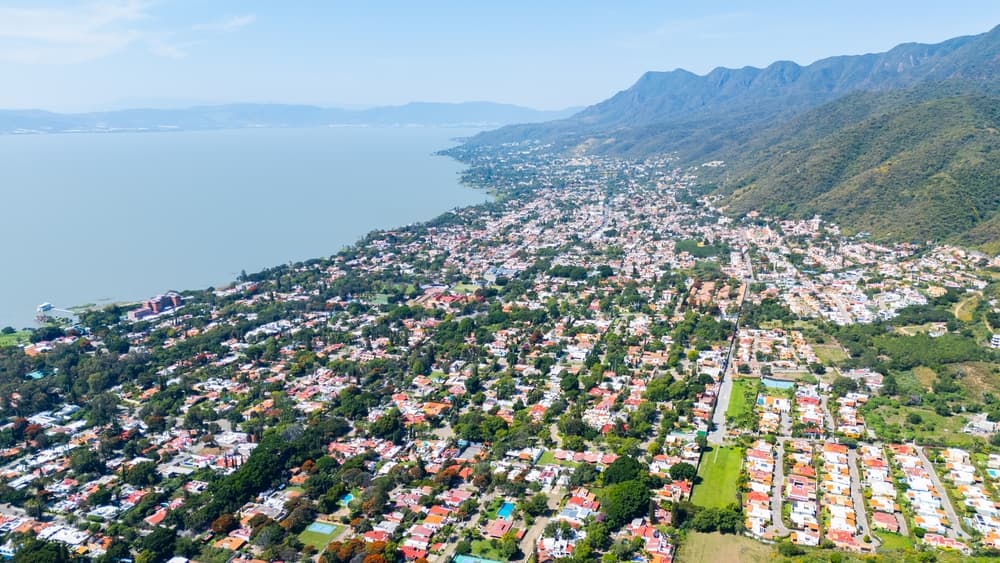
Lake Chapala: lakeside living with springtime weather year round
A string of lakeside towns in Jalisco where Americans and Canadians have been retiring since the 1950s, anchored by the village of Ajijic.
- $1,700/mo
- Monthly budget · single
- 69°F / 20°C
- Avg temperature
Budget about $1,700 a month in U.S. dollars for one person at Lake Chapala, around $2,400 for a couple, or roughly $3,500 for a family. A one-bedroom in the central villages averages about $800 a month, and about $600 if you rent farther from the lakefront strip. Those figures cover a comfortable life, not a bare-bones one, in a place where a meal at a simple restaurant costs about $8.
Lake Chapala isn't one city. It's a chain of towns along the north shore of Mexico's largest lake, with Ajijic as its center of gravity and Chapala, San Antonio Tlayacapan, and Jocotepec spread along the water. This has been a destination for American and Canadian retirees since the 1950s, so the infrastructure for newcomers is unusually deep: English-speaking doctors, rental agents who work with foreigners, and a social calendar that runs year-round. The near-constant spring weather, averaging 68.6 F across the year, is the other big draw.
The honest drawback is that this is a retirement community first. If you're under 50 and want nightlife, a dating pool, or a professional scene, the area will feel small fast, and you'll be driving to Guadalajara for most of it.
At a glance
$1,700
Monthly budget · single person
$800/mo 1-bed rent, center
54/100
Safety index
$25
Internet / month
69°Fannual average
Jan 63° · May 75°
Climate
Expatsi estimates, updated Aug 2026, based on rental listings, government statistics, and local reporting.
Cost of living
What it costs to live in Lake Chapala
Single person
$1,400–$2,000/mo
about 45% below Austin, TX
Couple
$2,000–$2,800/mo
about 50% below Austin, TX
Family of four
$2,900–$4,100/mo
about 55% below Austin, TX
Compared with Austin, TX (Expatsi estimate, 2026).
- $8 −60%
- Inexpensive meal
- $650–$950/mo −59%
- 1-bed rent, center
- $500–$700/mo −56%
- 1-bed rent, outside
- $25/mo −62%
- Internet
- $139/sq ft −79%
- Buy price, center
Expatsi estimates, updated Aug 2026, based on rental listings, government statistics, and local reporting.
Daily life
How Lake Chapala lives
- C- grade, 1st percentile among the cities we track
- Dining & cafésmodest
- C- grade, 4th percentile among the cities we track
- Arts & culturemodest
- C- grade, 1st percentile among the cities we track
- Parks & outdoorsmodest
- C grade, 11th percentile among the cities we track
- Schools & educationmodest
- C- grade, 1st percentile among the cities we track
- Healthcare accessmodest
- C+ grade, 19th percentile among the cities we track
- Bike infrastructuremodest
- C- grade, 3rd percentile among the cities we track
- Public transitmodest
Graded on OpenStreetMap amenity density relative to the 298 cities we track. Accessibility is the exception: it's graded against a fixed standard (terrain steepness and sidewalk surfaces), not a curve.
Climate
Weather through the year
Annual average 69°F (20°C) · 27 in of rain a year · Source: Open-Meteo Historical Weather API (temps: ERA5-Land 0.1°; precip/sunshine: ERA5 best-match; 1991-2020 normals)
On the ground
Scenes from Lake Chapala
Getting around
Transport in Lake Chapala
Day to day, most of Lakeside life happens along one road: the carretera that links Chapala to Jocotepec through Ajijic. Local buses and shared vans run this corridor every few minutes and cost very little; many residents get by on using them for errands between towns.
Within Ajijic and central Chapala, walking works for daily needs: villages are compact, with the plaza, markets, and restaurants sit within a few blocks of each other. The cobblestone streets are picturesque but rough underfoot, which matters more here than in most places given the age of the community.
A car is useful but not mandatory. Plenty of residents skip one entirely, relying on buses, taxis, and drivers for hire. If you want regular hourlong trips to Guadalajara, a car or standing arrangement with a driver makes life easier. Uber now covers the Lakeside towns as well as Guadalajara, though pickups take longer here than in a city, which is why plenty of people still keep a regular driver's WhatsApp number.
Guadalajara's international airport sits between the lake and the city, roughly 30 to 40 minutes from Ajijic, with direct flights to many U.S. hubs. That short airport run is a real part of the appeal for people who fly back to the States often.
- 0.0/sq mi
- Transit stops
- 0.0/sq mi
- Bike infrastructure
- 0.1/sq mi
- Wheelchair-accessible places
Mapped features per square mile from OpenStreetMap.
Keep exploring
Places like Lake Chapala
Community
Community & practical notes
Community: This is one of the largest concentrations of American and Canadian retirees in the world, centered on Ajijic. The Lake Chapala Society, founded in 1955, functions as the community hub with language classes, volunteer work, and a steady events calendar. English is widely spoken in shops, clinics, and restaurants along the north shore. The flip side, as longtime residents will tell you: it's easy to live here for years inside an English-speaking bubble, and integrating with Mexican neighbors takes deliberate effort. Learning Spanish will help you venture further out into Mexico with confidence.
Healthcare: Most newcomers use private care, paying out of pocket for routine visits and carrying private insurance or a fund for bigger events. Lakeside is better equipped than its size suggests: bilingual clinics, two small private hospitals, 24-hour emergency rooms, and a Red Cross ambulance in Chapala. Guadalajara, an hour away, handles anything complex. Residents with legal status can enroll in IMSS, the public system, though preexisting-condition exclusions and paperwork make it a poor fit for many older arrivals. Two things to plan around: U.S. Medicare pays for nothing in Mexico, and private insurers get expensive or stop writing policies for applicants in their 70s. Many residents will self-insure at that point.
Limited mobility: Getting around on wheels is hard here. The shoreline is gentle ground, but the village centers are cobblestone. Sidewalks are narrow, uneven, and often blocked. Mexican law prohibits discrimination against people with disabilities, and the State Department's own guidance is that it isn't enforced consistently, with accessibility limited in public transportation, older buildings, sidewalks, and intersections. Very little of the area has been mapped for step-free access, so inspect any particular clinic, restaurant, or rental for yourself. The offset is that in-home help and adapted housing are easier to arrange here than in most of Mexico.
Remote work: Home internet runs about $25 a month, and fiber is available in the main towns, though service can be inconsistent in outlying areas. There's a small remote-worker contingent and a few coworking spots around Ajijic, but nobody moves here for a local job market. Remote workers keep U.S. employers or clients; Guadalajara, Mexico's biggest tech hub, is the nearest place anyone hires in person.
Retirement: Mexico's temporary resident visa is the standard route; it requires proving monthly income or savings above thresholds that reset each year and are converted differently by each consulate. Check the figures where you'll actually apply; that unevenness is the main frustration people report. After four years of temporary residency, you can convert to permanent; applicants with higher savings can sometimes go straight to permanent. Start with our overview of retirement visa options and the full Mexico guide.
Housing
Renting and buying
- 1-bed rent (center)
- $650–$950/mo
- 1-bed rent (outside center)
- $500–$700/mo
- Buy price (center)
- $139/sq ft
- Buy price (outside center)
- $111/sq ft
Expatsi estimates, based on rental listings, government statistics, and local reporting.
Good to know
Frequently asked questions
How much does it cost to live at Lake Chapala?
Plan on about $1,700 a month for a single person, around $2,400 for a couple, and roughly $3,500 for a family, all in U.S. dollars. A one-bedroom rental averages about $800 in the central villages and about $600 outside them. An inexpensive restaurant meal runs about $8.
Is Lake Chapala wheelchair accessible?
Not very. Expect rough village streets, few curb cuts, and older buildings with steps rather than ramps or lifts. The workaround most people here use is a hired driver plus a single-level home outside the old centers, and both are affordable by U.S. standards.
Is Lake Chapala only for retirees?
Mostly, honestly. It's one of the world's largest American retiree communities, and the social scene, services, and pace reflect that. Younger remote workers do live here, helped by internet at about $25 a month, but people who want an urban scene usually pick Guadalajara and visit on weekends.
How do I retire at Lake Chapala?
Most Americans apply for a temporary resident visa at a Mexican consulate in the U.S., showing proof of monthly income or savings above the current thresholds. After four years you can convert to permanent residency, or qualify directly for permanent with higher savings. Many people also scout first on the 180-day tourist entry before committing.
What is the weather like at Lake Chapala?
The year averages 68.6 F, the near-perpetual spring the area is famous for. May is the warmest month, with days averaging in the high 80s, and January nights average around 54 F. Annual rainfall is about 676 mm, roughly 27 inches, most of it falling June through October as afternoon storms.
How is healthcare at Lake Chapala?
Local clinics with English-speaking doctors cover routine care, and Guadalajara's top-tier private hospitals are about an hour away. Most expats pay out of pocket or carry private insurance, since premiums climb steeply after 70. Legal residents can enroll in Mexico's public IMSS system, though exclusions for preexisting conditions limit its usefulness for many retirees.
Do I need a car at Lake Chapala?
Not necessarily. Frequent, inexpensive buses run the main road linking Chapala, Ajijic, and Jocotepec, and the village centers are walkable. A car helps for regular trips to Guadalajara or the airport, but plenty of residents rely on buses, Uber, taxis, and hired drivers instead.
Is Lake Chapala safe for Americans?
Jalisco, the state the lake sits in, carries a Level 3 “reconsider travel” advisory from the State Department, but that same advisory names Chapala and Ajijic among the places with no travel restrictions for U.S. government employees. The area scores 54 on the safety index against a crime index of 46. The lakeside towns are calm day to day, and residents take the usual Mexico precautions: petty theft happens, and few people drive remote highways after dark.
See how Lake Chapala fits your life
Take the free Expatsi Test and compare Mexico to nearly 200 countries on what actually matters: cost, healthcare, climate, and safety. About five minutes.
Why not you?