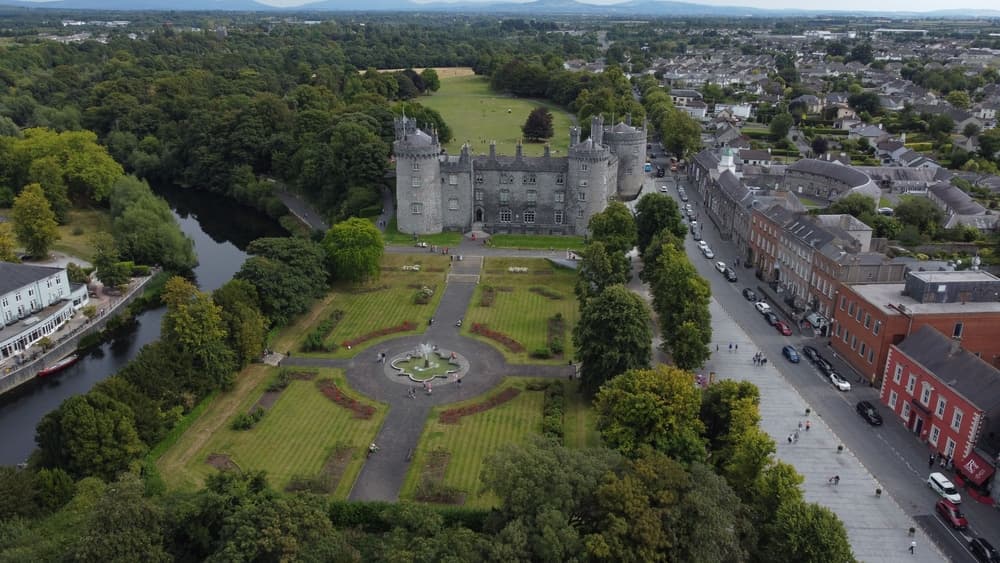
Kilkenny: small-city Ireland, from castle to cathedral on foot
A walkable medieval city in Ireland's southeast, with Dublin under two hours by train and a festival calendar much bigger than the town itself.
- 22,179
- Population (2011)
- $2,600/mo
- Monthly budget · single
- 49°F / 9°C
- Avg temperature
Budget about $2,600 a month in U.S. dollars for one person in Kilkenny, with a realistic range of $2,100 to $3,100 depending on rent and habits. A couple should plan on about $3,800 and a family of four about $5,500. A one-bedroom apartment runs about $1,400 a month in the center and about $1,150 farther out (2026 estimates).
Kilkenny suits people who want Irish small-city life at a lower rent than Dublin: retirees with solid independent income, remote workers who don't need a big tech scene, and anyone who'd rather walk to the butcher, the pub and the castle park than drive. The heart of town is the Medieval Mile, the stretch of High Street and Parliament Street that runs between Kilkenny Castle and St Canice's Cathedral.
It's a harder fit if you need a local job outside tourism and crafts, since the employer base is limited, or if you want the variety of a large city. It's a small place where you'll keep running into the same people, which is either the appeal or the problem.

Reviewed and updated October 1, 2026 · 4 min read
At a glance
$2,600
Monthly budget · single person
$1,400/mo 1-bed rent, center
78/100
Safety index
$50
Internet / month
49°Fannual average
Jan 40° · Jul 59°
Climate
22,179
Population (2011)
Expatsi estimates, updated Aug 2026, based on rental listings, government statistics, and local reporting.
Cost of living
What it costs to live in Kilkenny
Single person
$2,100–$3,100/mo
about 15% below Austin, TX
Couple
$3,100–$4,500/mo
about 15% below Austin, TX
Family of four
$4,300–$6,700/mo
about 30% below Austin, TX
Compared with Austin, TX (Expatsi estimate, 2026).
- $17 −15%
- Inexpensive meal
- $1,150–$1,650/mo −28%
- 1-bed rent, center
- $950–$1,400/mo −15%
- 1-bed rent, outside
- $50/mo −23%
- Internet
- $297/sq ft −54%
- Buy price, center
Expatsi estimates, updated Aug 2026, based on rental listings, government statistics, and local reporting.
Daily life
How Kilkenny lives
- C+ grade, 24th percentile among the cities we track
- Dining & cafésmodest
- B- grade, 37th percentile among the cities we track
- Arts & culturetypical
- B grade, 51st percentile among the cities we track
- Parks & outdoorstypical
- B grade, 41st percentile among the cities we track
- Schools & educationtypical
- B grade, 43rd percentile among the cities we track
- Healthcare accesstypical
- A- grade, 73rd percentile among the cities we track
- Bike infrastructurestrong
- B- grade, 37th percentile among the cities we track
- Public transittypical
- A grade, good physical accessibility
- Accessibilitygood
Graded on OpenStreetMap amenity density relative to the 436 cities we track. Accessibility is the exception: it's graded against a fixed standard (terrain steepness and sidewalk surfaces), not a curve.
Climate
Weather through the year
Annual average 49°F (9°C) · 32 in of rain a year · Source: Meteostat station normals (03960, 1961-1990)
On the ground
Scenes from Kilkenny
Getting around
Transport in Kilkenny
Most of daily life in Kilkenny happens on foot. The center is compact, and the Medieval Mile strings shops, cafes and pubs along the walk between the castle and St Canice's Cathedral. MacDonagh Station sits just off the Dublin Road, close enough to the center that you can walk to your train.
For anything farther out, Kilkenny has two city bus routes, KK1 and KK2, which started in December 2019. Each runs every 30 minutes Monday to Saturday, with a lighter Sunday schedule. KK2 heads out the Dublin Road and serves St Luke's Hospital; KK1 covers the Castlecomer Road and the Loughboy retail park. A TFI Leap Card works on both, and transfers between the two routes are free. Fares have changed since launch, so check the current ones on the TFI site.
Irish Rail trains on the Dublin to Waterford line get you to Dublin Heuston in under two hours, with seven trains a day Monday to Saturday and four on Sundays. Private coach companies also run to Dublin and to Dublin Airport, which is handy for flights home.
Do you need a car? Not if you live in town. If you settle in a village elsewhere in County Kilkenny, or want to get out to the countryside and the South East Greenway along the River Barrow, you'll want one. Ireland drives on the left.
- 10/sq mi
- Transit stops
- 28/sq mi
- Bike infrastructure
- 90/sq mi
- Wheelchair-accessible places
Mapped features per square mile from OpenStreetMap.
Keep exploring
Places like Kilkenny

Community
Community & practical notes
Community: Kilkenny is a close-knit Irish city, not an expat hub, so don't expect a large American circle. Social life runs through pubs, sports clubs and the festival calendar: Rhythm and Roots in May, The Cat Laughs comedy festival in early June, and the Kilkenny Arts Festival in August. The town fills with visitors for each one, and saying yes to invitations is how newcomers get folded in.
Healthcare: St Luke's General Hospital on the Freshford Road is the public general hospital for Counties Carlow and Kilkenny, with an emergency department and a maternity unit. Like hospitals across Ireland, it regularly reports heavy pressure on its emergency department, and the HSE asks people to try a GP or out-of-hours doctor first for anything that isn't an emergency. Many newcomers also carry private health insurance to shorten waits for specialist care.
Limited mobility: Kilkenny is mixed. The city buses are low-floor, and their stops were rebuilt with raised curbs for step-free wheelchair boarding. The old center is harder going, with narrow lanes, cobbled courtyards and some hills. Expect a step at the door and no elevator in many older buildings, so a newer, ground-floor apartment near a KK1 or KK2 stop makes daily life easier.
Remote work: Home internet runs about $50 a month. WeDo Work Spaces on Abbey Street offers hot desks and small private offices, though it recently listed itself as full, so ask about waiting lists. For bigger-city coworking and meetups, Dublin is a train ride away.
Retirement: Kilkenny's size, walkability and rail link make it a good fit for retirees who don't want to drive everywhere. Ireland's retirement route is Stamp 0, for people living on independent income. It requires private health insurance, doesn't let you work, and is granted one year at a time, so it suits well-funded retirees more than those relying on Social Security alone. Compare retirement visa options or read our full Ireland guide.
Housing
Renting and buying
- 1-bed rent (center)
- $1,150–$1,650/mo
- 1-bed rent (outside center)
- $950–$1,400/mo
- Buy price (center)
- $297/sq ft
- Buy price (outside center)
- $232/sq ft
Expatsi estimates, based on rental listings, government statistics, and local reporting.
Good to know
Frequently asked questions
Is Kilkenny a good place for remote workers?
It can be, if you want a quiet base rather than a big tech scene. Home internet costs about $50 a month, there's a small coworking space on Abbey Street, and Dublin's larger coworking and meetup scene is under two hours away by train. You'll still need a visa route that lets you live in Ireland, since remote work alone doesn't give you residence.
How much does it cost to live in Kilkenny, Ireland?
Plan on about $2,600 a month in U.S. dollars for one person, with most people landing between $2,100 and $3,100. A couple needs about $3,800 a month and a family of four about $5,500. Rent is the biggest cost: a one-bedroom apartment averages about $1,400 a month in the city center and about $1,150 outside it (2026 estimates).
Do you need a car to live in Kilkenny?
Not if you live in the city. The center is compact enough to walk, two city bus routes (KK1 and KK2) run every 30 minutes Monday to Saturday, and trains go to Dublin and Waterford. A car becomes useful if you live in a village elsewhere in County Kilkenny or want to explore the countryside often.
How far is Kilkenny from Dublin?
Kilkenny is under two hours from Dublin by train. Irish Rail runs seven trains a day to Dublin Heuston Monday to Saturday and four on Sundays from Kilkenny's MacDonagh Station, and private coach companies also run to Dublin and Dublin Airport.
Can Americans retire in Kilkenny?
Yes. Americans usually retire to Ireland on Stamp 0, a permission for people living on independent income. It requires private health insurance, doesn't allow you to work, and is granted one year at a time, so it suits retirees with substantial pensions or investments. Kilkenny itself works well for retirees because the center is walkable and trains run to Dublin.
Is Kilkenny safe?
Yes, Kilkenny is considered a safe place to live. It scores 78 out of 100 on our safety index, with a crime index of 22. Ordinary city precautions are enough: lock your bike and keep an eye on your things in busy pubs during festival weekends.
What is the weather like in Kilkenny?
Kilkenny has mild, damp weather year-round. July is the warmest month, with average highs near 68F, and January is the coldest, with average highs near 46F and lows near 35F. The city gets about 32 inches of rain a year, spread across every season.
See how Kilkenny fits your life
Take the free Expatsi Test and compare Ireland to over 100 countries on what actually matters: cost, healthcare, climate, and safety. About five minutes.
Why not you?