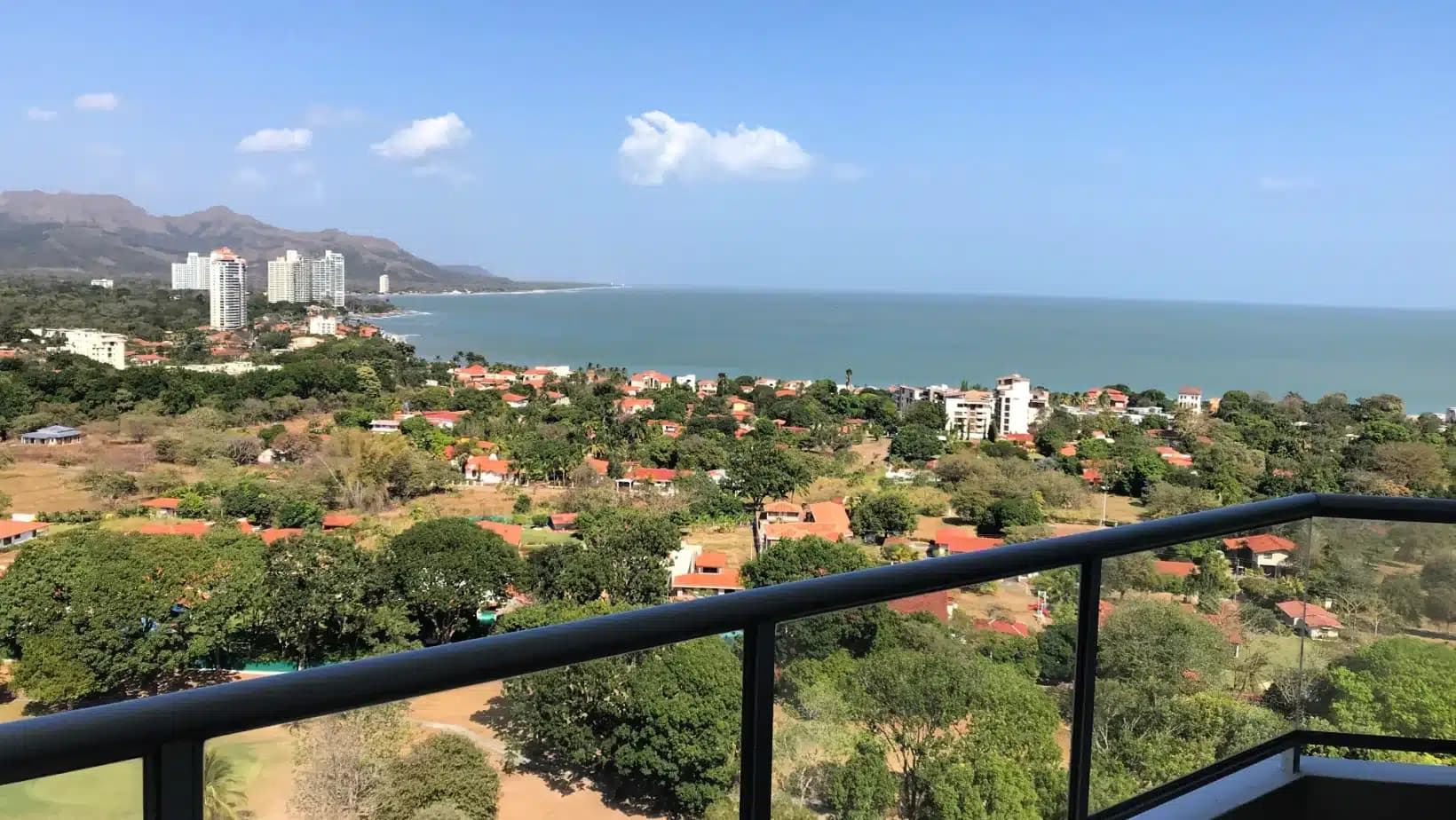
Coronado: warm Pacific water and an easy landing
A resort strip an hour from the capital's hospitals and airport, and a long-standing landing spot for American and Canadian retirees.
- $1,900/mo
- Monthly budget · single
- 79°F / 26°C
- Avg temperature
Budget about $1,900 a month for one person in Coronado, about $2,700 for a couple, and about $3,900 for a family. A one-bedroom near the center runs about $900 a month, or about $700 further out. An inexpensive meal costs about $9. Panama uses the U.S. dollar, so nothing you earn or spend gets converted.
Coronado sits about 50 miles west of Panama City, built around a golf resort, gated developments, and a row of plazas on the highway. It suits retirees and semi-retired couples who want warm water, an easy landing, and a place where English carries you through most errands. Families come too, and there's an international school in town.
The trade-offs are heat and price. The annual average temperature is about 79F; afternoons run into the upper 80s in March, and the rain arrives in May and stays through November. At about $1,900 a month for one person, Coronado is the priciest place we track in Panama after Panama City itself.
At a glance
$1,900
Monthly budget · single person
$900/mo 1-bed rent, center
66/100
Safety index
$40
Internet / month
79°Fannual average
Nov 78° · Apr 81°
Climate
Expatsi estimates, updated Aug 2026, based on rental listings, government statistics, and local reporting. Coverage here is thin, so treat these as a rough guide.
Cost of living
What it costs to live in Coronado
Single person
$1,400–$2,400/mo
about 40% below Austin, TX
Couple
$2,000–$3,400/mo
about 40% below Austin, TX
Family of four
$3,200–$4,600/mo
about 50% below Austin, TX
Compared with Austin, TX (Expatsi estimate, 2026).
- $9 −55%
- Inexpensive meal
- $700–$1,150/mo −54%
- 1-bed rent, center
- $550–$900/mo −48%
- 1-bed rent, outside
- $40/mo −38%
- Internet
- $167/sq ft −74%
- Buy price, center
Expatsi estimates, updated Aug 2026, based on rental listings, government statistics, and local reporting. Coverage here is thin, so treat these as a rough guide.
Daily life
How Coronado lives
- C- grade, 1st percentile among the cities we track
- Dining & cafésmodest
- C- grade, 0th percentile among the cities we track
- Arts & culturemodest
- C grade, 9th percentile among the cities we track
- Parks & outdoorsmodest
- C- grade, 1st percentile among the cities we track
- Schools & educationmodest
- C- grade, 0th percentile among the cities we track
- Healthcare accessmodest
- C- grade, 0th percentile among the cities we track
- Bike infrastructuremodest
- C- grade, 0th percentile among the cities we track
- Public transitmodest
Graded on OpenStreetMap amenity density relative to the 298 cities we track. Accessibility is the exception: it's graded against a fixed standard (terrain steepness and sidewalk surfaces), not a curve.
Climate
Weather through the year
Annual average 79°F (26°C) · 79 in of rain a year · Source: Open-Meteo Historical Weather API (temps: ERA5-Land 0.1°; precip/sunshine: ERA5 best-match; 1991-2020 normals)
On the ground
Scenes from Coronado
Getting around
Transport in Coronado
Plan on a car. Coronado's developments spread out along both sides of the Pan-American Highway, the beach sits at the end of a long access road, and the supermarkets, clinic, and restaurants cluster in plazas you wouldn't want to walk to in the midday heat. Inside a gated development, you can walk, bike, or run errands in a golf cart. Plenty of people do.
Buses run all day between Panama City's Albrook terminal and the beach towns, costing a few dollars. Get off at the Coronado entrance on the highway and finish the trip in a local taxi or a chiva, the shared vans that shuttle along the coast. Taxis around town are cheap and easy to flag down. Ride-hailing apps work for runs out from the city, but coverage thins out here, so most residents end up keeping a regular driver's number in their phone.
Driving into the capital takes about an hour, or two to three times that when the weekend beach traffic turns around on a Sunday. There's no train anywhere in this part of Panama.
- 0.0/sq mi
- Transit stops
- 0.0/sq mi
- Bike infrastructure
- 0.0/sq mi
- Wheelchair-accessible places
Mapped features per square mile from OpenStreetMap.
Keep exploring
Places like Coronado
Community
Community & practical notes
The expat scene: Coronado anchors the expat scene along Panama's Pacific beaches, mostly American and Canadian retirees mixed with Panamanian families who keep weekend homes here. That gives the town two speeds: busy on weekends and through the December-to-April dry stretch, quiet midweek and during the rainy months. Social life runs on the golf club, beach clubs, pickleball, volunteer groups, and a handful of restaurants that work as the community's living room. English carries most errands; Spanish is the language of anything official.
Healthcare: Clínica San Fernando in Coronado is a satellite of the San Fernando hospital in Panama City, and it handles consultations, lab work, imaging, and emergencies without leaving town. There's a public hospital minutes away in San Carlos. Planned surgery or a specialist means the drive into the capital where the big private hospitals are. Two things that Americans get wrong here: Original Medicare doesn't cover care outside the U.S., and Panamanian insurers generally stop writing new policies somewhere around age 65. People who move later usually buy an international plan or self-insure.
Getting online: Fiber reaches Coronado proper and most of the surrounding developments; home service is cheap by American standards. There's no real coworking scene, just a couple of shared-desk spots in the highway plazas and cafes with decent wifi. Wet-season storms take down power and internet, so a battery backup and a phone hotspot are worth having if your income depends on being connected.
Families and schools: Coronado International School is in town, bilingual, and takes students from preschool up through high school; there's a second international school a few minutes along the coast in Gorgona. Pediatric specialists are in Panama City.
Limited mobility: The ground here is flat, which is the good part. The hard part is everything else. Sidewalks are patchy or missing along the highway and inside the older developments; the distances between plazas rule out walking; buses and chivas have no accessible boarding, and reaching the water means crossing sand. Anyone with limited mobility should plan on a car and a driver. Look at newer condo buildings with elevators and step-free entrances rather than an older house.
Retiring here: This is Pensionado country. Show $1,000 a month in guaranteed lifetime pension income (Social Security counts) and Panama grants permanent residency from the start, along with legally mandated discounts on flights, restaurants, medical visits, and utilities. A Panamanian lawyer files it, and apostilled documents take time. Compare the options in our retirement visa guide, or start with the full Panama guide.
Housing
Renting and buying
- 1-bed rent (center)
- $700–$1,150/mo
- 1-bed rent (outside center)
- $550–$900/mo
- Buy price (center)
- $167/sq ft
- Buy price (outside center)
- $130/sq ft
Expatsi estimates, based on rental listings, government statistics, and local reporting. Coverage here is thin, so treat these as a rough guide.
Good to know
Frequently asked questions
What is the weather like in Coronado, Panama?
Hot and remarkably steady. The annual average is about 79F. Average highs run from about 84F in November to about 90F in March, and nights average in the mid-70s all year, so what changes is the rain, not the temperature. January through March is close to dry, the wet season runs May through November with heavy afternoon storms, and the year totals about 79 inches.
Can I retire in Coronado on Social Security?
Often, yes. Panama's Pensionado visa asks for $1,000 a month of guaranteed lifetime pension income and Social Security qualifies, so a couple with two average checks clears the bar. Affording the town is the separate question, because Coronado is not the cheap end of Panama, so a modest single benefit gets tight unless you rent outside the gated core.
How much does it cost to live in Coronado, Panama?
One person needs roughly $1,900 a month, a couple $2,700, and a family $3,900, all in U.S. dollars. A one-bedroom in the center averages about $900 and about $700 outside it, an inexpensive meal out is about $9, and home internet runs about $40 a month. Utilities are the wild card, because running air conditioning through the hot months costs real money.
What is it like to live in Coronado as an American?
Comfortable, and more suburban than picturesque. Daily life is a short drive to a plaza on the highway for groceries and the pharmacy, an afternoon at the pool or on the sand, and dinner somewhere you'll run into people you know. The beach is a broad stretch of dark, salt-and-pepper sand rather than a postcard white one. If you want a walkable Panamanian town with street life, the smaller beach villages nearby feel more local.
Do you need a car in Coronado?
For practical purposes, yes. The town is strung along a highway, and groceries, the clinic, and the beach are all separate drives. Some retirees do live here without one by staying inside a development and leaning on taxis, chivas, and the bus to the city, but it narrows your life to whatever is within a taxi ride.
Is Coronado, Panama safe?
Coronado scores 66 on our safety index and 34 on crime, the third-best reading of the seven places we track in Panama and well ahead of Panama City at 53. Residents describe the realistic risk as opportunistic: theft from cars, and break-ins at ungated beach houses left empty in the low season. Most people live in gated developments with a guard at the entrance and lock up the way they would at home.
How far is Coronado from Panama City?
About 50 miles west on the Pan-American Highway, an hour to an hour and a half by car, longer when the weekend beach crowd drives home. That distance is the whole appeal: specialists, major surgery, and international flights are all a morning's drive away, while your monthly costs run below city prices.
See how Coronado fits your life
Take the free Expatsi Test and compare Panama to nearly 200 countries on what actually matters: cost, healthcare, climate, and safety. About five minutes.
Why not you?