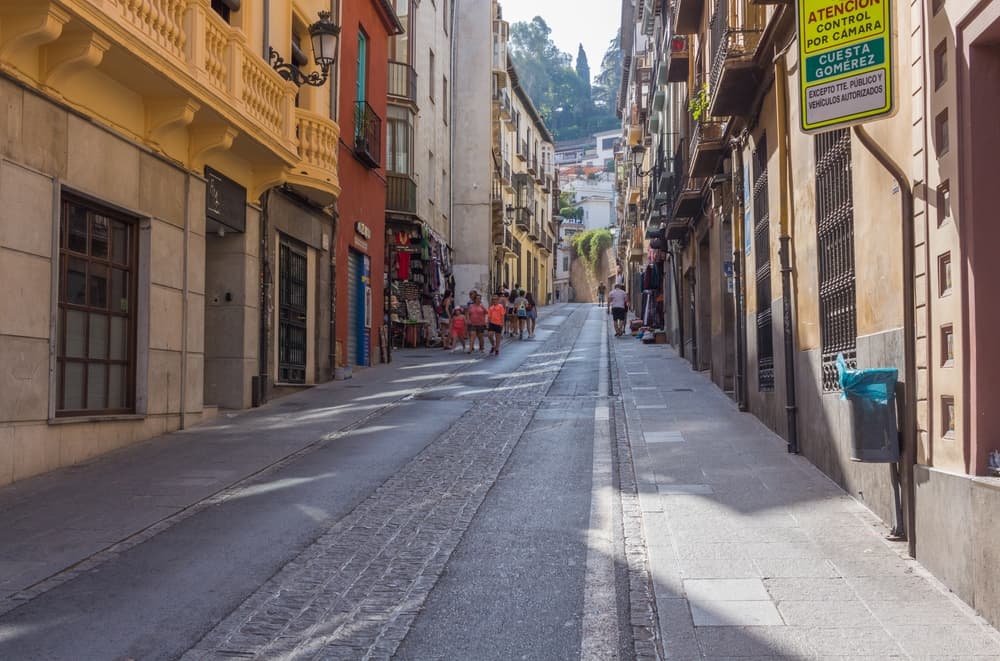
Granada: the Alhambra out your window, at the lowest rents we track in Spain
A compact Andalusian university city where free tapas still come with your drink and the Sierra Nevada sits an hour from your door.
- 233,975
- Population (2025)
- $1,800/mo
- Monthly budget · single
- 61°F / 16°C
- Avg temperature
Granada runs about $1,800 a month in U.S. dollars for one person, roughly $2,700 for a couple and around $4,100 for a family. Rent is what holds that down: a central one-bedroom averages $850, and $700 further out. Of the 19 Spanish cities we hold cost data for, none is cheaper.
It suits people who want a walkable historic center with real cultural depth and don't need a big-city economy around them. This is a university town of about 234,000, so the streets skew young and stay busy late. The Sierra Nevada ski area and Costa Tropical beaches sit roughly an hour away by car - an unusual combination at this price.
The honest drawback is work. Outside the university, tourism and healthcare, salaried jobs are thin; daily life also runs in Spanish rather than English. Most Americans who make Granada work arrive with remote income, a pension or savings, and a real willingness to learn the language.
At a glance
$1,800
Monthly budget · single person
$850/mo 1-bed rent, center
67/100
Safety index
$30
Internet / month
61°Fannual average
Jan 45° · Jul 79°
Climate
233,975
Population (2025)
Expatsi estimates, updated Aug 2026, based on rental listings, government statistics, and local reporting.
Cost of living
What it costs to live in Granada
Single person
$1,600–$2,000/mo
about 40% below Austin, TX
Couple
$2,400–$3,100/mo
about 40% below Austin, TX
Family of four
$3,600–$4,600/mo
about 50% below Austin, TX
Compared with Austin, TX (Expatsi estimate, 2026).
- $14 −30%
- Inexpensive meal
- $750–$950/mo −56%
- 1-bed rent, center
- $600–$750/mo −48%
- 1-bed rent, outside
- $30/mo −54%
- Internet
- $35/mo −15%
- Transit pass
- $283/sq ft −56%
- Buy price, center
Expatsi estimates, updated Aug 2026, based on rental listings, government statistics, and local reporting.
Daily life
How Granada lives
- A- grade, 76th percentile among the cities we track
- Dining & cafésstrong
- A- grade, 70th percentile among the cities we track
- Arts & culturestrong
- A+ grade, 99th percentile among the cities we track
- Parks & outdoorsstandout
- A- grade, 71st percentile among the cities we track
- Schools & educationstrong
- A grade, 86th percentile among the cities we track
- Healthcare accessstandout
- B+ grade, 64th percentile among the cities we track
- Bike infrastructurestrong
- A grade, 89th percentile among the cities we track
- Public transitstandout
- B+ grade, moderate physical accessibility
- Accessibilitymoderate
Graded on OpenStreetMap amenity density relative to the 298 cities we track. Accessibility is the exception: it's graded against a fixed standard (terrain steepness and sidewalk surfaces), not a curve.
Climate
Weather through the year
Annual average 61°F (16°C) · 14 in of rain a year · Source: Meteostat station normals (08420, 1991-2020)
On the ground
Scenes from Granada
Getting around
Transport in Granada
Granada is a city you mostly walk. The center is compact, where the oldest quarters, especially the Albaicín, are pedestrian lanes where cars barely fit anyway. A monthly transit pass costs about $35, and plenty of residents get by on foot.
The backbone of public transit is the light rail, running north to south out to Albolote, Maracena and Armilla, linking the university campuses, the bus station and the main teaching hospital. It's being extended toward Churriana de la Vega and Las Gabias, with the expansion due to finish in 2026. Buses cover the rest, including the small minibuses that climb to the Albaicín, Sacromonte and the Alhambra.
Coaches leave frequently for Málaga, Seville and the coast; the AVE puts Madrid at roughly three and a half hours. The local airport, situated 11 miles west, flies mostly domestic routes. Málaga offers the practical gateway for U.S. connections, about two hours away by direct bus.
Owning a car here is genuinely awkward. Parking is scarce; since October 2025, the whole built-up city's been a low emission zone, active 24/7, that fines vehicles without a Spanish environmental label unless they're registered in the municipality. A car earns its keep for the mountains, Alpujarras villages and the beaches. Many people will just rent one for the weekend.
- 67/sq mi
- Transit stops
- 19/sq mi
- Bike infrastructure
- 48/sq mi
- Wheelchair-accessible places
Mapped features per square mile from OpenStreetMap.
Keep exploring
Places like Granada




Community
Community & practical notes
The expat scene: Granada's foreign population is a mix of exchange students at the university, longer-term European residents, and a small but growing American contingent of remote workers and retirees. Language exchanges (intercambios), hiking groups and English-speaking meetups are easy to find, while the intercambio circuit is the fastest route to functional Spanish. This isn't an expat bubble: integration happens in Spanish. The people who lean into that challenge are the ones who stay.
Healthcare: The city has two public university hospitals: the Virgen de las Nieves, Grenada's provincial reference center for transplants and stroke care, and the newer Clínico San Cecilio out at the Parque Tecnológico de la Salud. Newcomers don't get public access on day one. Residence visas require full private Spanish insurance with no copays, and public coverage comes through a monthly buy-in that only opens up after a year of registered residence. The real friction is administrative, and it's all in Spanish. Start learning it as soon as you arrive, if not before.
Getting online: Home fiber runs about $30 a month, with quality coverage even in older buildings. The coworking market is genuinely small, roughly a handful of spaces in and around the center, though the city government runs its own coworking and coliving page for digital nomads. Local hiring is limited and salaries are Spanish rates, so most Americans here keep U.S. or Northern European jobs and work them remotely.
Limited mobility: The flat modern city is workable. The light rail is Girona's strongest link, with lifts at all three underground stations, level boarding and a wheelchair space on every train. The municipal tourism office says the minibuses up to the Alhambra, Albaicín and Sacromonte carry platform lifts, though it also counts only 11 wheelchair-adapted taxis in the whole city. The Alhambra publishes a stair-free itinerary with a lift and loaner chairs. The hill quarters are the honest limit: wheelchair users describe most of the city as manageable and the cobbled, stepped lanes higher up the incline as not feasible.
Retiring here: Spain doesn't have a dedicated retirement visa, so retirees use the non-lucrative one. The income test is a multiple of Spain's IPREM index and moves every year, so check the current figure. The bigger surprise is tax: live here most of the year and Spain treats you as a tax resident on worldwide income, so get advice first. See our retirement visa options and the full Spain guide.
Housing
Renting and buying
- 1-bed rent (center)
- $750–$950/mo
- 1-bed rent (outside center)
- $600–$750/mo
- Buy price (center)
- $283/sq ft
- Buy price (outside center)
- $195/sq ft
Expatsi estimates, based on rental listings, government statistics, and local reporting.
Good to know
Frequently asked questions
What is the weather like in Granada?
Granada sits at 2,274 feet, which makes it cooler than the Andalusian coast: the annual average is about 61F (15.9C), January nights average around 34F, and July days average about 95F. Rain totals about 14 inches a year, almost all of it between late autumn and early spring. The ski season happens up in the Sierra Nevada, and snow down in the city is occasional rather than annual.
How does healthcare work for expats in Granada?
New arrivals on residence visas must carry comprehensive private Spanish health insurance, because the visa itself requires it. After twelve months on the padrón, the local residents' register, you can generally buy into the public system through the convenio especial, a monthly fee arrangement. Anyone employed in Spain is covered through social security straight away. Granada has two large public university hospitals, plus private clinics people use for faster appointments.
Is Granada safe for Americans?
Granada scores 67 on the safety index we track, against a crime index of 33. Across the 19 Spanish cities in our data, safety scores run from 56 to 85, so Granada sits in the lower half of a generally safe set rather than at the top of it. State Department OSAC reporting for Spain says violent crime is not prevalent but that foreigners are the preferred targets of pickpockets. The crowds at the Alhambra and the busy tapas streets late at night are where that shows up.
Do people speak English in Granada?
Some, mostly around the university and the tourist areas, where exchange students and language schools keep it in circulation. Everyday errands, landlords, receptionists and government offices all run in Spanish. Americans who settle here either arrive with some Spanish or pick it up fast through classes and language exchanges.
How do I move to Granada from the US?
You need a long-stay visa before you arrive, because the 90-day tourist window does not allow residence. The usual routes are the non-lucrative visa for people living on passive income, the digital nomad visa for remote workers, and a student visa through the University of Granada. Applications go through the Spanish consulate covering your state, and most people rent short term on arrival before signing a year lease.
Can I retire in Granada?
Yes, and most American retirees do it on Spain's non-lucrative visa, which requires documented passive income, full private health insurance and no working in Spain. It renews toward permanent residence at five years. Granada ties for the lowest single-person budget of any Spanish city we hold data for, which is why a fixed income goes so far.
How much does it cost to live in Granada, Spain?
One person needs roughly $1,800 a month here, a couple about $2,700 and a family around $4,100, in U.S. dollars. Rent does most of that work: figure $850 for a one-bedroom in the center, $700 outside it. An inexpensive meal out is about $14, and the free tapa that comes with most drinks stretches a food budget further than the numbers suggest.
Do I need a car in Granada?
No. The center is compact and walkable, the light rail and city buses cover the rest, and a monthly pass costs about $35. A car mainly earns its place on trips to the mountains or the coast, and many residents just rent one for the weekend, since parking is scarce and the built-up city is now a low emission zone.
See how Granada fits your life
Take the free Expatsi Test and compare Spain to nearly 200 countries on what actually matters: cost, healthcare, climate, and safety. About five minutes.
Why not you?