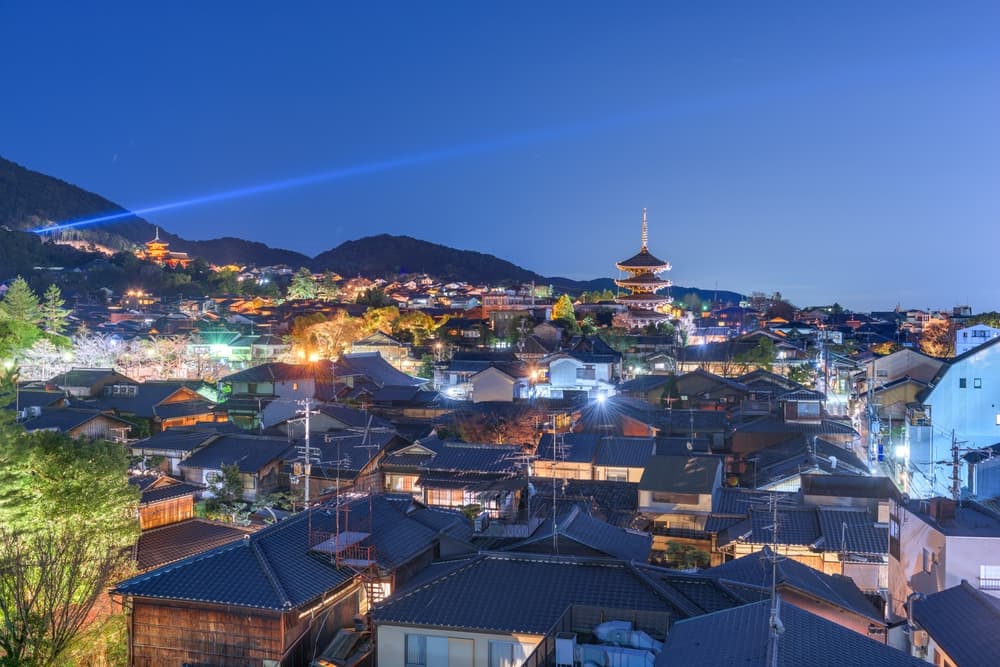
Kyoto: Japan's old capital, lived at bicycle speed
A flat, safe former capital where a bike beats the bus, temple gardens are part of the commute, and the paperwork stays in Japanese.
- 1,463,723
- Population (2020)
- $2,100/mo
- Monthly budget · single
- 60°F / 16°C
- Avg temperature
Plan on about $2,100 a month for one person in Kyoto, with most single budgets landing between $1,700 and $2,500. A couple spends about $3,000, and a family of four about $4,400. A one-bedroom near the center averages $900 a month, or $550 farther out, and home internet runs $35. All figures are in U.S. dollars, as of 2026.
Kyoto suits people who want Japan at a smaller, slower scale: researchers and students, remote workers, people learning a craft, and anyone who'd rather bike past a temple garden than squeeze onto a rush-hour train. About 1.46 million people live here (2020 count), and the center is a flat grid you can cross on two wheels.
It's a weaker fit if you need a big English-language job market or a simple way to stay long term. Japan has no retirement visa, and in the busy seasons you'll share the city's buses with a lot of visitors.

Reviewed and updated October 9, 2026 · 4 min read
At a glance
$2,100
Monthly budget · single person
$900/mo 1-bed rent, center
80/100
Safety index
$35
Internet / month
60°Fannual average
Jan 40° · Aug 82°
Climate
1,463,723
Population (2020)
Expatsi estimates, updated Oct 2026, based on rental listings, government statistics, and local reporting.
Cost of living
What it costs to live in Kyoto
Single person
$1,700–$2,500/mo
about 30% below Austin, TX
Couple
$2,500–$3,500/mo
about 35% below Austin, TX
Family of four
$3,400–$5,300/mo
about 45% below Austin, TX
Compared with Austin, TX (Expatsi estimate, 2026).
- $7 −65%
- Inexpensive meal
- $750–$1,050/mo −54%
- 1-bed rent, center
- $450–$650/mo −59%
- 1-bed rent, outside
- $35/mo −46%
- Internet
- $60/mo +45%
- Transit pass
- $604/sq ft −7%
- Buy price, center
Expatsi estimates, updated Oct 2026, based on rental listings, government statistics, and local reporting.
Daily life
How Kyoto lives
- A grade, 95th percentile among the cities we track
- Dining & cafésstandout
- A grade, 88th percentile among the cities we track
- Arts & culturestandout
- B grade, 49th percentile among the cities we track
- Parks & outdoorstypical
- A- grade, 85th percentile among the cities we track
- Schools & educationstrong
- A grade, 86th percentile among the cities we track
- Healthcare accessstandout
- B grade, 48th percentile among the cities we track
- Bike infrastructuretypical
- A- grade, 77th percentile among the cities we track
- Public transitstrong
- A grade, good physical accessibility
- Accessibilitygood
Graded on OpenStreetMap amenity density relative to the 298 cities we track. Accessibility is the exception: it's graded against a fixed standard (terrain steepness and sidewalk surfaces), not a curve.
Climate
Weather through the year
Annual average 60°F (16°C) · 61 in of rain a year · Source: Meteostat station normals (47759, 1971-2000; no sunshine data); sunshine: Kyoto (1991-2020 normals extremes 1880-present) via en.wikipedia.org/wiki/Kyoto
On the ground
Scenes from Kyoto
Getting around
Transport in Kyoto
A lot of Kyoto's daily life happens on a bicycle. The central grid is flat, bikes are a popular way to get around, and errands, commutes and a Sunday ride along the Kamo River all work on two wheels. Two rules to sort out early: bicycle insurance, or coverage equivalent to it, is mandatory in Kyoto City and Kyoto Prefecture, and you're expected to register your bike for theft prevention. Park only in designated lots. A bike left anywhere else can be hauled off to a storage yard, and getting it back costs you a fee and a trip.
Where a train or subway goes your way, take it. Rail is faster and more comfortable than the bus, and the city's private lines and JR fill in a lot of the map. Buses cover the rest, and they're Kyoto's weak spot. Popular routes are crowded with residents and tourists alike, and in peak seasons locals sometimes can't get on.
The city's response is a two-tier fare. Under a plan aimed at citywide rollout by fiscal year 2027, residents paying with a transit IC card linked to their My Number would pay ¥200 a ride (about $1.30), and visitors would pay more. It still needs the city assembly and the national government to sign off, and the plan doesn't yet say how foreign residents qualify, so check before you count on it. Budget about $60 a month for transport.
Do you need a car? Not in the city. Between a bike, the trains and the bus, most of Kyoto is covered, and a rental car handles the occasional trip into the countryside.
- 52/sq mi
- Transit stops
- 5.9/sq mi
- Bike infrastructure
- 38/sq mi
- Wheelchair-accessible places
Mapped features per square mile from OpenStreetMap.
Keep exploring
Places like Kyoto

Living here
Community and practical notes
The expat scene: Kyoto's foreign community is smaller and quieter than Tokyo's or Osaka's, and much of it orbits the universities, research institutes and traditional crafts. That makes it easy to find people with a shared interest and harder to find a big English-speaking bubble. Plan on Japanese for the ward office, your lease and most of daily life.
Healthcare: Residents staying three months or more join Japan's public insurance and pay 30 percent of covered bills; our guide to moving to Japan walks through how it works. Two Kyoto-proof habits: carry cash, because many clinics only accept cash, and expect some staff to speak little English. U.S. prescriptions aren't honored in Japan. Some common American medications, Adderall among them, are even illegal here, so check yours before you pack.
Remote work: Home internet runs $35 a month. The harder part is the clock. A U.S. East Coast morning lands late at night in Kyoto, so a team back home means a lot of evening calls.
LGBTQ expats: Japan has no legal restrictions on same-sex relationships, but it doesn't recognize same-sex marriage or civil unions. Kyoto City has run a partnership oath system since 2020, and in April 2024 Osaka, Kyoto and Hyōgo prefectures set up a shared partnership system. The limits matter: the certificates aren't legally binding, so landlords and hospitals don't have to honor them, and a partner without Japanese status should plan on qualifying for a visa of their own. Japan's Supreme Court sent six same-sex marriage appeals to its Grand Bench in March 2026, so check where that stands.
Black Americans: The State Department says hate-related violent crime is rare in Japan, but some U.S. citizens report being targeted for discrimination because of their race or nationality. Black Americans who've moved to Japan describe standing out and feeling like the other, even when they like the life they've built. In a smaller, more traditional city, expect to be noticed.
Limited mobility: Accessibility in Kyoto is mixed. Japanese law prohibits disability discrimination and the central streets are flat, but the State Department warns that older buildings and infrastructure are often not accessible, and Kyoto has a lot of both: temple grounds with gravel and steps, narrow lanes, and older wooden townhouses. Kyo-NAVI, the tourist center at Kyoto Station, lends wheelchairs on a first-come, first-served basis. If you use a wheelchair, see the building and the walk to the nearest station before you sign a lease.
Retirement: Kyoto's pace, safety and seasons appeal to a lot of retirees, but Japan has no retirement visa. The closest option is a savings-based long stay that tops out at a year and doesn't lead to residency. Read the realistic routes in our guide to moving to Japan, and compare countries that do welcome retirees in our guide to retirement visas.
Housing
Renting and buying
- 1-bed rent (center)
- $750–$1,050/mo
- 1-bed rent (outside center)
- $450–$650/mo
- Buy price (center)
- $604/sq ft
- Buy price (outside center)
- $372/sq ft
Expatsi estimates, based on rental listings, government statistics, and local reporting.
Good to know
Frequently asked questions
Do you need to speak Japanese to live in Kyoto?
For daily life, mostly yes. Ward offices, leases, landlords and many doctors work in Japanese, and Kyoto's English-speaking community is small compared with Tokyo's. You can get by with basics at first, but plan on studying Japanese from your first month.
Can Americans retire in Kyoto?
Not on a retirement visa, because Japan doesn't have one. The closest option is a long-stay status for people with large savings, which Japan sets at more than ¥30 million (about $192,000 in September 2026). It lasts a year at most, bans all work, and doesn't count toward permanent residency. Americans who live in Kyoto long term usually do it through a job, study, or marriage to a Japanese citizen.
Is Kyoto safe for Americans?
Yes. The U.S. State Department says crime against U.S. citizens in Japan is low and usually involves personal disputes, petty theft or vandalism. The main thing to watch is nightlife: robberies after spiked drinks do happen in entertainment districts of Japan's big cities.
Do you need a car in Kyoto?
No. Most people in Kyoto get around by bicycle, train, subway and city bus. If you ride a bike, bicycle insurance or equivalent coverage is mandatory in Kyoto City and Kyoto Prefecture, and you're expected to register the bike against theft.
What is the weather like in Kyoto?
Kyoto has four distinct seasons. Summers are hot and humid, with August highs averaging about 90F. Winters are cool, with January highs around 47F and lows near 33F. The city gets about 61 inches of rain a year, and June, July and September are the wettest months.
How much does it cost to live in Kyoto, Japan?
About $2,100 a month covers one person in Kyoto, with most single budgets between $1,700 and $2,500. A couple spends about $3,000 a month and a family of four about $4,400. A one-bedroom apartment near the center averages $900 a month, or $550 outside it. Figures are in U.S. dollars, as of 2026.
See how Kyoto fits your life
Take the free Expatsi Test and compare Japan to over 100 countries on what actually matters: cost, healthcare, climate, and safety. About five minutes.
Why not you?