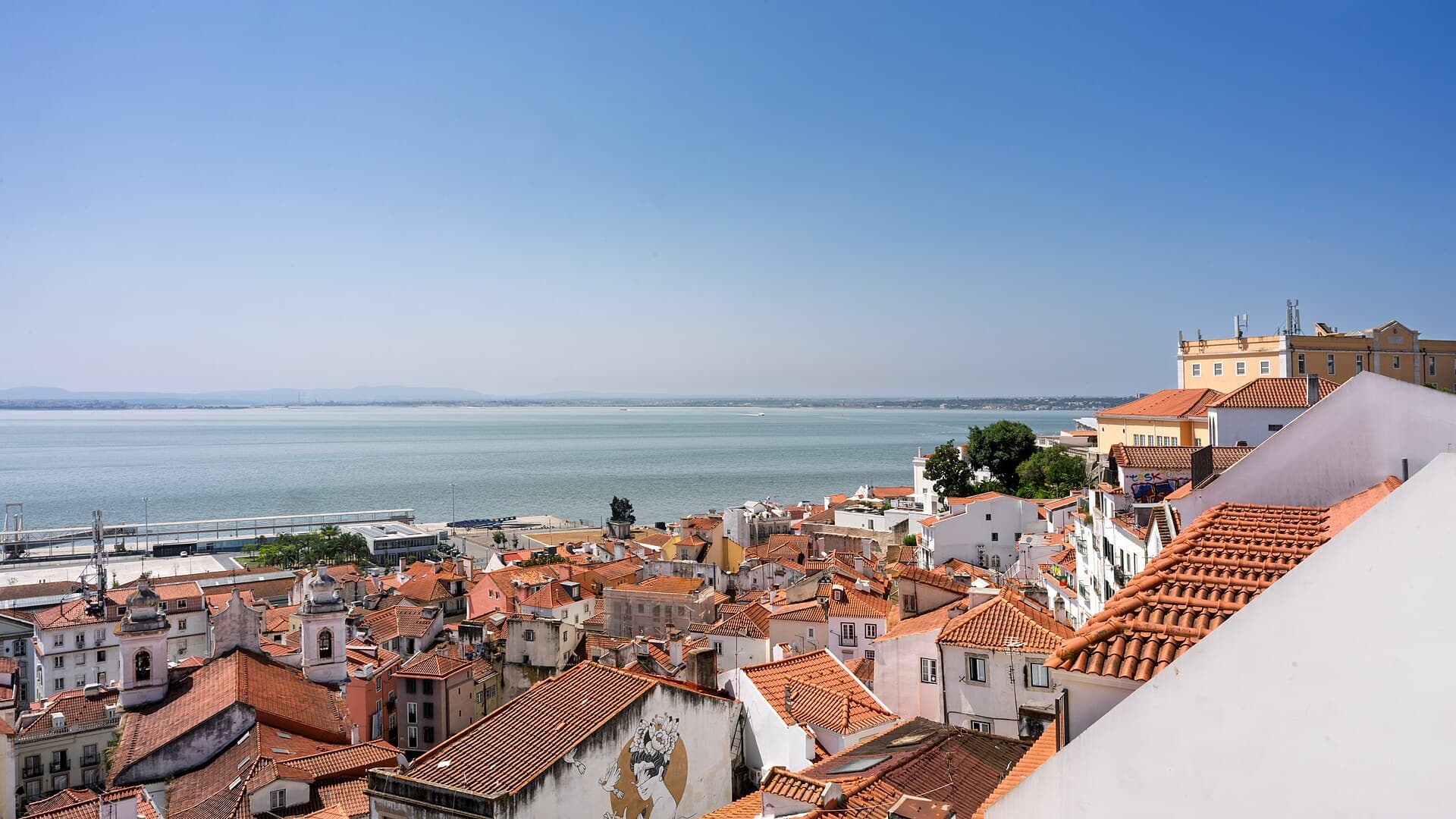
Lisbon: a real capital with midnight energy and Atlantic light
Portugal's capital: hills, tile, Atlantic light, and the country's biggest expat scene, with every service you'll need in English.
- 545,796
- Population (2021)
- $2,700/mo
- Monthly budget · single
- 64°F / 18°C
- Avg temperature
Lisbon is the easiest landing in Portugal. It's the capital and biggest city in the country (around 520,000 in the city, close to 3 million in the metro). It's absorbed so many Americans since 2020 that you can set up a bank account, find a lease, and fill a social calendar without speaking a word of Portuguese. That's both a real convenience and trade-off: the center, especially Alfama, Baixa, and Chiado, is heavily touristed, and rents there have climbed to match. Most people who settle in end up a ring further out, in neighborhoods like Campo de Ourique, a self-contained village with its own market and the best everyday food shopping in the city, or Alvalade, flat, leafy, metro-connected, and full of Portuguese families rather than tour groups. For costs, plan on about $2,700 a month all-in as a single person, with a one-bedroom in the center typically running $1,400 to $1,800, roughly 20% below Austin, TX.
Who it suits: people who want a real city. Restaurants at midnight, live fado and techno in the same week, a startup and remote-work scene anchored by Web Summit, direct flights home from Humberto Delgado airport twenty minutes away. Who it doesn't: anyone set on quiet streets, flat ground, or an easy apartment hunt. The light and the river views are as good as everyone says. Just know the seven hills are not a metaphor, and August in the center belongs to the tourists.
At a glance
$2,700
Monthly budget · single person
$1,600/mo 1-bed rent, center
71/100
Safety index
$35
Internet / month
64°Fannual average
Jan 53° · Aug 75°
Climate
545,796
Population (2021)
Expatsi estimates, updated Aug 2026, based on rental listings, government statistics, and local reporting.
Cost of living
What it costs to live in Lisbon
Single person
$2,400–$3,000/mo
about 15% below Austin, TX
Couple
$3,300–$4,300/mo
about 15% below Austin, TX
Family of four
$5,300–$6,700/mo
about 25% below Austin, TX
Compared with Austin, TX (Expatsi estimate, 2026).
- $15 −25%
- Inexpensive meal
- $1,400–$1,800/mo −18%
- 1-bed rent, center
- $1,050–$1,350/mo −11%
- 1-bed rent, outside
- $35/mo −46%
- Internet
- $45/mo +9%
- Transit pass
- $646/sq ft −1%
- Buy price, center
Expatsi estimates, updated Aug 2026, based on rental listings, government statistics, and local reporting.
Daily life
How Lisbon lives
- A+ grade, 98th percentile among the cities we track
- Dining & cafésstandout
- A grade, 95th percentile among the cities we track
- Arts & culturestandout
- A- grade, 74th percentile among the cities we track
- Parks & outdoorsstrong
- A grade, 90th percentile among the cities we track
- Schools & educationstandout
- A grade, 92nd percentile among the cities we track
- Healthcare accessstandout
- A- grade, 80th percentile among the cities we track
- Bike infrastructurestrong
- A+ grade, 99th percentile among the cities we track
- Public transitstandout
- C- grade, challenging physical accessibility
- Accessibilitychallenging
Graded on OpenStreetMap amenity density relative to the 298 cities we track. Accessibility is the exception: it's graded against a fixed standard (terrain steepness and sidewalk surfaces), not a curve.
Climate
Weather through the year
Annual average 64°F (18°C) · 30 in of rain a year · Source: Meteostat station normals (08535, 1991-2020)
On the ground
Scenes from Lisbon
Photos by Wikimedia Commons contributors; open any photo for its credit and license.
Getting around
Transport in Lisbon
You don't need a car; in the center, you actively don't want one. The metro, buses, trams, and ride-hailing (Uber and Bolt are cheap and everywhere) cover the city, while the Cascais and Sintra train lines handle the coast and suburbs. The hills are the real transit obstacle: many short trips are easier by funicular or ride than on foot. A monthly navegante pass covers the whole metro area for about $46 (roughly 40 euros).
- 110/sq mi
- Transit stops
- 50/sq mi
- Bike infrastructure
- 61/sq mi
- Wheelchair-accessible places
Mapped features per square mile from OpenStreetMap.
Keep exploring
Places like Lisbon





Community
Community & practical notes
Retirement: Lisbon is one of the most popular retirement landings in Europe, and Portugal's D7 retirement visa is built for it: show about €920 a month in passive income for one person (€1,380 for a couple, as of January 2026), and Social Security or a pension counts. You'll get residency with access to the public healthcare system. Lisbon's draw for retirees is the combination of that visa, the country's deepest private-hospital network, and a big English-speaking social scene; the trade-off is the highest rents in Portugal. Our Portugal moving guide covers the visa paths and the rest of the country.
Healthcare: Best healthcare access in the country. The public SNS network includes major hospitals like Santa Maria, and the private side is deep: CUF Tejo, CUF Descobertas, Hospital da Luz, and Lusíadas Lisboa all have English-speaking staff and most specialties. Private insurance typically runs a few hundred to about a thousand euros a year, and most expats carry it to skip public wait times.
LGBTQ+ life: Portugal has full legal equality, including same-sex marriage and adoption, and Lisbon is where that's most visible. Príncipe Real and Bairro Alto hold the gay bars and drag nights, Arraial Lisboa Pride draws large crowds each June, and the city consistently ranks near the top of European LGBTQ+ travel indexes. Queer expats generally describe daily life as calm and low-conflict.
Expats of color: Lisbon has long-standing Black Portuguese communities with roots in Angola, Cape Verde, and Mozambique, plus an organized Black American expat scene: the Black in Portugal group runs meetups and relocation support for members from 25+ countries. Black American accounts (including in the Christian Science Monitor and Travel Noire) often describe Lisbon as more integrated and welcoming than home, while noting racism exists here as everywhere; some report the worst of it coming from other American and Northern European expats, not the Portuguese.
Limited mobility: Honestly hard for limited mobility. Lisbon is built on seven hills, sidewalks are slick calçada cobblestone, and older buildings frequently lack elevators. Flat neighborhoods (Alvalade, Campo de Ourique, riverside Baixa) and newer metro stations with elevators make it workable, but check every apartment and route in person.
International schools: The metro area has the country's largest international-school cluster, though the big American and British schools sit west of the city (Sintra, Carcavelos); families often live along the Cascais line for the commute. Expect waitlists and tuition roughly 10,000 to 29,000 euros a year.
- Carlucci American International School of Lisbon (Sintra)
- St. Julian's School (Carcavelos)
- Lisboan International School
- Instituto Espanhol de Lisboa
Housing
Renting and buying
- 1-bed rent (center)
- $1,400–$1,800/mo
- 1-bed rent (outside center)
- $1,050–$1,350/mo
- Buy price (center)
- $646/sq ft
- Buy price (outside center)
- $409/sq ft
Expatsi estimates, based on rental listings, government statistics, and local reporting.
Good to know
Frequently asked questions
How much does it cost to live in Lisbon?
Plan on roughly $2,700 a month all-in as a single person, or about $3,800 as a couple. A one-bedroom in the center typically runs $1,400 to $1,800 a month (around $1,200 outside it), an inexpensive restaurant meal is about $15, and the navegante transit pass that covers the whole metro area is about $45 a month. These are Expatsi estimates, updated August 2026, cross-checked against rental listings and cost-of-living reports.
Is Lisbon safe?
Yes, by American big-city standards. Portugal consistently ranks among the safest countries in the world, and violent crime in Lisbon is rare. The practical issue is pickpocketing in the heavily touristed center (Alfama, Baixa, and Chiado) rather than anything that changes how you live. Standard city awareness covers it.
Can I retire in Lisbon?
Yes. Portugal's D7 visa was designed for exactly this: show about €920 a month in passive income for one person (€1,380 for a couple, as of January 2026), and Social Security or a pension counts. The average American retirement check clears that bar on its own. Retirees get residency with access to Portugal's healthcare system, and Lisbon offers the country's deepest private-hospital network on top of it. Budget realistically for Lisbon rents, though; many retirees on tighter budgets pick smaller Portuguese cities instead.
Do they speak English in Lisbon?
Widely, and more than anywhere else in Portugal. The city's absorbed enough Americans since 2020 that you can open a bank account, sign a lease, and build a social life entirely in English. Learning Portuguese still pays off with landlords, tradespeople, and government offices.
What's healthcare like for expats in Lisbon?
The best access in the country. The public SNS network includes major hospitals like Santa Maria, and the private side is deep: CUF Tejo, CUF Descobertas, Hospital da Luz, and Lusíadas Lisboa all have English-speaking staff and cover most specialties. Most expats carry private insurance, which typically runs a few hundred to about a thousand euros a year, to skip public wait times.
Can an American actually move to Lisbon?
Yes, and the paths are clearer than most people expect. If you have about €920 a month in passive income (Social Security counts), Portugal's D7 visa gets you residency. If you work remotely for a US employer or clients, the D8 digital nomad visa asks for around €3,500 a month in income. There are also work, study, and investment routes. Most people apply through VFS Global in the US and wait about 60 days for the visa itself. After five years of residency you can apply for citizenship.
Do I need a car in Lisbon?
No, and in the center you actively don't want one. The metro, buses, trams, and cheap ride-hailing (Uber and Bolt) cover the city, and the Cascais and Sintra train lines handle the coast and suburbs. A monthly navegante pass covers the whole metro area for about $46. The hills are the real obstacle: many short trips are easier by funicular or ride than on foot.
See how Lisbon fits your life
Take the free Expatsi Test and compare Portugal to nearly 200 countries on what actually matters: cost, healthcare, climate, and safety. About five minutes.
Why not you?