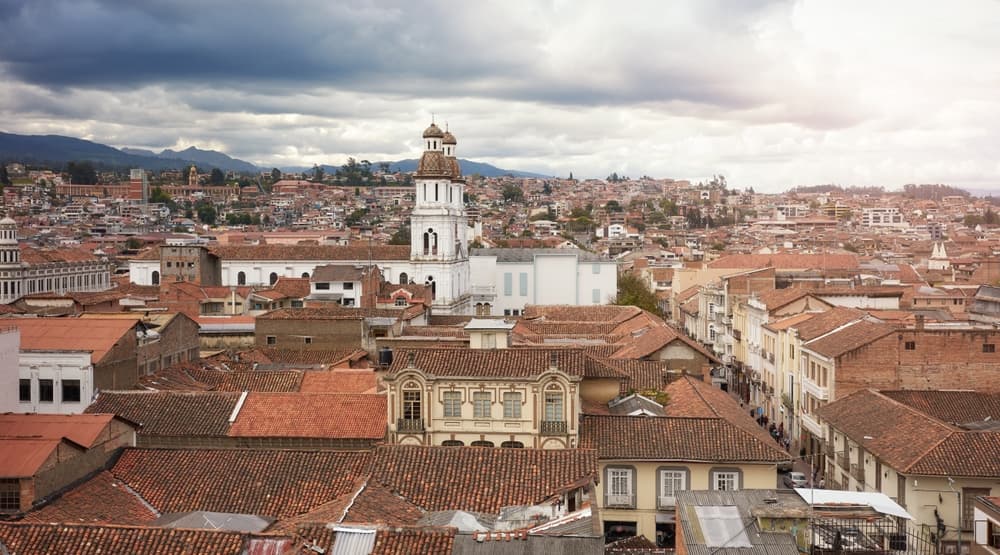
Cuenca: a walkable Andean city that stretches a fixed income
A colonial Andean city on the U.S. dollar, with the same mild weather every month and a center built for walking.
- 361,524
- Population (2022)
- $1,000/mo
- Monthly budget · single
- 60°F / 16°C
- Avg temperature
A single person lives comfortably in Cuenca on about $1,000 a month. A couple runs closer to $1,600, a family lands around $2,400, and a one-bedroom in the center rents for roughly $450. Ecuador uses the U.S. dollar, so those are real dollars with no exchange rate to watch or conversion math at the grocery store.
Cuenca suits retirees on a fixed income, remote workers who want a low burn rate, and anybody who would rather walk than drive. It sits at 8,366 feet in the southern Andes, and that altitude buys the flattest climate you will find anywhere: highs in the low 60s and lows in the mid 40s, every single month. That means no heating, no air conditioning, no seasons to plan around.
Here's the catch. Spanish matters here, the thin air takes a few weeks to get used to, and Cuenca's safety score of 54 out of 100 is middling rather than spotless. Petty theft is the honest risk, not the coastal drug violence that dominates the headlines about Ecuador.
At a glance
$1,000
Monthly budget · single person
$450/mo 1-bed rent, center
54/100
Safety index
$30
Internet / month
60°Fannual average
Jul 57° · Jan 62°
Climate
361,524
Population (2022)
Expatsi estimates, updated Aug 2026, based on rental listings, government statistics, and local reporting.
Cost of living
What it costs to live in Cuenca
Single person
$900–$1,200/mo
about 70% below Austin, TX
Couple
$1,400–$1,800/mo
about 65% below Austin, TX
Family of four
$2,100–$2,700/mo
about 70% below Austin, TX
Compared with Austin, TX (Expatsi estimate, 2026).
- $4 −80%
- Inexpensive meal
- $400–$500/mo −77%
- 1-bed rent, center
- $300–$400/mo −74%
- 1-bed rent, outside
- $30/mo −54%
- Internet
- $111/sq ft −83%
- Buy price, center
Expatsi estimates, updated Aug 2026, based on rental listings, government statistics, and local reporting.
Daily life
How Cuenca lives
- A- grade, 85th percentile among the cities we track
- Dining & cafésstrong
- B+ grade, 69th percentile among the cities we track
- Arts & culturestrong
- B+ grade, 68th percentile among the cities we track
- Parks & outdoorsstrong
- A- grade, 82nd percentile among the cities we track
- Schools & educationstrong
- A+ grade, 96th percentile among the cities we track
- Healthcare accessstandout
- B grade, 50th percentile among the cities we track
- Bike infrastructuretypical
- B+ grade, 66th percentile among the cities we track
- Public transitstrong
- B grade, moderate physical accessibility
- Accessibilitymoderate
Graded on OpenStreetMap amenity density relative to the 369 cities we track. Accessibility is the exception: it's graded against a fixed standard (terrain steepness and sidewalk surfaces), not a curve.
Climate
Weather through the year
Annual average 60°F (16°C) · 34 in of rain a year · Source: WMO 1981-2010 normals (Cuenca)
On the ground
Scenes from Cuenca
Getting around
Transport in Cuenca
Most people in Cuenca do not own a car, and that's rather the point.
The Tranvia, a single electric tram line that opened in 2020, runs from Parque Industrial in the east, through the edge of the historic center, out to Rio Tarqui in the west. It stops at the airport and at the Terminal Terrestre intercity bus station along the way. From there, it runs straight through Ordonez Lasso, the high-rise corridor locals nicknamed Gringolandia. Trams come every eight to ten minutes at peak times. Residents load a rechargeable card using their cedula, while visitors buy single tickets from the platform machines.
Buses cover everywhere the tram does not reach, run by private cooperatives under city contract. They take cash, so keep coins on you. Taxis are everywhere and cheap by American standards, meters are required by law, and most foreign residents lean on them for late nights and big grocery runs.
El Centro is genuinely walkable, but the sidewalks are narrow, the cobblestones are uneven, and at this elevation the hills will find you. Bike lanes keep expanding along the four rivers.
You only really need a car if you settle out in Challuabamba or Misicata, where errands need wheels.
- 38/sq mi
- Transit stops
- 5.5/sq mi
- Bike infrastructure
- 4.1/sq mi
- Wheelchair-accessible places
Mapped features per square mile from OpenStreetMap.
Keep exploring
Places like Cuenca
Living here
Community and practical notes
The expat scene: Cuenca has been on retirement-abroad lists for well over a decade, and several thousand foreign residents, mostly American and Canadian, live here now. That's big enough to find English-speaking friends in your first week, but small enough that you'll still need Spanish at the hardware store. The social scaffolding is real: a Wednesday dinner meetup anyone can walk into, Frisbee Fridays at Parque de la Madre, the Cuenca International Women's Club, hiking groups headed up to El Cajas, and language exchanges at the universities. Most people start in El Centro or Ordonez Lasso, then move out to Yanuncay or El Vergel once they know the city.
Healthcare: This is why a lot of people stay. Cuenca has three well-regarded private hospitals: Universitario del Rio, Monte Sinai and Santa Ines, alongside the public Vicente Corral Moscoso and IESS hospital. You can book a specialist without a referral and often be seen the same week. Legal residents can join IESS, the national system, as voluntary members for roughly $85 a month with no exclusions for pre-existing conditions. The trade-offs are a three-month wait before you can use it and an appointment system that tests your patience, so plenty of people carry IESS for the big things and pay cash for routine care. English is common in private clinics, though rare in public ones.
Remote work: Home internet costs about $30 a month and is stable rather than fast, which is fine for calls and frustrating if you push large files all day. Impaqto runs a Cuenca space above the Tomebamba, Coworking Cuenca has been going by the Yanuncay since 2017, and cafes with dependable wifi are easy to find. Ecuador does not change its clocks, so you are on US Eastern time in winter and an hour behind it in summer. That makes keeping American working hours about as easy as it gets abroad.
Limited mobility: Be honest with yourself about this one. Cuenca is a colonial city of cobblestones, narrow sidewalks, tall curbs and real hills, and step-free infrastructure is thin outside newer buildings. The Tranvia is the bright spot, with level boarding and dedicated spaces onboard. If mobility is a concern, look at modern apartments with elevators and a portero in Ordonez Lasso or El Vergel rather than something charming in El Centro.
Retirement: Cuenca is one of the great retirement bargains anywhere, and Ecuador's paperwork cooperates. The pensioner visa carries one of the lowest income floors in Latin America, and permanent residency opens up after 21 months in the country. Start with our Ecuador retirement visa guide, compare it against other countries on the retirement visa hub, and get the whole picture in our guide to moving to Ecuador.
Housing
Renting and buying
- 1-bed rent (center)
- $400–$500/mo
- 1-bed rent (outside center)
- $300–$400/mo
- Buy price (center)
- $111/sq ft
- Buy price (outside center)
- $79/sq ft
Expatsi estimates, based on rental listings, government statistics, and local reporting.
Good to know
Frequently asked questions
What is the weather like in Cuenca year round?
Remarkably consistent. Highs sit between 59F and 63F every month of the year and lows between 44F and 46F, averaging about 53F overall. There is no summer or winter, only wetter months around February through April and drier, sunnier ones in July and August. Total rainfall is about 18 inches a year. Homes have neither heating nor air conditioning, so evenings feel chilly indoors.
Do I need to speak Spanish to live in Cuenca?
You can get by without it inside the expat community, and private clinics and expat-facing businesses often have English. But Ecuador has low English proficiency overall, and daily life, government offices, buses, markets and neighbors all run in Spanish. People who learn even basic Spanish end up far happier here. Cuenca has plenty of language schools and free intercambio meetups.
How do Americans move to Cuenca?
You do not apply to Cuenca; you apply to Ecuador and then choose your city. The common routes are the pensioner visa for retirees with a guaranteed pension, an income or rentista visa for other passive income, the professional visa if you hold a university degree, and a real estate investment visa. Most convert to permanent residency after 21 months in the country.
Can I retire in Cuenca on Social Security?
For many people, yes. Ecuador's pensioner visa has one of the lowest income thresholds in Latin America, and a couple lives well here on about $1,600 a month, which is inside a lot of Social Security budgets. The threshold rises each year with Ecuador's minimum wage, so confirm the current figure before you count on it. See our Ecuador retirement visa guide for the details.
How much does it cost to live in Cuenca, Ecuador?
Budget about $1,000 a month for one person, $1,600 for a couple, and $2,400 for a family. A one-bedroom in the center runs around $450 a month, about $350 further out, a cheap restaurant meal is roughly $4, and home internet is about $30. Ecuador is dollarized, so there is no exchange rate eating your income.
Is Cuenca, Ecuador safe for Americans?
Cuenca scores 54 out of 100 on safety, which is middling and worth taking seriously. It is consistently the calmest of Ecuador's big cities, and the drug violence driving the country's headlines is concentrated on the coast and the Colombian border, not the Andes. The realistic risk is petty theft: pickpockets in crowded markets, around the bus terminal, and in the busiest parts of El Centro after dark.
What is it like living in Cuenca at 8,366 feet?
The altitude is the thing nobody warns you about. Stairs leave you winded for the first couple of weeks, and most people need a month or so to fully adjust. It also means intense equatorial sun, so sunscreen is a daily habit rather than a beach thing. If you have a heart or lung condition, talk to your doctor before committing to a city this high.
See how Cuenca fits your life
Take the free Expatsi Test and compare Ecuador to nearly 200 countries on what actually matters: cost, healthcare, climate, and safety. About five minutes.
Why not you?