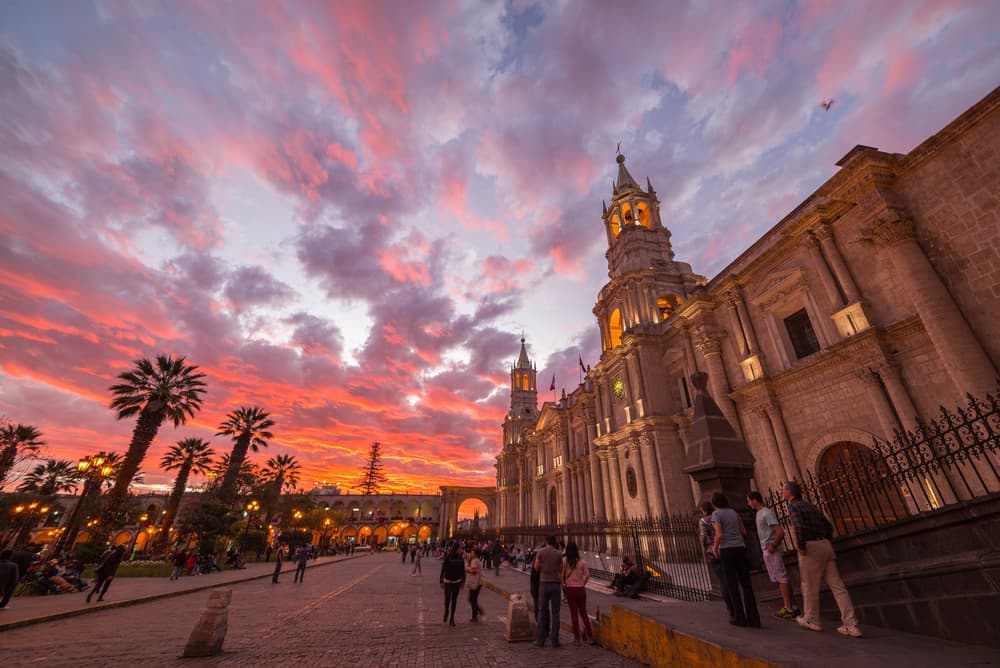
Arequipa: what life costs in Peru's white volcanic city
Rent, monthly budgets, safety, weather and neighborhoods for Americans thinking about moving to or retiring in Arequipa.
- 1,008,290
- Population (2017)
- $1,200/mo
- Monthly budget · single
- 59°F / 15°C
- Avg temperature
One person can live well in Arequipa on about $1,200 a month in U.S. dollars, and most single budgets fall between $900 and $1,400. A couple spends about $1,800, and a family of four about $2,600. Rent is the big swing: a one-bedroom near the center runs around $550, and about $350 farther out.
The city suits retirees, remote workers and anyone who wants dry, sunny weather and a walkable colonial center at a calmer pace than Lima. That center is built from white volcanic stone and has been a UNESCO World Heritage Site since 2000, with El Misti, Chachani and Pichu Pichu on the skyline.
Two things to plan around. The city sits above 7,600 feet, so give yourself a week or two to adjust. And earthquakes are part of life here; the 2001 quake measured 8.4. The rental market runs in Spanish, so some Spanish goes a long way.

Reviewed and updated October 8, 2026 · 3 min read
At a glance
$1,200
Monthly budget · single person
$550/mo 1-bed rent, center
52/100
Safety index
$20
Internet / month
59°Fannual average
Jul 58° · Mar 60°
Climate
1,008,290
Population (2017)
Expatsi estimates, updated Oct 2026, based on rental listings, government statistics, and local reporting.
Cost of living
What it costs to live in Arequipa
Single person
$900–$1,400/mo
about 60% below Austin, TX
Couple
$1,400–$2,100/mo
about 60% below Austin, TX
Family of four
$2,000–$3,100/mo
about 65% below Austin, TX
Compared with Austin, TX (Expatsi estimate, 2026).
- $4 −80%
- Inexpensive meal
- $450–$650/mo −72%
- 1-bed rent, center
- $300–$400/mo −74%
- 1-bed rent, outside
- $20/mo −69%
- Internet
- $121/sq ft −81%
- Buy price, center
Expatsi estimates, updated Oct 2026, based on rental listings, government statistics, and local reporting.
Daily life
How Arequipa lives
- B+ grade, 63rd percentile among the cities we track
- Dining & cafésstrong
- B+ grade, 65th percentile among the cities we track
- Arts & culturestrong
- A- grade, 80th percentile among the cities we track
- Parks & outdoorsstrong
- A+ grade, 100th percentile among the cities we track
- Schools & educationstandout
- A- grade, 74th percentile among the cities we track
- Healthcare accessstrong
- B- grade, 38th percentile among the cities we track
- Bike infrastructuretypical
- B- grade, 35th percentile among the cities we track
- Public transittypical
- B- grade, moderate physical accessibility
- Accessibilitymoderate
Graded on OpenStreetMap amenity density relative to the 298 cities we track. Accessibility is the exception: it's graded against a fixed standard (terrain steepness and sidewalk surfaces), not a curve.
Climate
Weather through the year
Annual average 59°F (15°C) · 4 in of rain a year · Source: Meteostat station normals (84752, 1991-2020; no sunshine data); sunshine: Arequipa Peru via en.wikipedia.org/wiki/Arequipa
On the ground
Scenes from Arequipa
Getting around
Transport in Arequipa
You don't need a car to live in Arequipa. The historic center is compact enough to walk for most errands and sights, and taxis are how most people cover longer trips across town. Agree on the fare before you get in, or book through an app. City buses and minibuses reach the outer districts too, though the routes take some learning in Spanish.
In the outer neighborhoods you'll see moto-taxis. They're handy for short daytime hops, but skip them late at night. Rodríguez Ballón International Airport is about 20 minutes from the center by taxi.
A car earns its keep mainly on weekends, for trips like the long climb up to Colca Canyon. Plenty of people skip the rental and join a tour instead.
- 12/sq mi
- Transit stops
- 2.2/sq mi
- Bike infrastructure
- 1.8/sq mi
- Wheelchair-accessible places
Mapped features per square mile from OpenStreetMap.
Keep exploring
Places like Arequipa
Community & practical notes
Settling in: neighborhoods, leases and doctors
Where foreigners settle
Yanahuara and Cayma are the areas most in demand with expats: quiet and residential, close to Clínica Arequipa, international schools and good restaurants. Umacollo costs a bit less and sits handy to the clinic and university zones. Families who want more space for the money often look at José Luis Bustamante y Rivero, and Cerro Colorado has newer condo buildings with on-site security.
Renting as a foreigner
Landlords have to register foreign tenants with Migraciones, Peru's immigration agency, before handing over keys, so have your passport or carné de extranjería ready. Expect a deposit of at least one month's rent, check whether the lease is priced in soles or dollars, and don't assume utilities are included. Listings and leases are in Spanish.
Healthcare and remote work
Private clinics such as Clínica Arequipa are where most foreigners go for checkups and specialists, so budget for private health coverage. If you have a heart or lung condition, talk to your doctor about the altitude before you commit. Remote workers mostly work from home; test the connection at a specific apartment before you sign, since service varies by building.
Retiring in Arequipa
Retirees like the mild days, the private clinics and a city big enough to keep busy in. Peru's pension-based route is the Rentista residence; our Rentista guide covers the income rule, the Peru moving guide covers the rest, and our retirement visa roundup shows how Peru compares.
Limited mobility
Wheelchair access in Arequipa is limited. The historic center's streets are paved in volcanic sillar stone and take care on wheels or with a cane, and the altitude adds effort for the first weeks. Ask about steps and elevators before you sign a lease. Lean on taxis for anything beyond a short walk.
Housing
Renting and buying
- 1-bed rent (center)
- $450–$650/mo
- 1-bed rent (outside center)
- $300–$400/mo
- Buy price (center)
- $121/sq ft
- Buy price (outside center)
- $84/sq ft
Expatsi estimates, based on rental listings, government statistics, and local reporting.
Good to know
Frequently asked questions
What is the cost of living in Arequipa, Peru?
A single person in Arequipa spends about $1,200 a month in U.S. dollars (most budgets run $900 to $1,400), a couple about $1,800, and a family of four about $2,600, based on 2026 figures. A one-bedroom apartment near the center rents for around $550 a month, or about $350 farther out.
Which neighborhoods do expats choose in Arequipa?
Yanahuara and Cayma are the most popular with expats for their quiet, residential feel near clinics, international schools and restaurants. Umacollo costs a little less, José Luis Bustamante y Rivero gives families more space for the money, and Cerro Colorado has newer condo buildings with security.
What is the weather like in Arequipa?
Arequipa is dry and sunny most of the year. Average highs sit near 68F to 72F in every month, and average lows run from about 45F in July to about 51F in February. The city gets only about 3.6 inches of rain a year, most of it from January through March.
How high is Arequipa, and will the altitude bother me?
Arequipa sits at 2,335 meters, a little over 7,600 feet. Most people need a week or two to get used to the thin air. If you have a heart or lung condition, talk to your doctor before moving.
Is Arequipa safe for Americans?
Arequipa scores 52 out of 100 on Expatsi's safety index and 48 on crime, which puts it in the moderate range. Use ordinary big-city precautions, take regular taxis rather than moto-taxis late at night, and remember it's earthquake country: an 8.4-magnitude quake hit the city in 2001, so ask how a building was constructed before you rent.
Do I need to speak Spanish to live in Arequipa?
It helps a lot. Arequipa's rental market works entirely in Spanish, from listings to leases, and buses and everyday errands run in Spanish too. Plenty of newcomers start with basic Spanish and take lessons after they arrive.
Can I retire in Arequipa?
Yes. Peru's Rentista residence is the usual route for retirees living on a pension, and residence lets you live anywhere in the country, Arequipa included. Retirees tend to settle in Yanahuara or Cayma, close to Clínica Arequipa, and the dry, sunny weather is a big draw.
Do I need a car in Arequipa?
No. The historic center is walkable, and taxis cover most trips across town, with city buses and minibuses as a lower-cost option. A car is mainly useful for weekend trips like Colca Canyon, and tours run there too.
See how Arequipa fits your life
Take the free Expatsi Test and compare Peru to over 100 countries on what actually matters: cost, healthcare, climate, and safety. About five minutes.
Why not you?