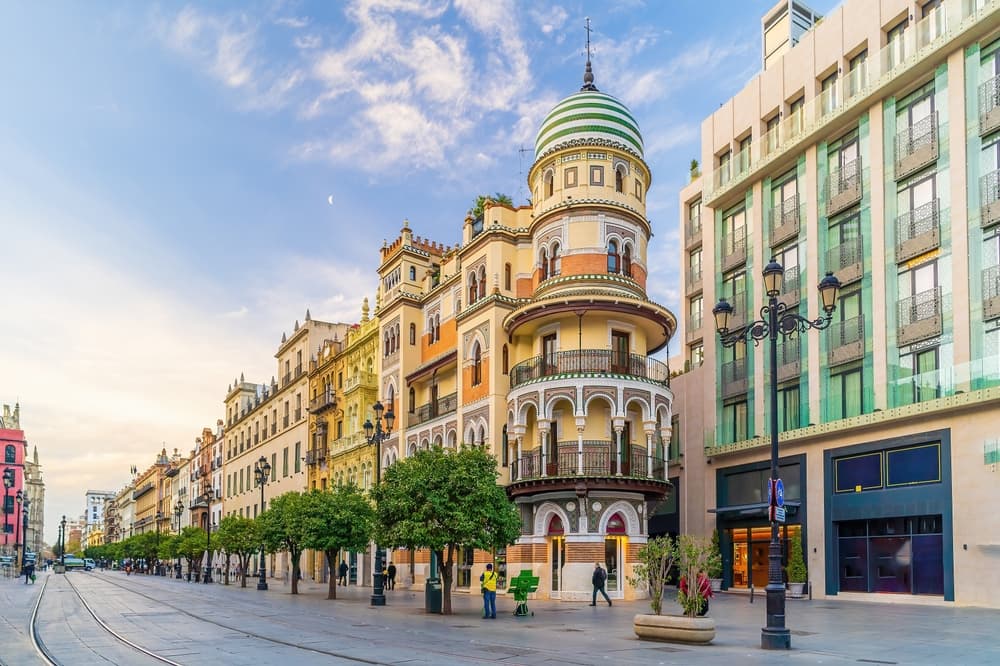
Seville: flamenco, tapas, and a walkable historic center
Spain's fourth-largest city pairs orange-tree streets and a walkable historic core with rents well below Madrid and Barcelona, plus the Atlantic beaches of the Costa de la Luz about an hour west.
- 689,423
- Population (2025)
- $2,000/mo
- Monthly budget · single
- 67°F / 20°C
- Avg temperature
Budget about $2,000 a month in U.S. dollars for a single person in Seville, around $3,000 for a couple, and roughly $4,500 for a family. A one-bedroom apartment runs about $950 in the center and around $700 in outer neighborhoods, keeping life inside the old city within reach of an ordinary American income. An inexpensive restaurant meal is about $13, and internet averages $35 a month.
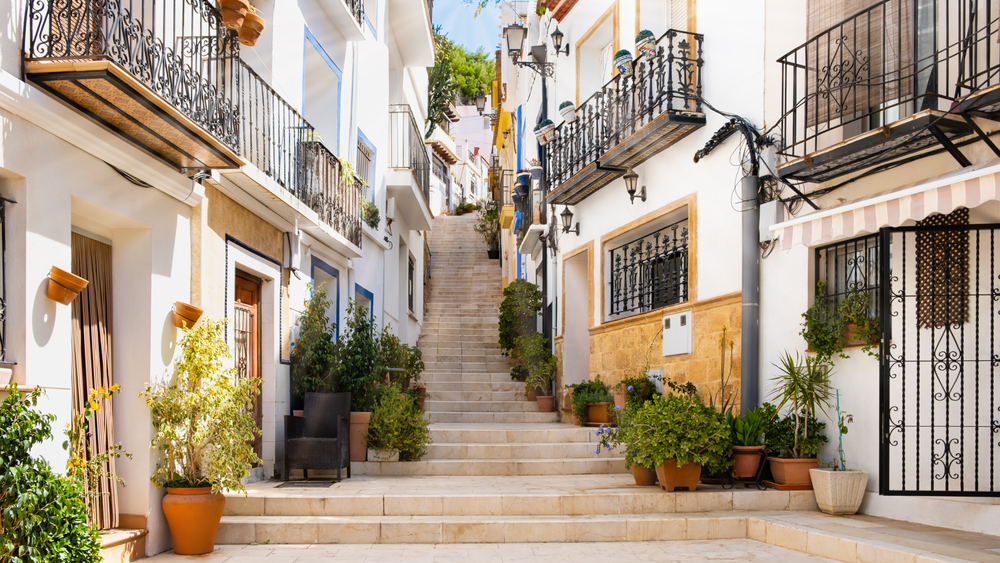
Seville suits people who want daily life in Spanish rather than an expat bubble. The city of about 689,000 has flamenco in its working-class bars, tapas culture that starts after 9 pm, and a historic center (Santa Cruz, Alameda, Triana across the river) you can cross on foot. It draws retirees, remote workers, and students more than corporate transferees, since the job market is thin for English-only professionals.
The honest drawback is summer, when average highs sit near 97F and daily life empties out in the midafternoon. The trade-off is that the Atlantic is close: the Costa de la Luz begins about an hour west, where average highs in Cádiz run closer to 82F in those same months, which is why Sevillanos have spent generations clearing out to it. If serious heat is a dealbreaker, look further north.
At a glance
$2,000
Monthly budget · single person
$950/mo 1-bed rent, center
66/100
Safety index
$35
Internet / month
67°Fannual average
Jan 52° · Aug 83°
Climate
689,423
Population (2025)
Expatsi estimates, updated Aug 2026, based on rental listings, government statistics, and local reporting.
Cost of living
What it costs to live in Seville
Single person
$1,700–$2,200/mo
about 35% below Austin, TX
Couple
$2,600–$3,400/mo
about 35% below Austin, TX
Family of four
$4,000–$5,000/mo
about 45% below Austin, TX
Compared with Austin, TX (Expatsi estimate, 2026).
- $13 −35%
- Inexpensive meal
- $850–$1,100/mo −51%
- 1-bed rent, center
- $650–$800/mo −48%
- 1-bed rent, outside
- $35/mo −46%
- Internet
- $40/mo −3%
- Transit pass
- $376/sq ft −42%
- Buy price, center
Expatsi estimates, updated Aug 2026, based on rental listings, government statistics, and local reporting.
Daily life
How Seville lives
- A grade, 86th percentile among the cities we track
- Dining & cafésstandout
- A- grade, 80th percentile among the cities we track
- Arts & culturestrong
- A grade, 92nd percentile among the cities we track
- Parks & outdoorsstandout
- A- grade, 81st percentile among the cities we track
- Schools & educationstrong
- A grade, 94th percentile among the cities we track
- Healthcare accessstandout
- A grade, 90th percentile among the cities we track
- Bike infrastructurestandout
- A grade, 86th percentile among the cities we track
- Public transitstandout
- A- grade, good physical accessibility
- Accessibilitygood
Graded on OpenStreetMap amenity density relative to the 298 cities we track. Accessibility is the exception: it's graded against a fixed standard (terrain steepness and sidewalk surfaces), not a curve.
Climate
Weather through the year
Annual average 67°F (20°C) · 20 in of rain a year · Source: Meteostat station normals (08391, 1991-2020)
On the ground
Scenes from Seville
Getting around
Transport in Seville
Most people in Seville simply walk. The historic center is compact and largely pedestrianized; many errands that require drive in the U.S. are a 10-minute stroll here.
For longer trips there's a real network. TUSSAM runs the city buses and the MetroCentro tram through the center, and Metro de Sevilla's Line 1 crosses the south of the city between Ciudad Expo and Olivar de Quintos. A second line has been under construction north to south since 2023; completion is expected around 2030. A monthly transport budget of about $40 covers typical use.
Seville is built for cycling: an extensive network of protected bike lanes went in during the late 2000s. The terrain is almost entirely flat, and the Sevici bike-share covers the city.
Reaching the coast is easy in one direction and awkward in the other. Renfe Media Distancia trains leave Santa Justa roughly a dozen times a day, calling at Jerez de la Frontera and El Puerto de Santa María before ending a short walk from Cádiz's old town. The Huelva beaches have no station of their own: buses run from Plaza de Armas to Matalascañas, the closest sand, but schedules thin outside summer and most residents drive.
A car makes little sense inside the city. Restricted traffic zones and scarce parking mean most residents skip ownership, renting one for trips into the countryside or along the coast.
- 63/sq mi
- Transit stops
- 112/sq mi
- Bike infrastructure
- 143/sq mi
- Wheelchair-accessible places
Mapped features per square mile from OpenStreetMap.
Keep exploring
Places like Seville


Community
Community & practical notes
The expat scene: Seville's foreign community is smaller and more integrated than the ones on Spain's coasts. You'll find Americans teaching English through programs like the Auxiliares de Conversación, students at the University of Seville, and remote workers scattered through Alameda and Triana. English gets you through tourist areas, but daily life (landlords, utilities, the town hall) runs in Spanish, and learning it matters more here than in Madrid or Barcelona.
Healthcare: The medicine is rarely the problem. The friction is administrative: the queues are real, and all of it happens in Spanish. Seville's public network is anchored by the Virgen del Rocío complex. Newcomers who want faster appointments tend to keep a private policy even after they qualify for public care after their first year of residency.
Limited mobility: Seville sits on the flat floodplain of the Guadalquivir, sparing it the problem that defines a lot of Andalusian hill towns. Metro Line 1 is step-free at every station, the MetroCentro tram loads at platform level, and TUSSAM's buses are low-floor with ramps. The city tourism office publishes four adapted routes through the historic center, with notes on paving and step-free entrances at each stop. The caveats are the narrowest lanes of the oldest barrios, where sidewalks give out and doorway thresholds predate any accessibility code, along with adapted taxis, which need calling ahead.
Remote work: Internet runs about $35 a month and fiber reaches most buildings. Coworking spaces cluster around Alameda and the center. The economy leans on tourism, the university, and aerospace (Airbus assembles military transports at San Pablo and Tablada) rather than tech, so most Americans here keep their U.S. jobs. The digital nomad visa makes this legal.
Retirement: Most American retirees here land on the non-lucrative visa, trading the right to work for a comparatively low income bar tied to Spain's IPREM index. Budget time for consulate appointments and apostilled documents before you move. Retirees who want the same region at a slower pace often end up looking at Costa de la Luz towns instead: Sanlúcar de Barrameda at the mouth of the Guadalquivir, Chipiona, Conil de la Frontera, or hilltop Vejer de la Frontera. Just don't assume the coast is automatically cheaper. See our retirement visa options and the full Spain guide.
Housing
Renting and buying
- 1-bed rent (center)
- $850–$1,100/mo
- 1-bed rent (outside center)
- $650–$800/mo
- Buy price (center)
- $376/sq ft
- Buy price (outside center)
- $209/sq ft
Expatsi estimates, based on rental listings, government statistics, and local reporting.
Good to know
Frequently asked questions
Can I retire in Seville?
Yes, most American retirees use Spain's non-lucrative visa, which requires proof of passive income, private health insurance, and no work in Spain. It renews toward permanent residency at five years. Seville works on Social Security plus modest savings, and the flat, walkable center is a real advantage as mobility declines.
Is Seville safe for Americans?
The safety index here is 66 against a crime index of 34, the second lowest score among the Spanish cities we cover, and theft is what drags it down. OSAC's Spain report puts violent crime at roughly 5% of national offenses and says foreign travelers are rarely targeted, but ranks Spain second in the EU for opportunistic crime. Expect pickpockets around the cathedral and in Santa Cruz, and worse odds during Semana Santa and the Feria de Abril.
How do I move to Seville from the US?
You need a long-stay visa before arrival, since the visa-free limit is 90 days in the Schengen area. The most common routes are the non-lucrative visa for people with passive income, the digital nomad visa for remote workers, and student visas. You apply at the Spanish consulate serving your U.S. state, then register locally after you land.
How far is Seville from the beach?
Seville is inland, but the Costa de la Luz is an easy trip. Matalascañas, the nearest sand, is about an hour west by car past the edge of Doñana, and Chipiona and Rota are around an hour and a quarter. Without a car, Cádiz is the simplest target at roughly 90 minutes by train. One caution for anyone eyeing a move to the coast: Cádiz is not the budget option, running about $2,100 a month for one person against Seville's $2,000.
How does healthcare work for expats in Seville?
Most visas require a private Spanish policy with no copays or deductibles. Once you are a legal resident paying into social security, you can register for the public system, home to large hospitals like Virgen del Rocío and Virgen Macarena. Your residence card and town hall registration both come before your health card, so leave weeks for it.
How much does it cost to live in Seville?
One person needs roughly $2,000 a month here in U.S. dollars. Couples should budget $3,000 and families $4,500. In the center a one-bedroom averages about $950, or $700 outside it, an inexpensive meal out runs $13, and transit costs around $40 a month.
Do I need a car in Seville?
No. The center is compact, flat, and largely pedestrianized, and TUSSAM buses, the MetroCentro tram, the metro, and the Sevici bike-share cover longer trips for around $40 a month. Most residents only rent a car for weekend trips outside the city, and parking in the center is scarce enough to make ownership a burden.
How hot does Seville get?
Summer is the hard part. Average highs in July and August sit near 97F, and the city reorganizes itself around the worst of it, with shutters closed and errands done early or after dark. The annual average is about 67F (19.5C) with roughly 20 inches (497 mm) of rain, nearly all between October and March, so winters are mild and summers effectively rainless.
See how Seville fits your life
Take the free Expatsi Test and compare Spain to nearly 200 countries on what actually matters: cost, healthcare, climate, and safety. About five minutes.
Why not you?