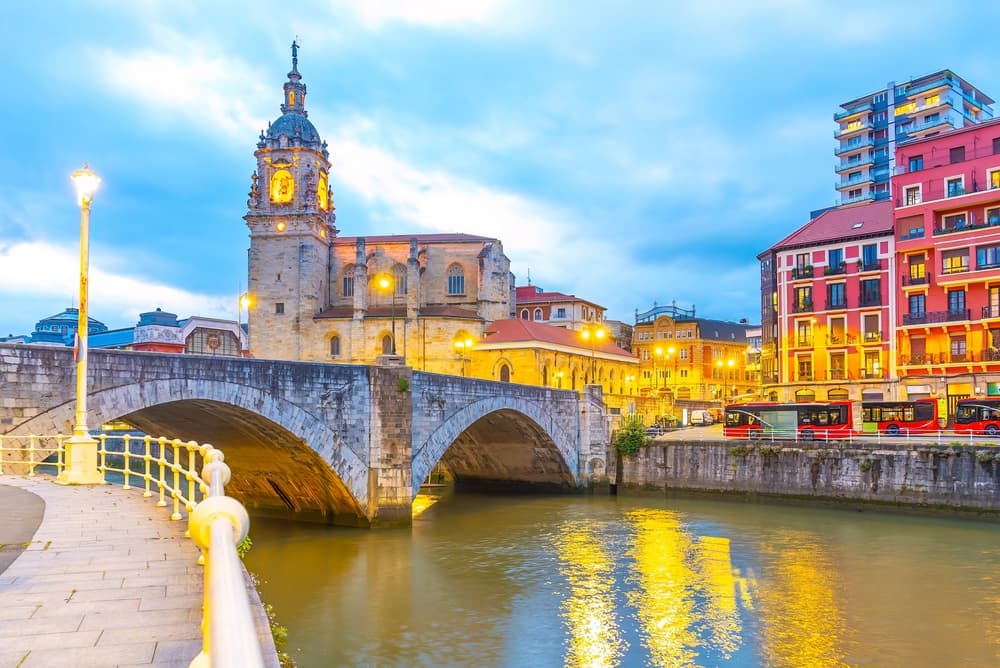
Bilbao: Basque food culture in a compact green city
The largest city in the Basque Country: serious food, a compact walkable center, steep hills all around it, and a lot more rain than southern Spain.
- 351,124
- Population (2025)
- $2,300/mo
- Monthly budget · single
- 59°F / 15°C
- Avg temperature
Living in Bilbao runs about $2,300 a month in U.S. dollars for one person, around $3,400 for a couple and roughly $5,200 for a family. A one-bedroom rents for about $1,200 in the center and about $1,000 outside it, less than you would pay in Madrid, Barcelona or nearby San Sebastián.
The region has its own language alongside Spanish, and one of Europe's densest concentrations of Michelin stars, several of them in Bilbao itself. Since the Guggenheim opened in 1997, Bilbao has turned itself from rusting shipyards into a compact, tidy place of riverfront parks, pintxo bars and serious restaurants. It suits food lovers, walkers and anyone who would rather have green hills than a crowded beach. About 351,000 people live in the city proper.
The trade-off is the weather. Bilbao sits on the Atlantic coast and takes about 45 inches of rain a year (1,152 mm), second only to San Sebastián among the Spanish cities we cover. Winter is the wet half of the year and summer the dry one. If you're picturing the sunbaked Spain of the postcards, Bilbao and Green Spain aren't what you're looking for.
At a glance
$2,300
Monthly budget · single person
$1,200/mo 1-bed rent, center
75/100
Safety index
$35
Internet / month
59°Fannual average
Jan 49° · Aug 70°
Climate
351,124
Population (2025)
Expatsi estimates, updated Aug 2026, based on rental listings, government statistics, and local reporting.
Cost of living
What it costs to live in Bilbao
Single person
$2,000–$2,600/mo
about 25% below Austin, TX
Couple
$3,000–$3,800/mo
about 25% below Austin, TX
Family of four
$4,600–$5,800/mo
about 35% below Austin, TX
Compared with Austin, TX (Expatsi estimate, 2026).
- $17 −15%
- Inexpensive meal
- $1,050–$1,350/mo −38%
- 1-bed rent, center
- $850–$1,100/mo −26%
- 1-bed rent, outside
- $35/mo −46%
- Internet
- $50/mo +21%
- Transit pass
- $488/sq ft −25%
- Buy price, center
Expatsi estimates, updated Aug 2026, based on rental listings, government statistics, and local reporting.
Daily life
How Bilbao lives
- A- grade, 84th percentile among the cities we track
- Dining & cafésstrong
- B+ grade, 66th percentile among the cities we track
- Arts & culturestrong
- B+ grade, 68th percentile among the cities we track
- Parks & outdoorsstrong
- A- grade, 71st percentile among the cities we track
- Schools & educationstrong
- A grade, 90th percentile among the cities we track
- Healthcare accessstandout
- B+ grade, 68th percentile among the cities we track
- Bike infrastructurestrong
- A grade, 90th percentile among the cities we track
- Public transitstandout
- B- grade, moderate physical accessibility
- Accessibilitymoderate
Graded on OpenStreetMap amenity density relative to the 298 cities we track. Accessibility is the exception: it's graded against a fixed standard (terrain steepness and sidewalk surfaces), not a curve.
Climate
Weather through the year
Annual average 59°F (15°C) · 45 in of rain a year · Source: Meteostat station normals (08025, 1991-2020)
On the ground
Scenes from Bilbao
Getting around
Transport in Bilbao
Bilbao is one of the easier European cities to live in without a car. The metro, designed by Norman Foster and known for its glass "fosterito" entrances, links the center to the suburbs and beach towns along the estuary. The Euskotren tram runs beside the river past the Guggenheim. Bilbobus covers what the metro misses, and commuter trains handle the wider region. A single card, the Barik, works on all of it. San Sebastián is an hour and a quarter away by bus, leaving hourly from Termibus.
The center is genuinely walkable. Here are the numbers behind it: 64 percent of trips inside Bilbao are made on foot; plus since 2020, the speed limit on every street in the municipality has been a sedate 30 km/h. Casco Viejo, Abando and Indautxu are flat and dense, with the riverside promenade tying them together.
The limit is terrain. Bilbao sits in a valley ringed by steep hills, and plenty of residential barrios sit high above it. Public lifts and the Artxanda funicular exist for that reason, but walk the hill before you sign a lease.
A car earns its keep for the coast, the countryside and the Rioja vineyards, and not much else. Inside the city it is mostly a parking problem, and the low emission zone covering Abando and Indautxu runs weekdays from 7am to 8pm, with cameras reading plates and a 200 euro fine for cars without a DGT 0, ECO or C label.
- 68/sq mi
- Transit stops
- 28/sq mi
- Bike infrastructure
- 182/sq mi
- Wheelchair-accessible places
Mapped features per square mile from OpenStreetMap.
Keep exploring
Places like Bilbao


Community
Community & practical notes
The expat scene: Bilbao's foreign community is smaller and quieter than Madrid's or Valencia's, which is part of the appeal for some people. It skews Latin American and European, with a modest and growing set of remote workers, and InterNations and language-exchange meetups are the usual way in. Basque (Euskera) shares official status with Spanish, and while everyone speaks Spanish, you'll need Castilian for daily life. English gets you through the tourist streets but not much further.
Healthcare: Osakidetza, the Basque health service, runs the public system here and is well regarded. Most Americans arrive on a visa that requires private insurance for the first year, then move onto the public system by working here or paying into the convenio especial. Dependents aren't covered automatically, so each person applies separately. The friction is administrative: the padrón, TIE card, health card and appointments all move at Spanish speed.
Limited mobility: Mixed, and it depends heavily on the barrio. The flat central districts are easy going, with wide, well-surfaced sidewalks and step-free transit. That changes quickly once you leave the valley floor, because this is a hill city and some streets climb hard. The municipal lifts help, and they take the Barik card, but they are fixed points rather than a network. Look at the specific street in person before you commit to it.
Getting online: Fiber runs about $35 a month and it is fast. Coworking clusters around Abando and the riverfront rather than in any one building. The local economy leans on banking, energy, engineering and advanced manufacturing, though most Americans here work remotely for U.S. employers or teach English. Spain's digital nomad visa covers remote workers earning above its income threshold.
Retiring here: Spain's non-lucrative visa is the standard route: prove passive income against the IPREM-linked threshold, carry private health insurance, and renew until long-term residency at five years. The mild weather and the flat, walkable core suit older movers well; the hills do not. Spain also taxes worldwide income once you are resident, and the Basque tax rules sit apart from the rest of the country's, so get cross-border advice before you commit. Compare programs at retirement visa options, or start with our Spain guide.
Housing
Renting and buying
- 1-bed rent (center)
- $1,050–$1,350/mo
- 1-bed rent (outside center)
- $850–$1,100/mo
- Buy price (center)
- $488/sq ft
- Buy price (outside center)
- $325/sq ft
Expatsi estimates, based on rental listings, government statistics, and local reporting.
Good to know
Frequently asked questions
How do I move to Bilbao from the US?
Americans need a long-stay visa: the non-lucrative visa if you have passive income, the digital nomad visa if you work remotely, or a work or student visa. You apply through a Spanish consulate in the U.S., then handle residency paperwork, the TIE card and padrón registration once you land. Most people rent short-term first and hunt for an apartment in person.
Do I need a car in Bilbao?
No. Metro, tram and city buses cover the metropolitan area on one Barik card, and a realistic monthly transit spend is about $50. The center is compact enough to walk. A car only earns its keep for regular trips out to the countryside or wine country, and the low emission zone keeps older cars out of Abando and Indautxu on weekdays.
How much does it cost to live in Bilbao?
One person needs roughly $2,300 a month here, in U.S. dollars, with a couple around $3,400 and a family about $5,200. Expect around $1,200 a month for a one-bedroom downtown, closer to $1,000 further out, and about $17 for a meal at an inexpensive restaurant.
Is Bilbao wheelchair accessible?
Partly, and the neighborhood decides it. Metro stations have lifts, the tram is low-floor, and the flat central districts of Casco Viejo, Abando and Indautxu have wide, well-surfaced sidewalks. Bilbao is a valley city ringed by hills, though, so a flat address matters more here than the citywide picture suggests.
How is healthcare in Bilbao?
Osakidetza, the Basque public health service, is among the best regarded in Spain. New arrivals normally need private insurance for their visa, then reach the public system through work or through the convenio especial pay-in scheme, which opens up after twelve continuous months on the padrón. Every family member has to apply for it separately.
What is the weather like in Bilbao?
Mild and wet. The annual average temperature is about 59°F (14.9°C), with cool winters and warm rather than hot summers. Rain is the trade-off: roughly 45 inches (1,152 mm) spread across a lot of gray, drizzly days. November is the wettest month, and unusually for Spain, summer is the driest stretch of the year.
Can I retire in Bilbao?
Yes, and most American retirees use Spain's non-lucrative visa, which asks for proof of passive income and private health insurance. Long-term residency comes after five years. Keep in mind that Spain taxes residents on worldwide income and that Bizkaia collects its own income tax under the Basque foral system, so talk to a cross-border tax advisor first.
Is Bilbao safe for Americans?
Bilbao scores 75 on the safety index and 25 on the crime index. Across the 19 Spanish cities we hold data for, safety scores run from 56 to 85, so Bilbao sits in the upper half. OSAC's Spain report says violent crime is not prevalent but that foreigners are the pickpockets' targets of choice on public transit and in crowded places.
See how Bilbao fits your life
Take the free Expatsi Test and compare Spain to nearly 200 countries on what actually matters: cost, healthcare, climate, and safety. About five minutes.
Why not you?