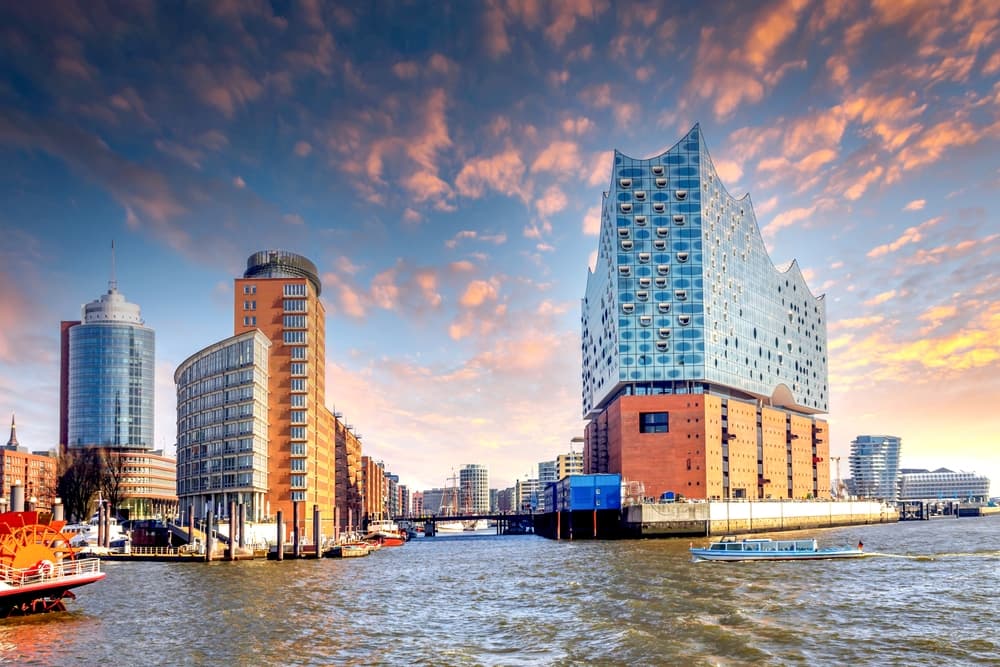
Hamburg: a big city organized around water
A wealthy old port city built around the Elbe and two lakes, with parks in every direction and an economy that doesn't depend on tourists.
- 1,910,160
- Population (2023)
- $2,700/mo
- Monthly budget · single
- 49°F / 10°C
- Avg temperature
A single person lives in Hamburg on about $2,700 a month. A couple runs about $4,000, and a family lands near $6,200. A one bedroom in the center is roughly $1,350, or about $1,000 if you move a few S-Bahn stops out. Dinner out is around $16, home internet $40, and a monthly transit pass $70.
That makes Hamburg cheaper than Berlin and well under Munich. This catches people off guard because the wealthy old port city sounds like it should be the pricey one. It suits families, remote workers, and anyone who wants a big European city organized around water: the Elbe, the two Alster lakes, parks in every direction, and an economy built on shipping, aerospace and media, rather than tourism.
Here's the catch, and it's not the money. Hamburg is the coldest of the German cities we cover, at a 49F annual average, and December light is genuinely thin. The second catch is the apartment hunt, which is competitive enough that most people search for months instead of weeks.
At a glance
$2,700
Monthly budget · single person
$1,350/mo 1-bed rent, center
64/100
Safety index
$40
Internet / month
49°Fannual average
Jan 35° · Jul 65°
Climate
1,910,160
Population (2023)
Expatsi estimates, updated Aug 2026, based on rental listings, government statistics, and local reporting.
Cost of living
What it costs to live in Hamburg
Single person
$2,300–$3,000/mo
about 15% below Austin, TX
Couple
$3,500–$4,400/mo
about 15% below Austin, TX
Family of four
$5,500–$6,900/mo
about 20% below Austin, TX
Compared with Austin, TX (Expatsi estimate, 2026).
- $16 −20%
- Inexpensive meal
- $1,150–$1,500/mo −31%
- 1-bed rent, center
- $850–$1,100/mo −26%
- 1-bed rent, outside
- $40/mo −38%
- Internet
- $70/mo +70%
- Transit pass
- $794/sq ft +22%
- Buy price, center
Expatsi estimates, updated Aug 2026, based on rental listings, government statistics, and local reporting.
Daily life
How Hamburg lives
- A grade, 90th percentile among the cities we track
- Dining & cafésstandout
- A grade, 94th percentile among the cities we track
- Arts & culturestandout
- B+ grade, 56th percentile among the cities we track
- Parks & outdoorsstrong
- A grade, 89th percentile among the cities we track
- Schools & educationstandout
- B+ grade, 69th percentile among the cities we track
- Healthcare accessstrong
- A- grade, 83rd percentile among the cities we track
- Bike infrastructurestrong
- B+ grade, 62nd percentile among the cities we track
- Public transitstrong
- A grade, good physical accessibility
- Accessibilitygood
Graded on OpenStreetMap amenity density relative to the 298 cities we track. Accessibility is the exception: it's graded against a fixed standard (terrain steepness and sidewalk surfaces), not a curve.
Climate
Weather through the year
Annual average 49°F (10°C) · 30 in of rain a year · Source: Meteostat station normals (10147, 1991-2020)
On the ground
Scenes from Hamburg
Getting around
Transport in Hamburg
Hamburg runs one integrated network called the hvv, and the best thing about it is that your ticket floats. Alongside the U-Bahn, S-Bahn and buses, the hvv covers the HADAG harbour ferries on the Elbe. Those are working commuter boats rather than tour boats; they all call at Landungsbrücken, so an ordinary trip home can involve standing on a deck watching container ships. Our data puts a monthly pass at $70, which matches the nationwide Deutschlandticket covering local and regional trains anywhere in Germany, though not the fast ICE services.
One oddity: Hamburg has no trams. The last one ran in 1978, leaving it the largest German city without a tram network, so the U-Bahn, S-Bahn and a dense bus web carry everything. Trains run from early morning until around 1am on weekdays and straight through the night on weekends.
The city is also flat, which makes it a real cycling town. StadtRAD, the red station-based bike share, gives you the first 30 minutes of every ride free, so short hops cost nothing. From the airport, the S-Bahn reaches the main station in about 25 minutes. You don't need a car in the inner districts, and parking will make you regret owning one.
- 38/sq mi
- Transit stops
- 60/sq mi
- Bike infrastructure
- 396/sq mi
- Wheelchair-accessible places
Mapped features per square mile from OpenStreetMap.
Keep exploring
Places like Hamburg





Living here
Community and practical notes
The expat scene: Hamburg has a large, settled international community rather than a churn of newcomers, which is a different feel from Berlin. Newcomers cluster in Ottensen and the wider Altona district, Eimsbüttel, Winterhude, Sternschanze and St. Georg, each with a distinct personality. Ottensen feels creative and walkable; Eimsbüttel is leafy and family-heavy; Winterhude's vibes are moneyed and quiet by the Stadtpark, and Sternschanze gets loud and alternative. English gets you a long way socially and inside international employers like Airbus and the shipping and media firms. It won't get you through a government counter, and permanent residence still expects German to be used.
Healthcare: German coverage is mandatory from your first day, and you pick a Hausarzt who gates the specialists. The University Medical Center Hamburg-Eppendorf, known as the UKE, is the city's largest hospital and the teaching hospital of the University of Hamburg; it runs an International Office for patients who arrive without German. Asklepios operates the other big hospital network across the city.
Schools: The International School of Hamburg opened in 1957 as Germany's first international school. It teaches in English through the IB and is the only school in the city accredited by the Council of International Schools. Several other international and bilingual private schools operate here. German public schools are free and generally strong, but instruction is in German.
Remote work: Home internet runs about $40 a month and fiber is normal. The real constraint is the clock, since Hamburg sits six hours ahead of New York, so an American team's morning is your evening.
Limited mobility: Hamburg is one of the flatter cities we cover, sitting essentially at sea level, and our street data shows well surfaced paths across the sampled area. Buses and the S-Bahn are broadly usable. The weak spots are older U-Bahn stations and, above all, housing: the handsome brick and Altbau buildings people move here for are frequently walk-ups with no lift. Ask about the elevator before you ask about the view.
Retirement: Hamburg suits aging in place well, with flat streets, real transit and serious hospitals. Here's the honest part: Germany has no dedicated retirement visa, so most American retirees arrive through citizenship by descent, an EU passport, or family. If you're weighing visa paths, compare it against countries that do have one on our retirement visa guide, and read the full Germany guide before you commit. Winter darkness is the other thing to test before you sign a lease.
Housing
Renting and buying
- 1-bed rent (center)
- $1,150–$1,500/mo
- 1-bed rent (outside center)
- $850–$1,100/mo
- Buy price (center)
- $794/sq ft
- Buy price (outside center)
- $488/sq ft
Expatsi estimates, based on rental listings, government statistics, and local reporting.
Good to know
Frequently asked questions
Can Americans retire in Hamburg?
You can live there, but Germany has no retirement visa. Retirees generally need citizenship by descent, an EU passport, family ties, or a residence permit granted for other purposes with proof of long term income and health cover. The city itself is well suited to it: flat, walkable, strong hospitals, and a couple's budget near $4,000 a month.
How hard is it to find an apartment in Hamburg?
Hard. Demand outstrips supply, popular districts draw crowds to viewings, and most people search for months rather than weeks. The usual route is booking a furnished short term flat that permits registration, doing your Anmeldung from that address, then hunting locally. Have your documents ready before you arrive, and start earlier if you are moving in late summer.
How much does it cost to live in Hamburg?
Budget about $2,700 a month as a single person, $4,000 as a couple, and around $6,200 for a family. A one bedroom in the center averages $1,350, dropping to roughly $1,000 outside it. A cheap restaurant meal is about $16, internet $40, and a transit pass $70. That is cheaper than Berlin and noticeably below Munich.
Do you need a car in Hamburg?
No. The hvv network covers the U-Bahn, S-Bahn, buses and the harbour ferries on one ticket, and a monthly pass runs about $70. The city is flat enough that cycling works year round, and StadtRAD gives you the first 30 minutes of every ride free. A car is useful for weekends at the coast and a nuisance the rest of the time.
Is Hamburg safe?
Hamburg scores 64 on our safety index, the same as Berlin and below Munich's 80. OSAC notes that Berlin, Hamburg and Bremen carry Germany's highest regional crime rates. In practice that means theft, not violence. The consistent hot spots are the blocks around the Hauptbahnhof and Steindamm in St. Georg, plus the Reeperbahn late at night. Residential districts feel calm.
What is the weather like in Hamburg?
Cool and maritime. The annual average is 49F. July and August average highs near 74F with nights near 56F, and hotter spells happen on top of that. January and February average highs near 40F, with nights right around freezing. Rain totals about 30 inches a year and actually peaks in July. December is the darkest month.
Is Hamburg wheelchair accessible?
Better than most European cities of its age, with real caveats. Hamburg is essentially flat and our data shows well surfaced streets, and buses and the S-Bahn are workable. Older U-Bahn stations are the weak link. The bigger obstacle is housing, since the classic Altbau buildings are often walk-ups. Confirm step free access on any flat before you sign.
See how Hamburg fits your life
Take the free Expatsi Test and compare Germany to nearly 200 countries on what actually matters: cost, healthcare, climate, and safety. About five minutes.
Why not you?