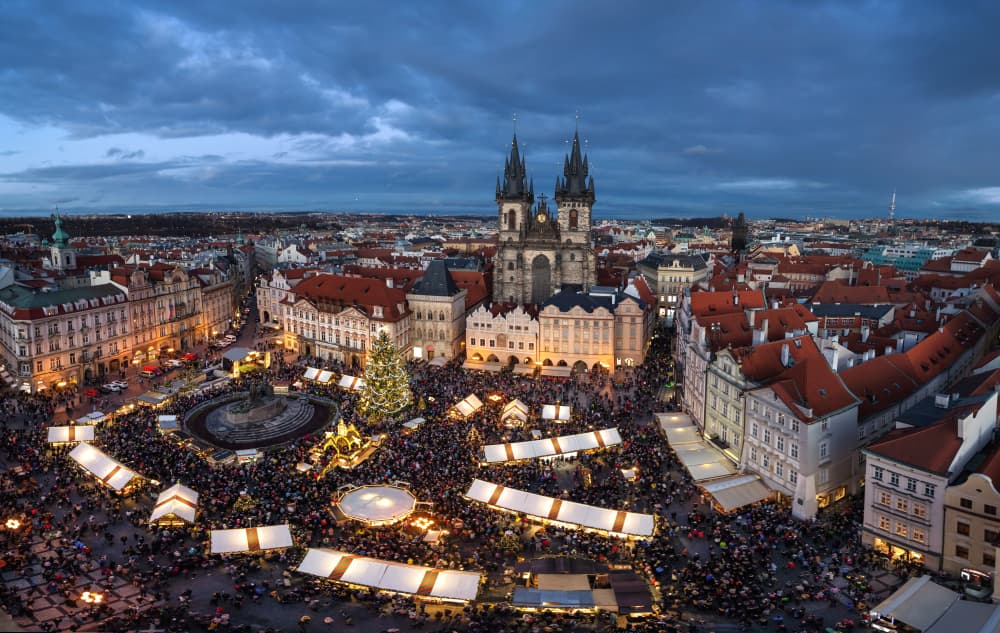
Prague, Czechia: a capital you can run without a car
Rent, monthly budgets, safety, gray winters, and the visa catch for retirees, for Americans weighing a move to the Czech capital.
- 1,397,880
- Population (2025)
- $2,400/mo
- Monthly budget · single
- 50°F / 10°C
- Avg temperature
Plan for around $2,400 a month in U.S. dollars if you're living alone in Prague (2026 figures), with most single people landing between $2,100 and $2,700. Couples spend about $3,300. Rent is the biggest line: a one-bedroom in the center runs about $1,250 a month, and most fall between $1,100 and $1,400.
Prague is a city of about 1.4 million and the place most Americans try first in Czechia. It suits remote workers, people moving for an English-language job, and anyone who wants neighborhood cafes in Vinohrady or Žižkov and a tram to everywhere else.
Here's the catch: rents here have climbed well past the rest of the country, and tour groups crowd the Old Town. If your budget is tight or you want quiet, compare the rest of Czechia before you commit.

Reviewed and updated October 9, 2026 · 4 min read
At a glance
$2,400
Monthly budget · single person
$1,250/mo 1-bed rent, center
72/100
Safety index
$25
Internet / month
50°Fannual average
Jan 31° · Jul 67°
Climate
1,397,880
Population (2025)
Expatsi estimates, updated Oct 2026, based on rental listings, government statistics, and local reporting.
Cost of living
What it costs to live in Prague
Single person
$2,100–$2,700/mo
about 25% below Austin, TX
Couple
$2,900–$3,700/mo
about 30% below Austin, TX
Family of four
$4,200–$5,400/mo
about 40% below Austin, TX
Compared with Austin, TX (Expatsi estimate, 2026).
- $11 −45%
- Inexpensive meal
- $1,100–$1,400/mo −36%
- 1-bed rent, center
- $850–$1,050/mo −30%
- 1-bed rent, outside
- $25/mo −62%
- Internet
- $25/mo −39%
- Transit pass
- $743/sq ft +14%
- Buy price, center
Expatsi estimates, updated Oct 2026, based on rental listings, government statistics, and local reporting.
Daily life
How Prague lives
- A+ grade, 97th percentile among the cities we track
- Dining & cafésstandout
- A+ grade, 98th percentile among the cities we track
- Arts & culturestandout
- A- grade, 75th percentile among the cities we track
- Parks & outdoorsstrong
- A grade, 90th percentile among the cities we track
- Schools & educationstandout
- A- grade, 81st percentile among the cities we track
- Healthcare accessstrong
- A- grade, 85th percentile among the cities we track
- Bike infrastructurestrong
- A- grade, 80th percentile among the cities we track
- Public transitstrong
- B- grade, moderate physical accessibility
- Accessibilitymoderate
Graded on OpenStreetMap amenity density relative to the 298 cities we track. Accessibility is the exception: it's graded against a fixed standard (terrain steepness and sidewalk surfaces), not a curve.
Climate
Weather through the year
Annual average 50°F (10°C) · 21 in of rain a year · Source: Meteostat station normals (11520, 1991-2020)
On the ground
Scenes from Prague
Getting around
Transport in Prague
You can skip owning a car in Prague. The metro, trams and buses run as one system called PID, and the same tickets also cover suburban trains and buses. On trams and buses you tap a contactless bank card on the terminal inside, and metro stations have contactless terminals too. Paper tickets from machines still work, but stamp them once on first use or they don't count.
For daily life, buy a long-term pass for 1 month, 3 months, 10 months or a year through the Lítačka app and pair it with your bank card. Using the app or card as your pass costs nothing extra, and a month of transit runs about $25. Short tickets of up to 72 hours also work across the surrounding Central Bohemian region, which helps on day trips.
Keep a car on the list only if you'll live out past the transit lines or spend most weekends in the countryside.
- 54/sq mi
- Transit stops
- 70/sq mi
- Bike infrastructure
- 175/sq mi
- Wheelchair-accessible places
Mapped features per square mile from OpenStreetMap.
Keep exploring
Places like Prague
Settling in
Community and practical notes
Who you'll meet
Prague has more English-language work, coworking and expat services than anywhere else in Czechia, so it's the easiest place in the country to land without speaking Czech. You'll still want some Czech for landlords, government offices and everyday errands. Home internet runs about $25 a month in 2026, so working from your apartment is easy to budget for.
Healthcare
Several large hospitals run desks for foreign patients, including Na Homolce and Motol in Prague 5 and Královské Vinohrady University Hospital in Prague 10. Private clinics such as Canadian Medical and Medicover are set up for English-speaking patients and international insurance. How you're insured depends on your visa and on whether a Czech employer covers you; our Czechia guide explains the options.
Schools
The International School of Prague is a private, English-language school authorized to teach the IB Primary Years, Middle Years, Diploma and Career-related programmes.
LGBTQ expats
Since January 2025, same-sex couples in Czechia can enter a partnership under new rules, but parliament stopped short of marriage, and restrictions on adoption remain, according to ILGA-Europe's review of 2025. Prague Pride organizes a festival in the city. If you're moving as a couple, check how your U.S. marriage will be treated for residence before you apply.
Black Americans
There's little recent reporting to go on. Black residents interviewed by Expats.cz in 2020 described very different experiences: one said he'd never faced racism in Prague and felt safer than at home, while others described stares, comments aimed at their kids, and a landlord who canceled a viewing after seeing the tenant was Black. Talk to Black residents already living here before you sign a lease.
Limited mobility
Prague's public transport isn't fully accessible yet, the city's tourism board says. Most of the 61 metro stations have elevators or lifts, but the gap and height difference between platform and train is hard going, especially in an electric wheelchair. More than half the tram fleet is low-floor, and buses are low-floor too, though whether you can board depends on the stop. The Petřín funicular isn't accessible. The DPP connection finder shows each stop's accessibility with a photo. Be sure to check the stops near any apartment you're considering.
Retiring in Prague
Czechia has no retirement visa. The route open to most retirees is the long-term visa for "other purposes," which needs an invitation or sworn statement from a Czech person or organization, notarized proof of housing written in Czech, proof of funds, and travel medical insurance. The Czech Embassy in Washington says processing takes 90 to 120 days. That makes Prague a realistic retirement base mainly if you have family, a partner or another real tie here. Our Czechia guide covers the route, and our retirement visa guide compares countries with simpler options.
Housing
Renting and buying
- 1-bed rent (center)
- $1,100–$1,400/mo
- 1-bed rent (outside center)
- $850–$1,050/mo
- Buy price (center)
- $743/sq ft
- Buy price (outside center)
- $492/sq ft
Expatsi estimates, based on rental listings, government statistics, and local reporting.
Good to know
Frequently asked questions
Is Prague safe for Americans?
Prague rates as fairly safe in the data Expatsi tracks: it scores 72 out of 100 on the safety index and 28 on the crime index (2026). Use the same street sense you would in any big city, especially in crowded tourist areas.
Which Prague neighborhoods do Americans like?
Vinohrady and Žižkov are common starting points for Americans, thanks to their neighborhood cafes and quick tram links to the center. Rents there run higher than in outer districts, so compare a few areas against your budget before signing a lease.
How much does it cost to live in Prague?
A family of four in Prague spends about $4,800 a month in U.S. dollars (2026), and most families land between $4,200 and $5,400. One person living alone needs about $2,400 a month. A one-bedroom apartment outside the center rents for about $950, roughly $300 less than the same apartment in the center.
Is Prague a good place for LGBTQ Americans?
Prague has a visible LGBTQ community and hosts Prague Pride, but the law still lags the U.S. Since January 2025, same-sex couples in Czechia can register a partnership, not marry, and adoption restrictions remain. Check how your relationship will be recognized for residence before you apply.
Can Americans retire in Prague?
Yes, but not on a retirement visa, because Czechia doesn't have one. Retirees generally apply for a long-term visa for "other purposes," which requires an invitation or sworn statement from a Czech person or organization, notarized proof of housing, proof of funds, and travel medical insurance. The Czech Embassy in Washington lists processing at 90 to 120 days. It works best for people with family, a partner or another real tie in Czechia.
What is the weather like in Prague?
Prague has cold, gray winters and warm summers. In January, average highs sit near 36F and lows near 27F. July highs average about 78F. The city gets about 21 inches of precipitation a year, and more than half of it falls from May through August.
Do you need a car to live in Prague?
No. Prague's metro, trams and buses run as one system, and you can pay by tapping a contactless bank card or carry a monthly pass in the Lítačka app. A month of transit costs about $25 (2026). A car only helps if you live beyond the transit lines or travel into the countryside often.
See how Prague fits your life
Take the free Expatsi Test and compare Czechia to over 100 countries on what actually matters: cost, healthcare, climate, and safety. About five minutes.
Why not you?