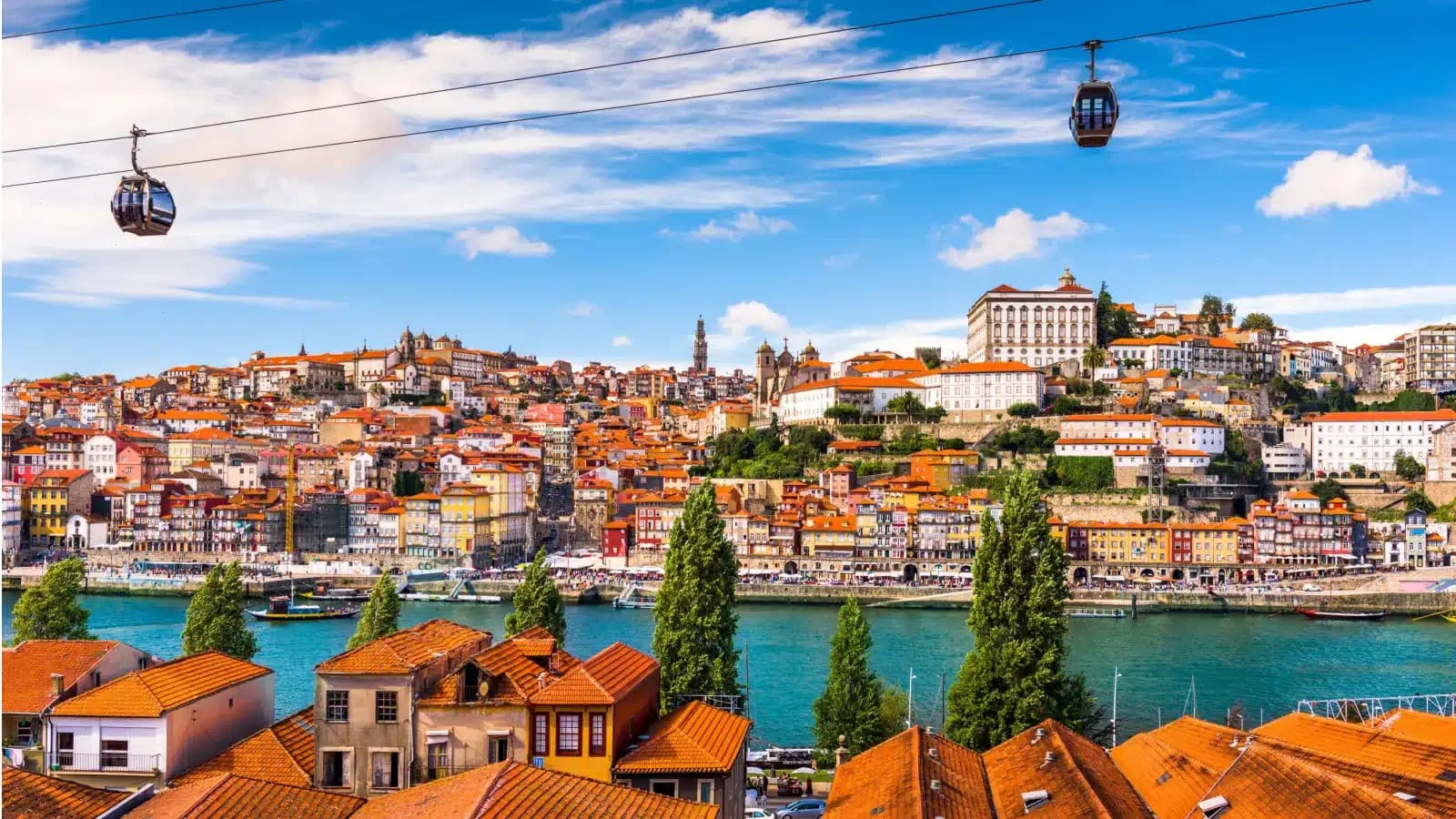
Porto: Portugal's second city, with everything the capital has
Granite hills above the Douro, port wine lodges across the river, and a metro area of more than 1.7 million people that costs less than Lisbon.
- 231,800
- Population (2021)
- $2,300/mo
- Monthly budget · single
- 59°F / 15°C
- Avg temperature
Porto runs about $2,300 a month for one person and $3,300 for a couple, with a family of four closer to $5,100. A one-bedroom in the center typically costs $1,250 a month, or about $950 outside it. A simple restaurant meal is around $12, and home internet runs $40. That sits well under Lisbon for a city with the same airport, metro and hospitals.
The city proper holds about 232,000 people and the metro area more than 1.7 million. Porto suits remote workers, families who want a real city on a smaller budget, and retirees who'd rather have hospitals and trains than a beach. Where you land matters: Ribeira and Baixa are beautiful and loud; Cedofeita draws the galleries; Bonfim still feels like ordinary Portuguese life; Boavista is the practical family pick near most of the international schools.
The trade-off is weather and terrain. Porto gets about 48 inches of rain a year, most of it October through April, January averages around 50F, and plenty of older apartments have no central heating. Expect fewer English speakers than Lisbon.
At a glance
$2,300
Monthly budget · single person
$1,250/mo 1-bed rent, center
71/100
Safety index
$40
Internet / month
59°Fannual average
Jan 50° · Aug 69°
Climate
231,800
Population (2021)
Expatsi estimates, updated Aug 2026, based on rental listings, government statistics, and local reporting.
Cost of living
What it costs to live in Porto
Single person
$2,000–$2,500/mo
about 25% below Austin, TX
Couple
$2,900–$3,700/mo
about 30% below Austin, TX
Family of four
$4,500–$5,700/mo
about 35% below Austin, TX
Compared with Austin, TX (Expatsi estimate, 2026).
- $12 −40%
- Inexpensive meal
- $1,100–$1,400/mo −36%
- 1-bed rent, center
- $850–$1,050/mo −30%
- 1-bed rent, outside
- $40/mo −38%
- Internet
- $45/mo +9%
- Transit pass
- $465/sq ft −29%
- Buy price, center
Expatsi estimates, updated Aug 2026, based on rental listings, government statistics, and local reporting.
Daily life
How Porto lives
- A grade, 92nd percentile among the cities we track
- Dining & cafésstandout
- A grade, 92nd percentile among the cities we track
- Arts & culturestandout
- B+ grade, 55th percentile among the cities we track
- Parks & outdoorsstrong
- A- grade, 85th percentile among the cities we track
- Schools & educationstrong
- A- grade, 79th percentile among the cities we track
- Healthcare accessstrong
- B grade, 49th percentile among the cities we track
- Bike infrastructuretypical
- A grade, 95th percentile among the cities we track
- Public transitstandout
- C+ grade, challenging physical accessibility
- Accessibilitychallenging
Graded on OpenStreetMap amenity density relative to the 298 cities we track. Accessibility is the exception: it's graded against a fixed standard (terrain steepness and sidewalk surfaces), not a curve.
Climate
Weather through the year
Annual average 59°F (15°C) · 48 in of rain a year · Source: Meteostat station normals (08546, 1991-2020)
On the ground
Scenes from Porto
Photos by Wikimedia Commons contributors; open any photo for its credit and license.
Getting around
Transport in Porto
You don't need a car in Porto. The metro runs six lines and 85 stations across the metro area. The violet E line comes in from Francisco Sá Carneiro airport in about half an hour. STCP buses cover the gaps. One monthly Andante pass, about $45, covers the whole metropolitan area on metro, bus and urban trains; a pass for your own municipality costs less, and riders aged 4 to 23 travel free. Stations have no barriers, so validate your card every time.
The center is walkable in the sense that everything is close and steep in the sense that you will feel it. The old town falls from Batalha to the river in granite and cobbles, and the Funicular dos Guindais does the work of an elevator between Ribeira and Batalha. Boavista and the western side of the city are much flatter.
Uber and Bolt are cheap and fill the late-night gaps. A car earns its keep in the outer metro area or for weekends in the Douro Valley, and downtown it is mostly a parking problem. Long-distance trains all leave from Campanhã, with Lisbon about two hours 45 minutes away.
- 83/sq mi
- Transit stops
- 6.7/sq mi
- Bike infrastructure
- 92/sq mi
- Wheelchair-accessible places
Mapped features per square mile from OpenStreetMap.
Keep exploring
Places like Porto


Community
Community & practical notes
The expat scene: Porto's foreign community is smaller than Lisbon's and skews toward people who stayed. The big Porto expat groups on Facebook handle the practical work of finding a lease or plumber, InterNations runs monthly meetups, and language exchange nights fill the Baixa cafes midweek. Portuguese stops being optional after the first year, so take advantage of the language classes offered by the government.
Healthcare: The strongest hub in northern Portugal. Since the 2024 health service reform, the public anchors are ULS de São João, built around the north's biggest hospital, and ULS de Santo António, which also runs the region's maternal and child hospital; which one you register with depends on your address. IPO Porto handles cancer care, and the private side is deep, with CUF Porto, Lusíadas and Hospital da Luz all easy places to find an English-speaking specialist.
Remote work: Home fiber runs about $40 a month and handles video calls without drama. Coworking clusters in Bonfim, Cedofeita and around Boavista, with the cafe scene absorbing the overflow. Short-term rentals are where remote workers get burned on wifi, so test the connection before signing anything long-term.
International schools: There are around eight international schools in the Porto area. Oporto British School, founded in 1894, is the oldest British school in mainland Europe and only one in northern Portugal offering the IB diploma; CLIP is the other large English-language option, with about 1,000 students. Tuition at those two runs roughly 9,000 to 17,000 euros a year, and the Lycée Français and the Deutsche Schule cost much less.
LGBTQ+ life: Portugal legalized same-sex marriage in 2010 and has strong anti-discrimination law. Porto's scene is real but low-key next to Lisbon's, with no gay neighborhood, a cluster of established bars near the Galerias nightlife streets, and a Pride march every year since 2006.
Expats of color: Porto is less diverse than Lisbon, so Black and brown residents stand out more here than in the capital. Racism is documented rather than hypothetical: in May 2024, three attacks on immigrants in one night around Campo 24 de Agosto and Rua do Bonfim put five people in the hospital, drawing national condemnation. Most expats report ordinary daily life with rare incidents.
Limited mobility: Portugal's tourism board rates Porto's paving as regular and in good repair, with wide sidewalks and low, level crossings. The limit is the hills. The old town drops to the river fast, the Sé cathedral sits up a slope with steps at the door, and São Francisco church and the Palácio da Bolsa have entrance stairs. The Ribeira waterfront has no guardrails. Boavista, Foz and the newer western districts are flat and far easier to live in.
Retirement: Porto works for retirees who want a city rather than a beach town, with hospitals, an airport, trains and a walkable core. The hills and the wet winters are the honest arguments against it. Most Americans who retire here use the D7 visa; our guide to retirement visas and our Portugal country guide cover the paperwork.
- Oporto British School
- CLIP - Oporto International School
- Lycée Français International de Porto
- Deutsche Schule zu Porto
Housing
Renting and buying
- 1-bed rent (center)
- $1,100–$1,400/mo
- 1-bed rent (outside center)
- $850–$1,050/mo
- Buy price (center)
- $465/sq ft
- Buy price (outside center)
- $344/sq ft
Expatsi estimates, based on rental listings, government statistics, and local reporting.
Good to know
Frequently asked questions
Can I retire in Porto?
Yes, and Porto suits retirees who want hospitals, trains and a walkable center more than a beach. A couple can live comfortably on about $3,300 a month. Most Americans arrive on the D7 passive income visa, which asks for at least 920 euros a month for one adult in 2026 and roughly 1,380 for a couple.
Can I get by with only English?
In the private healthcare system, the tech scene and the tourist-facing center, yes. Overall expect fewer English speakers than Lisbon and more reserve from locals, with a real payoff once you have been to the same cafe twenty times. Portuguese classes are the fastest way in.
What is healthcare like in Porto?
The strongest hub in northern Portugal. Two public systems anchor the city, ULS de São João and ULS de Santo António, and which one you register with depends on your address. Private care is cheap by American standards, which is why many foreign residents carry private insurance alongside an SNS registration.
Do I need a car in Porto?
Not in Porto proper. Six metro lines, STCP buses and your feet cover most of it, the metro runs straight to the airport, and Uber and Bolt are cheap. A car starts to make sense in the outer metro area or for weekends in the Douro Valley.
Is Porto wheelchair accessible?
Partly, and the geography decides it. The metro is step-free with level boarding, STCP buses carry ramps and braille stop buttons, and São Bento station has a side ramp and a lowered ticket counter. The Funicular dos Guindais is fully adapted and is the practical link between Ribeira and Batalha. Adapted taxis operate here, but book ahead.
How rainy is Porto, really?
Rainy by Portuguese standards: about 48 inches a year, most of it October through April, with November the wettest month and December the darkest. January averages about 50F and August about 69F, so the summers are dry and mild. Climate figures are Meteostat station normals.
Is Porto safe?
Yes by American big-city standards. Portugal ranks seventh worldwide on the Global Peace Index and sits at US State Department Level 1. Pickpocketing in the Ribeira crush and around busy metro stations is the everyday issue, and US security reporting names Porto among the cities where theft is common.
How much does it cost to live in Porto?
Plan on roughly $2,300 a month for one person and about $3,300 for a couple, meaningfully under Lisbon. A one-bedroom in the center runs $1,100 to $1,400 a month, about $950 outside it, a cheap restaurant meal is about $12, and a metro-area Andante pass about $45. Expatsi estimates, updated August 2026.
See how Porto fits your life
Take the free Expatsi Test and compare Portugal to nearly 200 countries on what actually matters: cost, healthcare, climate, and safety. About five minutes.
Why not you?