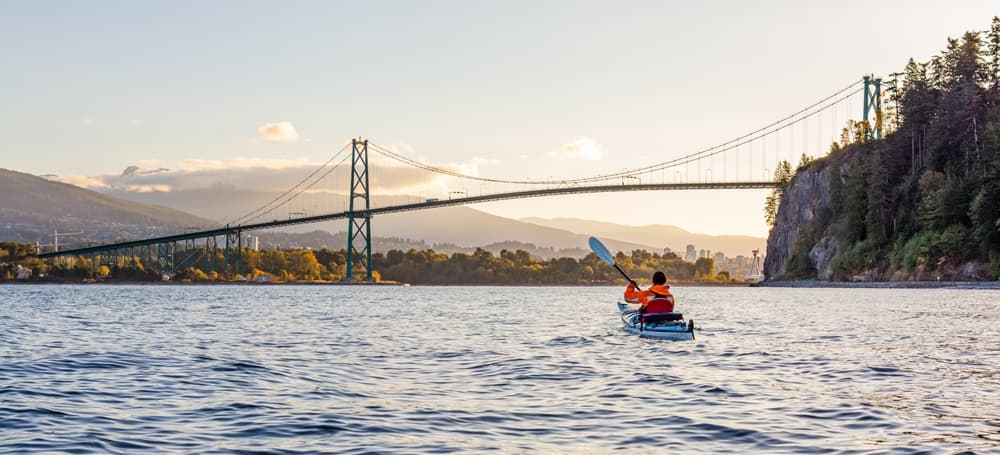
Vancouver: ocean, mountains, and mild winters in one city
Sea, mountains, and a seawall inside the city limits, with winters that barely freeze and rain gear as standard equipment.
- 662,248
- Population (2021)
- $3,100/mo
- Monthly budget · single
- 53°F / 11°C
- Avg temperature
One person needs about $3,100 a month in Vancouver, all in. A couple runs about $4,600, and a family about $7,300. A one-bedroom in the center averages $1,850, or about $1,600 if you move a few SkyTrain stops out. Groceries and a $19 lunch out are the easy part. Rent is what decides whether this city works for you.
Vancouver suits people who will actually use what they are paying for. Ocean, mountains, and a 28 km seawall sit inside the city limits, and the winters barely freeze. Remote workers earning U.S. salaries, outdoorsy families, and retirees who want a soft climate without leaving North America all do well here.
Here's the catch: it rains. About 1,533 mm a year, roughly 60 inches; most of it falls between October and March. People who thrive here own good rain gear and go outside anyway.
At a glance
$3,100
Monthly budget · single person
$1,850/mo 1-bed rent, center
62/100
Safety index
$55
Internet / month
53°Fannual average
Dec 41° · Jul 66°
Climate
662,248
Population (2021)
Expatsi estimates, updated Aug 2026, based on rental listings, government statistics, and local reporting.
Cost of living
What it costs to live in Vancouver
Single person
$2,700–$3,500/mo
about the same as Austin, TX
Couple
$4,100–$5,200/mo
about the same as Austin, TX
Family of four
$6,400–$8,200/mo
about 10% below Austin, TX
Compared with Austin, TX (Expatsi estimate, 2026).
- $19 −5%
- Inexpensive meal
- $1,650–$2,100/mo −5%
- 1-bed rent, center
- $1,400–$1,750/mo +19%
- 1-bed rent, outside
- $55/mo −15%
- Internet
- $90/mo +118%
- Transit pass
- $845/sq ft +30%
- Buy price, center
Expatsi estimates, updated Aug 2026, based on rental listings, government statistics, and local reporting.
Daily life
How Vancouver lives
- B+ grade, 63rd percentile among the cities we track
- Dining & cafésstrong
- B- grade, 35th percentile among the cities we track
- Arts & culturetypical
- A grade, 90th percentile among the cities we track
- Parks & outdoorsstandout
- B grade, 44th percentile among the cities we track
- Schools & educationtypical
- B+ grade, 68th percentile among the cities we track
- Healthcare accessstrong
- A- grade, 82nd percentile among the cities we track
- Bike infrastructurestrong
- B+ grade, 65th percentile among the cities we track
- Public transitstrong
- A grade, good physical accessibility
- Accessibilitygood
Graded on OpenStreetMap amenity density relative to the 298 cities we track. Accessibility is the exception: it's graded against a fixed standard (terrain steepness and sidewalk surfaces), not a curve.
Climate
Weather through the year
Annual average 53°F (11°C) · 60 in of rain a year · Source: Meteostat station normals (71201, 1991-2020; no sunshine data)
On the ground
Scenes from Vancouver
Getting around
Transport in Vancouver
Most people in the city core don't own a car, and that is a big part of how anyone affords this place.
The backbone is SkyTrain: three driverless lines running every few minutes. The Canada Line reaches the airport from downtown in about 25 minutes, which is a genuine luxury. Buses cover everything the trains miss, the SeaBus crosses the harbor to North Vancouver, and one Compass Card taps you onto all of it. Budget about $90 a month for a pass. The Broadway Subway extension is under construction now and will open up the Kitsilano and Mount Pleasant corridor when it's finished.
Biking is transportation here, not a hobby. The seawall runs 28 km along the water without interruption; the city has more than 450 km of bike routes, and Mobi bike share has over 250 stations. Helmets are legally required in BC, though Mobi keeps them at the docks for free.
Do you need a car? Downtown, Kitsilano, Mount Pleasant, and Commercial Drive, no. If you commute to a suburban office, juggle kids across schools, or ski most weekends, then yes.
- 41/sq mi
- Transit stops
- 59/sq mi
- Bike infrastructure
- 54/sq mi
- Wheelchair-accessible places
Mapped features per square mile from OpenStreetMap.
Keep exploring
Places like Vancouver
Living here
Community and practical notes
The expat scene: Vancouver is one of the most foreign-born cities in North America, so being from somewhere else is unremarkable here. There's no single American enclave to plug into, though, and the city has an honest reputation for being hard to crack. People are friendly but slow to become close friends. What works is joining something that meets on a schedule: a run club, a climbing gym, a paddling club, or one of the neighbourhood houses on the East Side. Kitsilano and the West End draw newcomers and young professionals; Commercial Drive and Mount Pleasant pull the people who came for the city rather than the job.
Healthcare: BC's Medical Services Plan costs nothing once you are in it, but you are not in it on day one. Coverage starts after the balance of your arrival month plus two more months, so landing on April 5 means covered on July 1. Apply the day you arrive, because the clock runs from your residency date and not your application date, and carry private insurance for the gap. MSP leaves out prescriptions, dental, and vision. Finding a family doctor takes patience: register with the Health Connect Registry through HealthLink BC at 811. Lean on walk-in clinics and Urgent and Primary Care Centres until your name comes up.
Remote work: Internet runs about $55 USD a month and is fast and boringly reliable. Mount Pleasant is the coworking heart of the city, all converted warehouses full of studios and small tech offices, with more space around Gastown and the Broadway corridor. Pacific time is the quiet advantage: you overlap with New York through early afternoon and still get your evening back.
Limited mobility: Vancouver is one of the easier big cities in North America to get around on wheels. The core is flat; sidewalks are paved and cut at the curbs; every SkyTrain station has an elevator, and the trains board level with no gap. Every bus is low-floor with a ramp, SeaBus terminals use wide ramped doors, and HandyDART runs door to door for people who cannot use regular transit. The weak spot is that most stations have exactly one elevator. TransLink is replacing 21 aging ones across 15 Expo Line stations, so check the alerts before you head out.
Retirement: The climate is the draw. January averages 41F and the city almost never freezes, which you cannot say about the rest of Canada. The West End is flat, walkable, and full of people who never left. Here's the catch: Canada has no retirement visa. There's no passive-income route like the ones Portugal or Costa Rica offer, so Americans who retire here usually get there through family sponsorship, a Super Visa if their children are Canadian, or by qualifying for permanent residence another way. Start with our guide to retirement visas and the full Canada guide.
Housing
Renting and buying
- 1-bed rent (center)
- $1,650–$2,100/mo
- 1-bed rent (outside center)
- $1,400–$1,750/mo
- Buy price (center)
- $845/sq ft
- Buy price (outside center)
- $632/sq ft
Expatsi estimates, based on rental listings, government statistics, and local reporting.
Good to know
Frequently asked questions
What is the weather really like in Vancouver?
Mild and wet. The annual average is about 53F, January averages 41F, and July highs sit near 73F, so you get neither hard freezes nor real heat. The trade-off is 1,533 mm of rain a year, about 60 inches. November is the wettest month by a wide margin and July is the driest.
Can Americans retire in Vancouver?
You can live there, but no visa exists to make it simple. Canada has no retirement or passive-income visa, so retiring in Vancouver usually means family sponsorship, a Super Visa if your children are Canadian citizens or permanent residents, or qualifying for permanent residence another way. Visitors get six months per entry and no provincial health coverage.
How much does it cost to live in Vancouver?
Budget about $3,100 a month for one person and $4,600 for a couple, all in. A family lands closer to $7,300. Rent is the swing factor: a one-bedroom in the center averages $1,850 a month and about $1,600 outside the core. Internet runs about $55 and a monthly transit pass about $90.
Do you need a car in Vancouver?
Not in the core. SkyTrain, buses, and the SeaBus run on one Compass Card for about $90 a month, and downtown, Kitsilano, Mount Pleasant, and Commercial Drive are all walkable. You will want a car if you commute to a suburban office, have kids spread across schools and activities, or ski most weekends.
Is Vancouver safe?
Yes, by big-city standards. Vancouver scores 62 on the safety index, which is comfortable without being spotless. Violent crime is rare and what newcomers actually run into is property crime: car break-ins, bike theft, packages taken off porches. The Downtown Eastside has a visible and serious drug and homelessness crisis that catches Americans off guard, but it is concentrated in a small number of blocks.
How do Americans move to Vancouver?
Most arrive through work or a points-based program. Express Entry is the federal route for skilled workers, and British Columbia runs its own Provincial Nominee Program that can nominate you for permanent residence, often tied to a BC job offer. Employer-sponsored work permits and family sponsorship are the other common doors.
See how Vancouver fits your life
Take the free Expatsi Test and compare Canada to nearly 200 countries on what actually matters: cost, healthcare, climate, and safety. About five minutes.
Why not you?