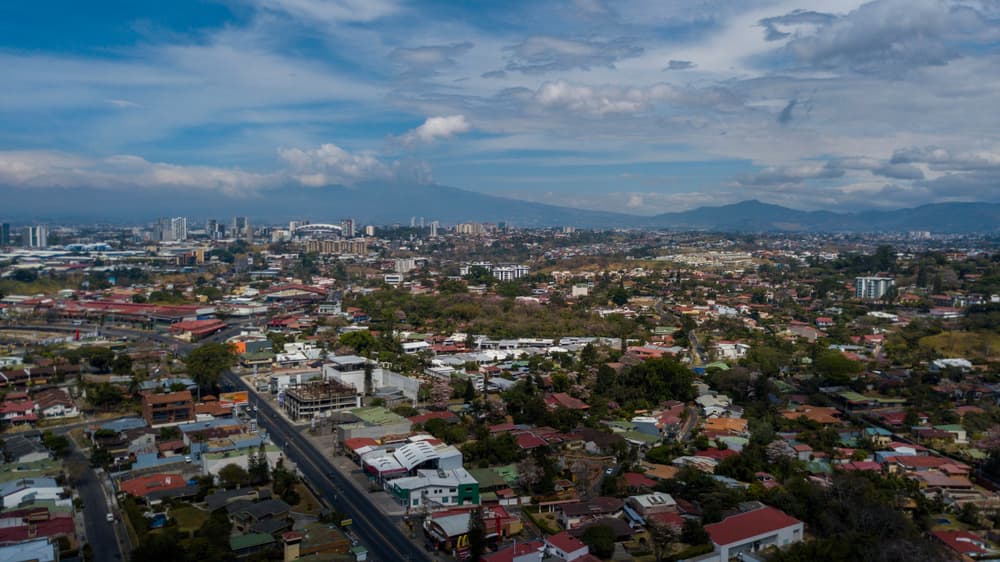
Escazú: the comfortable side of the Central Valley
About $2,400 a month for one person, a JCI-accredited hospital in the canton, easy English, and hills steep enough that most people keep a car.
- 12,590
- Population (2022)
- $2,400/mo
- Monthly budget · single
- 75°F / 24°C
- Avg temperature
Escazú runs about $2,400 a month for one person and $3,400 for a couple, with a family closer to $4,900. A one-bedroom in the center rents for around $1,050, or about $900 further out, internet is about $50 a month, and a simple lunch out is $11.
That is about $500 a month more than San José, a few miles east, and it buys an unusually easy landing. Escazú suits retirees who want a big private hospital ten minutes away, remote workers who need fiber and a half-hour run to the airport, and families who want an international school on a US calendar. English is spoken at most counters, and the safety index here is 59 against 46 for the capital next door.
The trade-off is immersion. This is the most Americanized corner of the country, so if you came for somewhere that feels genuinely different, you will have to go looking for it. The hills are the other catch, since Escazú sits at 3,612 feet and keeps climbing, which is lovely for views and hard on anyone who wants to walk everywhere.

Reviewed and updated September 23, 2026 · 4 min read
At a glance
$2,400
Monthly budget · single person
$1,050/mo 1-bed rent, center
59/100
Safety index
$50
Internet / month
75°Fannual average
Oct 73° · Apr 77°
Climate
12,590
Population (2022)
Expatsi estimates, updated Aug 2026, based on rental listings, government statistics, and local reporting.
Cost of living
What it costs to live in Escazú
Single person
$2,000–$2,800/mo
about 25% below Austin, TX
Couple
$2,800–$4,000/mo
about 25% below Austin, TX
Family of four
$4,000–$5,800/mo
about 40% below Austin, TX
Compared with Austin, TX (Expatsi estimate, 2026).
- $11 −45%
- Inexpensive meal
- $850–$1,250/mo −46%
- 1-bed rent, center
- $700–$1,050/mo −33%
- 1-bed rent, outside
- $50/mo −23%
- Internet
- $232/sq ft −64%
- Buy price, center
Expatsi estimates, updated Aug 2026, based on rental listings, government statistics, and local reporting.
Daily life
How Escazú lives
- B- grade, 30th percentile among the cities we track
- Dining & caféstypical
- C grade, 15th percentile among the cities we track
- Arts & culturemodest
- C+ grade, 24th percentile among the cities we track
- Parks & outdoorsmodest
- B- grade, 27th percentile among the cities we track
- Schools & educationtypical
- B- grade, 29th percentile among the cities we track
- Healthcare accesstypical
- B- grade, 35th percentile among the cities we track
- Bike infrastructuretypical
- B- grade, 31st percentile among the cities we track
- Public transittypical
Graded on OpenStreetMap amenity density relative to the 369 cities we track. Accessibility is the exception: it's graded against a fixed standard (terrain steepness and sidewalk surfaces), not a curve.
Climate
Weather through the year
Annual average 75°F (24°C) · 74 in of rain a year · Source: Meteostat station normals (78762, 1991-2020; sunshine from 1971-2000)
On the ground
Scenes from Escazú
Getting around
Transport in Escazú
Most people here drive, and the reason is vertical. The canton climbs from the valley floor at San Rafael into the Cerros de Escazú, so addresses that look like neighbors on a map can be a steep 20 minutes apart on foot, and not every street has a sidewalk.
Route 27, the Próspero Fernández highway, is the spine: east into San José in about 15 minutes when the road is clear, west to Santa Ana in ten, and out to Juan Santamaría airport in roughly half an hour. Rush hour undoes all of those numbers, while the toll plaza west of town is where the worst of it collects.
Buses to San José leave the terminal by the Escazú park through the day, take a little over 20 minutes on a good run and closer to 45 in traffic, and still want cash in colones. There's no train, since the commuter rail serves Heredia, Alajuela and Cartago. Uber and DiDi both work well; most Americans lean on them after dark.
San José's weekday plate restriction is worth knowing before you buy a car. It runs 6am to 7pm inside the Circunvalación ring road, which excludes Escazú, so it only limits which days you drive into the city.
- 6.9/sq mi
- Transit stops
- 0.9/sq mi
- Bike infrastructure
- 0.7/sq mi
- Wheelchair-accessible places
Mapped features per square mile from OpenStreetMap.
Keep exploring
Places like Escazú
Community
Community & practical notes
The expat scene: The canton is really three places. San Rafael is the modern one, where the malls, office towers and newer condo buildings sit. Escazú Centro keeps the older town shape, with adobe houses, a farmers market and cheaper rents. San Antonio climbs higher into coffee and pasture. Every second Sunday in March, it hosts the Día del Boyero, when a hundred or so hand-painted oxcarts parade uphill to the church.
Healthcare: This is the practical reason many Americans pick Escazú. Hospital CIMA sits in San Rafael, has been Joint Commission International accredited since 2008, and runs a 24-hour emergency room, an international insurance desk and English-speaking, often US-trained doctors. Clínica Bíblica and Hospital Metropolitano are minutes away. Legal residents also enroll in the Caja, the public system, paying a share of declared income for coverage with no pre-existing condition exclusions. The limit is speed rather than quality, since non-urgent specialist waits run months; most expats keep the Caja for catastrophic care, paying privately for anything time-sensitive.
Schools: Blue Valley School in Guachipelín has been here since 1989, teaches Pre-K through 12th grade in English and Spanish, offers both the IB diploma and a US-accredited high school diploma, bussing students from most Escazú neighborhoods. Country Day School, long an Escazú institution, moved to San Rafael de Alajuela in 2016, about 20 minutes west on Route 27.
Remote work: Fiber reaches most of the canton and internet runs about $50 a month. Coworking is corporate rather than cafe-based, with WeWork's Costa Rica flagship in the Escazú Village towers and serviced office floors at Plaza Roble. Costa Rica skips daylight saving, so you keep Chicago's clock in winter and Denver's in summer.
Limited mobility: Escazú is hard going for anyone with limited mobility, and the terrain is why. Hillside streets are steep, sidewalks narrow or vanish, and open storm drains and sudden steps are common outside the newest developments. The step-free mapping data for the canton is too thin to draw conclusions from. What works is indoors and on the flat: the malls, Avenida Escazú, the hospitals and newer valley-floor buildings with elevators and covered parking, as Law 7600, the 1996 equal-opportunity law, requires. If mobility matters, rent low in San Rafael rather than up the hill, use Uber over buses, and walk the block before you sign.
Retirement: Escazú is an easy place to retire for reasons of logistics rather than scenery. Nothing about an ordinary week needs a plan here, from the pharmacy to the specialist to the flight home. Costa Rica's pensionado route is built for retirees living on a lifetime pension. Our Costa Rica guide covers residency and taxes, the retirement visa hub compares countries, and the pensionado page has the requirements.
Housing
Renting and buying
- 1-bed rent (center)
- $850–$1,250/mo
- 1-bed rent (outside center)
- $700–$1,050/mo
- Buy price (center)
- $232/sq ft
- Buy price (outside center)
- $177/sq ft
Expatsi estimates, based on rental listings, government statistics, and local reporting.
Good to know
Frequently asked questions
Do you need a car in Escazú?
Most residents have one. The canton climbs steeply from San Rafael into the hills, so distances that look walkable are not, and there is no train. Buses to San José run through the day and take a little over 20 minutes when traffic cooperates. Uber and DiDi cover the area well, and people on the flat near Avenida Escazú do manage without a car.
Is Escazú, Costa Rica safe?
Escazú scores 59 on safety and 41 on crime, well ahead of San José at 46, which makes it one of the more comfortable corners of the metro area. In an affluent suburb the risk skews toward residential burglary and car break-ins rather than street crime. Gated buildings with a guard are standard, and the canton funds its own municipal police.
Is Escazú wheelchair accessible?
Only in parts. The malls, Avenida Escazú, the private hospitals and newer buildings with elevators and covered parking are workable, which Costa Rica's 1996 equal-opportunity law helped bring about. Outside them, steep streets, missing sidewalks and open drains make independent travel hard. Residents who need step-free access rent on the flat in San Rafael and use Uber rather than buses.
Can you retire in Escazú, Costa Rica?
Yes, and the logistics are unusually simple. You get a JCI-accredited private hospital in the canton, specialists and pharmacies nearby, an airport half an hour away and English almost everywhere. Costa Rica's pensionado residency is built for retirees with a lifetime pension. Plan on about $2,400 a month for one person or $3,400 for a couple.
What is it like living in Escazú as an American?
Familiar, which is both the appeal and the complaint. You can bank, see a doctor, shop and socialize in English, and American brands are everywhere. The flip side is that Escazú feels like an affluent international suburb rather than the Costa Rica people picture, Spanish comes slowly when you never need it, and the traffic into San José is a daily fact.
How much does it cost to live in Escazú, Costa Rica?
Budget about $2,400 a month for one person, $3,400 for a couple and $4,900 for a family. A one-bedroom in the center runs around $1,050 and about $900 further out, internet is roughly $50, and an inexpensive meal out is $11. That runs about $500 a month above the capital next door.
What is the weather like in Escazú, Costa Rica?
Steady and mild. Average highs run 81 to 87F and average lows 65 to 67F in every month, with an annual mean near 75F at 3,612 feet. About 74 inches of rain falls a year, nearly all of it from May through November, with September and October wettest and December through March dry. Homes higher in the hills run a few degrees cooler.
See how Escazú fits your life
Take the free Expatsi Test and compare Costa Rica to nearly 200 countries on what actually matters: cost, healthcare, climate, and safety. About five minutes.
Why not you?