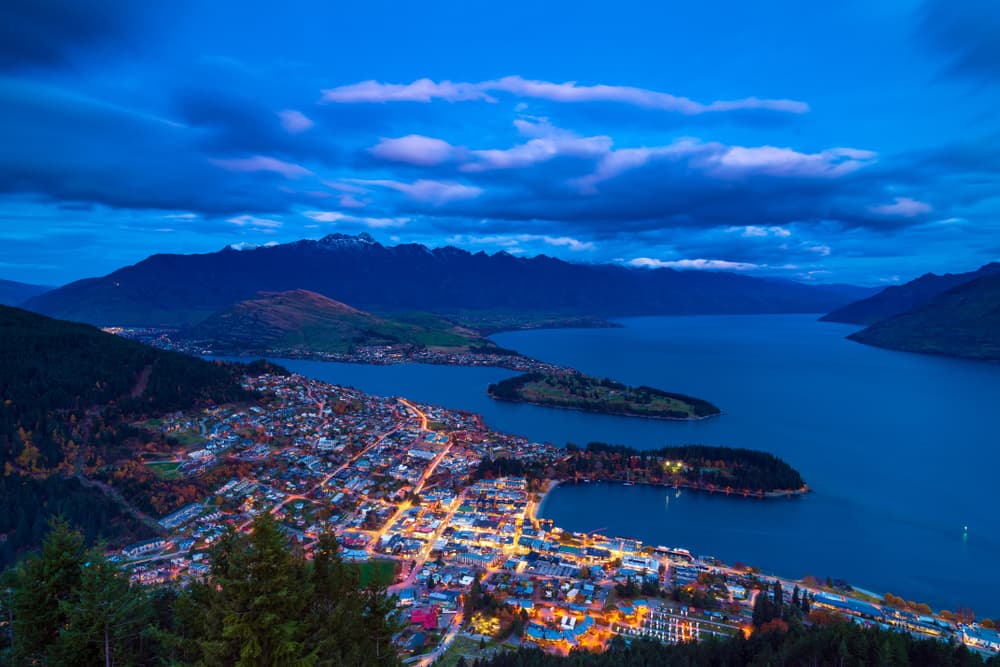
Queenstown: lake, mountains, and a housing hunt
What it costs, how safe it is, and who can make a move to New Zealand's adventure capital work.
- 29,000
- Population (2023)
- $3,000/mo
- Monthly budget · single
- 47°F / 9°C
- Avg temperature
Plan on about $3,000 a month in U.S. dollars to live alone in Queenstown, with a realistic range of $2,500 to $3,500 (2026 estimates). A couple runs about $4,300 and a family of four about $6,200. A one-bedroom in the center averages around $1,550 a month, or about $1,300 farther out. That puts a single person's budget roughly $400 a month above Auckland's, in a town of about 29,000.
Queenstown suits people who want a ski lift, a trailhead, and a lake within reach of home, and whose income doesn't depend on the local economy: remote workers with U.S. clients, people with a New Zealand job offer, and retirees with serious savings. Daily life spreads well beyond the lakefront center, out to Frankton, Kelvin Heights, Lake Hayes Estate, and Arrowtown.
Here's the catch: housing is the hard part. Long-term rentals are competitive, especially in peak season, and the whole town runs on tourism, so it can feel like a resort first and a hometown second.

Reviewed and updated October 2, 2026 · 4 min read
At a glance
$3,000
Monthly budget · single person
$1,550/mo 1-bed rent, center
82/100
Safety index
$55
Internet / month
47°Fannual average
Jul 35° · Jan 59°
Climate
29,000
Population (2023)
Expatsi estimates, updated Aug 2026, based on rental listings, government statistics, and local reporting.
Cost of living
What it costs to live in Queenstown
Single person
$2,500–$3,500/mo
about the same as Austin, TX
Couple
$3,500–$5,100/mo
about 5% below Austin, TX
Family of four
$5,100–$7,300/mo
about 20% below Austin, TX
Compared with Austin, TX (Expatsi estimate, 2026).
- $17 −15%
- Inexpensive meal
- $1,300–$1,850/mo −21%
- 1-bed rent, center
- $1,100–$1,550/mo −4%
- 1-bed rent, outside
- $55/mo −15%
- Internet
- $687/sq ft +6%
- Buy price, center
Expatsi estimates, updated Aug 2026, based on rental listings, government statistics, and local reporting.
Daily life
How Queenstown lives
- B- grade, 26th percentile among the cities we track
- Dining & caféstypical
- C+ grade, 21st percentile among the cities we track
- Arts & culturemodest
- C+ grade, 18th percentile among the cities we track
- Parks & outdoorsmodest
- C grade, 9th percentile among the cities we track
- Schools & educationmodest
- C grade, 9th percentile among the cities we track
- Healthcare accessmodest
- B+ grade, 66th percentile among the cities we track
- Bike infrastructurestrong
- B- grade, 27th percentile among the cities we track
- Public transittypical
- B grade, moderate physical accessibility
- Accessibilitymoderate
Graded on OpenStreetMap amenity density relative to the 369 cities we track. Accessibility is the exception: it's graded against a fixed standard (terrain steepness and sidewalk surfaces), not a curve.
Climate
Weather through the year
Annual average 47°F (9°C) · 54 in of rain a year · Source: Open-Meteo Historical Weather API (temps: ERA5-Land 0.1°; precip/sunshine: ERA5 best-match; 1991-2020 normals)
On the ground
Scenes from Queenstown
Getting around
Transport in Queenstown
Orbus runs Queenstown's public buses for the Otago Regional Council on five routes. Together they link the town center with Frankton, the airport, Kelvin Heights, Jacks Point, Lake Hayes Estate, and Arrowtown, so living outside the center doesn't automatically mean driving. You pay with a Bee Card or cash; the buses don't take bank cards or phones. With a Bee Card, the airport costs the same flat fare as any other trip, while paying cash to the airport costs more.
You can also commute by water. Orbus Ferries runs daily between Frankton Marina and Queenstown Bay, stopping at the Hilton and at Bayview in Kelvin Heights, with early-morning trips aimed at commuters. The ferry takes a Bee Card or bank card, but not cash.
The town center is compact and easy on foot, and the lakeside Frankton Arm Walkway connects it to Frankton for walkers and cyclists. Leave the waterfront and the hills start fast.
A car still makes sense if you'll ski often or explore past the bus routes. Driving is on the left. Ritchies coaches run daily to Wānaka, Cromwell, and Dunedin. Queenstown Airport sits in Frankton and closes to flights at 10 p.m. Its international routes go only to Australia, so flying home to the U.S. means connecting through Auckland or an Australian hub.
- 4.6/sq mi
- Transit stops
- 17/sq mi
- Bike infrastructure
- 3.4/sq mi
- Wheelchair-accessible places
Mapped features per square mile from OpenStreetMap.
Keep exploring
Places like Queenstown
Community
Community & practical notes
Community: Queenstown's population turns over more than most New Zealand towns because so much of it works in tourism, hospitality, and the ski fields. That cuts both ways for Americans. Newcomers are normal here and people are used to meeting strangers, but friends also leave when the season or their visa ends. Clubs built around skiing, biking, running, and the lake are the easiest way into a longer-term crowd, and Arrowtown and Lake Hayes Estate feel more settled than the center.
Healthcare: Lakes District Hospital in Queenstown runs a 24-hour emergency department with CT scanning, but it's built to treat and stabilize. Complex cases get transferred to the hospitals in Southland or Dunedin, which is worth knowing if you manage a chronic condition. Southern Cross Central Lakes Hospital at Lake Hayes Estate is a private hospital for planned surgery and has no emergency department. Check your visa's public-healthcare eligibility and price private insurance before you move.
Limited mobility: Queenstown is a steep town. The flat ground is mostly along the water: the lakeside Frankton Arm Walkway is fairly flat and wheelchair friendly apart from a short steep rise at Battery Hill, and Queenstown Gardens has a wheelchair-accessible loop with a couple of steeper stretches. Away from the lake, many streets and homes sit on hillsides, and July averages lows near 31°F, so winter footing adds to the challenge. Look hard at a property's approach before you sign.
Remote work: Fiber is available in much of the urban area, with rural wireless covering places outside fiber zones, and home internet runs about $55 a month. Coworking options include iMeet on Camp Street, Fluid Sharespace on Memorial Street, and The Workshop in Frankton. The harder part is the clock: New Zealand is 16 to 18 hours ahead of Eastern, by season, so U.S. meetings land early in your morning or late at night.
Retirement: New Zealand doesn't offer a standard retirement visa. The closest thing is the Temporary Retirement Visitor Visa, for people 66 or older with a large sum to invest in New Zealand plus separate living funds and income. It lasts up to two years, requires insurance, doesn't allow work, and has to be applied for again to stay longer. That makes Queenstown a realistic retirement base mainly for wealthy retirees or those with another route in. Compare retirement visa options, and see our full New Zealand guide.
Housing
Renting and buying
- 1-bed rent (center)
- $1,300–$1,850/mo
- 1-bed rent (outside center)
- $1,100–$1,550/mo
- Buy price (center)
- $687/sq ft
- Buy price (outside center)
- $511/sq ft
Expatsi estimates, based on rental listings, government statistics, and local reporting.
Good to know
Frequently asked questions
Is it hard to find a rental in Queenstown?
Yes. Long-term rentals are competitive, especially in the summer and ski seasons, because the town's economy runs on tourism. Start looking well before you arrive, widen your search to Frankton, Lake Hayes Estate, and Arrowtown, and plan on short-term housing while you hunt.
Do you need a car to live in Queenstown?
Not necessarily. Orbus buses link the town center with Frankton, the airport, Kelvin Heights, Jacks Point, Lake Hayes Estate, and Arrowtown, and a daily ferry crosses from Frankton Marina to Queenstown Bay. Many people still keep a car for frequent ski days or trips beyond the bus routes. New Zealanders drive on the left.
Can Americans retire in Queenstown?
Only with substantial money or another visa route. New Zealand has no standard retirement visa. The Temporary Retirement Visitor Visa is for people 66 or older who can invest a large sum in New Zealand and show separate living funds and income; it lasts up to two years, requires insurance, and doesn't allow work. Americans with a partner, family, or job route have more options.
Can you fly direct from the U.S. to Queenstown?
No. Queenstown Airport's international flights go only to Australia, so travelers from the U.S. connect through Auckland or an Australian city. The airport is in Frankton, close to town, and has a 10 p.m. curfew on flights.
Is Queenstown safe for Americans?
Yes. Queenstown scores 82 out of 100 on our safety index, a high score, with a crime index of 18. The bigger day-to-day risks come from the outdoors: mountain weather, cold lakes, and winter roads, so check conditions before you head out.
How much does it cost to live in Queenstown, New Zealand?
A single person should budget about $3,000 a month in U.S. dollars as of 2026, and a couple about $4,300. Rent is the biggest line: a one-bedroom outside the center averages about $1,300 a month. Living alone in Queenstown costs roughly $400 a month more than in Auckland.
What is the weather like in Queenstown?
Queenstown has four distinct seasons. January averages highs near 66°F, while July averages highs near 38°F and lows near 31°F. The town gets about 54 inches of precipitation a year, spread fairly evenly across the months, and winter brings snow to the surrounding ski fields.
See how Queenstown fits your life
Take the free Expatsi Test and compare New Zealand to over 100 countries on what actually matters: cost, healthcare, climate, and safety. About five minutes.
Why not you?