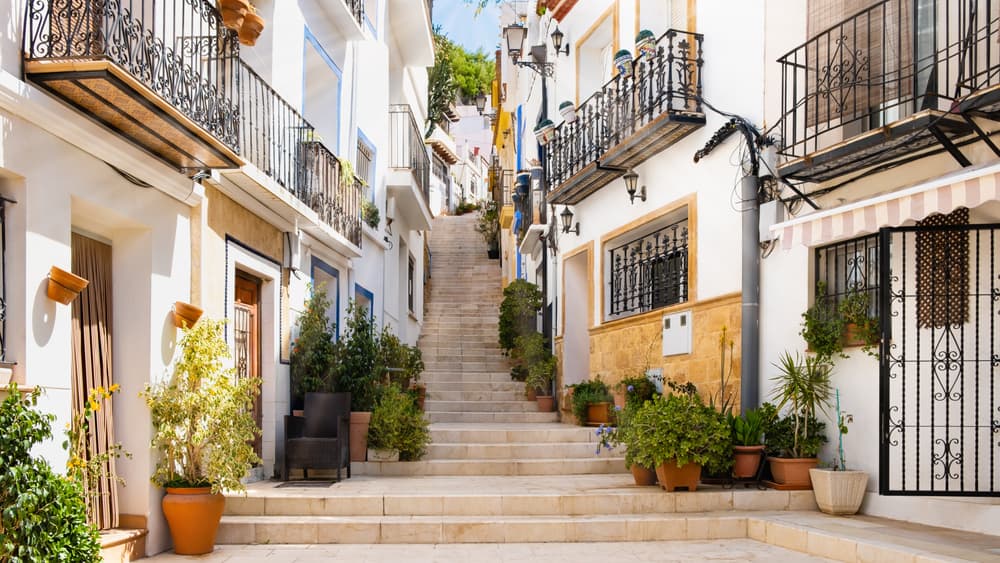
Alicante: urban beaches in a real port city
A mid-sized Costa Blanca port city with a walkable center, a tram to the beach, and barely 11 inches of rain a year.
- 366,221
- Population (2025)
- $2,000/mo
- Monthly budget · single
- 65°F / 18°C
- Avg temperature
Budget about $2,000 a month in U.S. dollars for one person in Alicante, roughly $3,000 for a couple, and around $4,600 for a family. Rent is a big part of why those numbers stay manageable: a one-bedroom averages about $1,000 in the center and about $800 outside it. Eating out follows the same logic, with an inexpensive restaurant meal running about $15.
Alicante suits people who want the Spanish Mediterranean without big-city prices or big-city sprawl. It's a working port city of about 366,000 people in the Valencian Community, with a real historic core under the Santa Bárbara castle. There's also urban beaches you can walk to and Spain's fifth-busiest airport just outside town. Retirees, remote workers, and young families all find footing here. The long-established international community on the Costa Blanca means the practical questions have usually been answered by someone before you.
The honest drawback is that Alicante is not a career town. Local salaries are modest, the economy leans on tourism and services, and if you need to earn locally rather than remotely, options thin out fast. Summers also bring crowds and heat to the waterfront, and August can feel like the whole city is on vacation because much of it is.
At a glance
$2,000
Monthly budget · single person
$1,000/mo 1-bed rent, center
67/100
Safety index
$30
Internet / month
65°Fannual average
Jan 53° · Aug 80°
Climate
366,221
Population (2025)
Expatsi estimates, updated Aug 2026, based on rental listings, government statistics, and local reporting.
Cost of living
What it costs to live in Alicante
Single person
$1,700–$2,200/mo
about 35% below Austin, TX
Couple
$2,600–$3,300/mo
about 35% below Austin, TX
Family of four
$4,000–$5,200/mo
about 40% below Austin, TX
Compared with Austin, TX (Expatsi estimate, 2026).
- $15 −25%
- Inexpensive meal
- $900–$1,100/mo −49%
- 1-bed rent, center
- $700–$900/mo −41%
- 1-bed rent, outside
- $30/mo −54%
- Internet
- $30/mo −27%
- Transit pass
- $339/sq ft −48%
- Buy price, center
Expatsi estimates, updated Aug 2026, based on rental listings, government statistics, and local reporting.
Daily life
How Alicante lives
- B+ grade, 66th percentile among the cities we track
- Dining & cafésstrong
- B grade, 42nd percentile among the cities we track
- Arts & culturetypical
- A grade, 87th percentile among the cities we track
- Parks & outdoorsstandout
- B+ grade, 62nd percentile among the cities we track
- Schools & educationstrong
- B+ grade, 62nd percentile among the cities we track
- Healthcare accessstrong
- A- grade, 73rd percentile among the cities we track
- Bike infrastructurestrong
- A- grade, 73rd percentile among the cities we track
- Public transitstrong
- A+ grade, good physical accessibility
- Accessibilitygood
Graded on OpenStreetMap amenity density relative to the 298 cities we track. Accessibility is the exception: it's graded against a fixed standard (terrain steepness and sidewalk surfaces), not a curve.
Climate
Weather through the year
Annual average 65°F (18°C) · 11 in of rain a year · Source: Meteostat station normals (08359, 1991-2020)
On the ground
Scenes from Alicante
Getting around
Transport in Alicante
Alicante is easy to live in without a car. The TRAM, the area's light rail network, is the backbone: lines fan out from the Luceros interchange to the university, up the coast to El Campello and Playa de San Juan, and on to Benidorm. Carrying on to Dénia means changing at Benidorm onto a separate diesel line, making it a three-hour trip; that stretch keeps closing for electrification work. Urban buses fill the gaps in town, and roughly $30 a month covers normal transit use.
The center is compact and walkable. From the Explanada de España, you reach the old town, the market, and Postiguet beach on foot, meaning most daily errands in central neighborhoods happen without a vehicle. The main climb is up toward the castle; the flat grid near the water is easy going.
For longer trips, high-speed trains reach Madrid in about two and a half hours, and the airport sits six miles out, with the C-6 bus running into the center in 20-30 minutes.
A car starts to make sense only if you settle in the suburban urbanizaciones or want to explore inland villages regularly. In the city proper, parking is a chore and the tram usually wins. Rent a car if infrequent excursions are your thing.
- 49/sq mi
- Transit stops
- 36/sq mi
- Bike infrastructure
- 36/sq mi
- Wheelchair-accessible places
Mapped features per square mile from OpenStreetMap.
Keep exploring
Places like Alicante
Community
Community & practical notes
The expat scene: Alicante province has the highest share of foreign residents of any province in Spain, close to a quarter of its two million people, and Britons are the largest single group. The city itself is more Spanish in daily texture than resort towns like Benidorm or Torrevieja, which many newcomers consider the point. English-speaking services and language exchanges are easy to find, but you'll still need functional Spanish for bureaucracy and to feel at home.
Healthcare: Spain's public system is well regarded, and residents who work or pay into social security get access. Most Americans arrive on visas that require private health insurance, which is genuinely affordable in Spain. The real friction here is administrative: getting your residency paperwork, padrón registration and health card sequenced correctly takes patience and repeat visits.
Limited mobility: The seafront, Explanada and newer commercial areas are flat and smooth. Alicante sits at sea level, so most daily ground is easy. Exceptions are the old town and castle on Mount Benacantil, a 545-foot hill rising straight behind the beach. A public lift bored into the rock, entered opposite Postiguet beach, handles that climb, though it's got a history of going out of service for repairs. The fortress still has steps and uneven stone at the top that you'd have to contend with. Wheelchair users who have written about the city rate the promenade and center highly, singling out individual curb cuts as the weak point. Walk the block before you sign a lease.
Getting online: Fiber coverage across the city is solid, there is a small but real coworking scene in the center, and the regional Distrito Digital tech hub keeps drawing companies to Alicante. Local hiring is still thin, though. Most foreign remote workers here keep U.S. or northern European employers and enjoy the arbitrage.
Retiring here: Spain's non-lucrative visa is the usual route. It asks for proof of passive income (the threshold tracks Spain's IPREM index and rises with each dependent), private health insurance and a clean background check, and it bars working. Permanent residency comes after five years of legal residence. Plan for Spanish taxes on worldwide income once you are a tax resident, U.S. retirement income included. Compare paths at retirement visa options and get the wider picture in our Spain guide.
Housing
Renting and buying
- 1-bed rent (center)
- $900–$1,100/mo
- 1-bed rent (outside center)
- $700–$900/mo
- Buy price (center)
- $339/sq ft
- Buy price (outside center)
- $204/sq ft
Expatsi estimates, based on rental listings, government statistics, and local reporting.
Good to know
Frequently asked questions
How does healthcare work for expats in Alicante?
Most Americans arrive with private Spanish health insurance, which their visa requires and which costs far less than U.S. coverage. Alicante has both public and private hospitals, and private clinics in the area are used to foreign patients. Residents who work and pay into social security gain access to the public system.
Do I need a car in Alicante?
Not in the city. The center is walkable, buses cover the neighborhoods, and the TRAM light rail reaches El Campello, Playa de San Juan and Benidorm along the coast. Budget about $30 a month for transit. A car only becomes useful if you live in the outlying urbanizaciones or want regular trips inland.
Is Alicante safe?
Yes. Alicante scores 67 on the safety index with a crime index of 33, which puts it in the safe range for a mid-sized city. The practical risk is the one every Mediterranean port city with heavy summer tourism shares: watch your pockets in the crowded zones and around the beach, and that is most of it.
Can I retire in Alicante?
Yes, and many people do. The non-lucrative visa is the standard retirement path: show sufficient passive income, carry private health insurance, and renew until you qualify for permanent residency at five years. A retired couple should budget around $3,000 a month, and expect Spanish tax residency on worldwide income once you live there most of the year.
Is internet in Alicante good enough for remote work?
Yes. Fiber is widely available in the city and home internet runs about $30 a month. There are coworking spaces in the center, and the time difference of six hours ahead of U.S. Eastern time lets remote workers finish a U.S. morning meeting in their Spanish evening.
How much does it cost to live in Alicante?
In U.S. dollars, one person needs roughly $2,000 a month here, a couple about $3,000, and a family around $4,600. Expect to pay around $1,000 for a one-bedroom downtown, or roughly $800 further out, and about $15 for a meal at an inexpensive restaurant.
What is the weather like in Alicante?
Mediterranean and notably dry. The annual average temperature is about 65°F (18.4°C), and only about 11 inches of rain falls in a year, 285 mm. Of the Spanish cities we cover, only Murcia down the coast is drier. Winters are mild, summers are hot and busy along the beaches, and gray stretches are rare.
How do Americans move to Alicante?
Americans need a Spanish visa before settling in. The most common routes are the non-lucrative visa for people with passive income, the digital nomad visa for remote workers, and work or student visas. Applications start at a Spanish consulate in the U.S., and once approved you register locally in Alicante and apply for your residency card.
See how Alicante fits your life
Take the free Expatsi Test and compare Spain to nearly 200 countries on what actually matters: cost, healthcare, climate, and safety. About five minutes.
Why not you?