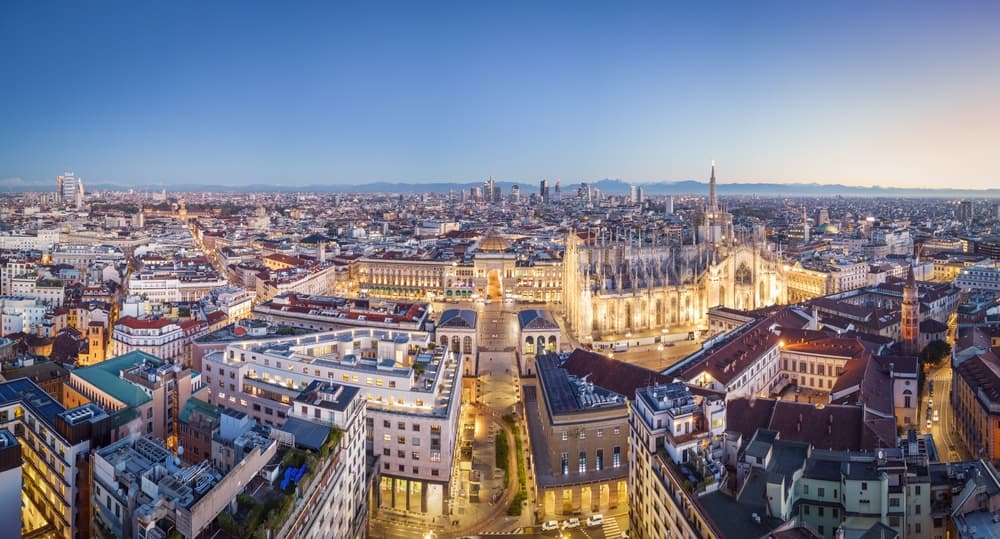
Milan is where Italy goes to work, with the Alps an hour north
What living in Milan costs an American in 2026, how safe it feels, how you'll get around without a car, and whether it makes sense for retirement.
- 1,354,196
- Population (2023)
- $3,000/mo
- Monthly budget · single
- 55°F / 13°C
- Avg temperature
Budget roughly $3,000 a month for one person in Milan, about $4,400 for a couple, and around $7,100 for a family of four, all in U.S. dollars. A one-bedroom near the center rents for about $1,650 a month, or about $1,200 farther out. That's around $600 a month more than a single person needs in Rome, and $400 of the gap is rent.
Milan suits people who want Italy with a working economy attached: corporate transfers, people in finance, fashion, and design, remote workers who like a fast-moving city, and families who need international schools. The lakes and mountains are close enough for weekends.
It's a poor fit if you're moving to Italy to stretch a modest budget, or picturing a slow, sun-drenched version of Italian life. Winters are gray and damp, and the city's charm hides in courtyards and along the canals rather than on postcard piazzas.

Reviewed and updated October 1, 2026 · 4 min read
At a glance
$3,000
Monthly budget · single person
$1,650/mo 1-bed rent, center
56/100
Safety index
$30
Internet / month
55°Fannual average
Jan 36° · Jul 74°
Climate
1,354,196
Population (2023)
Expatsi estimates, updated Aug 2026, based on rental listings, government statistics, and local reporting.
Cost of living
What it costs to live in Milan
Single person
$2,600–$3,300/mo
about the same as Austin, TX
Couple
$3,900–$4,900/mo
about the same as Austin, TX
Family of four
$6,200–$8,000/mo
about 10% below Austin, TX
Compared with Austin, TX (Expatsi estimate, 2026).
- $21 +5%
- Inexpensive meal
- $1,450–$1,850/mo −15%
- 1-bed rent, center
- $1,050–$1,300/mo −11%
- 1-bed rent, outside
- $30/mo −54%
- Internet
- $45/mo +9%
- Transit pass
- $813/sq ft +25%
- Buy price, center
Expatsi estimates, updated Aug 2026, based on rental listings, government statistics, and local reporting.
Daily life
How Milan lives
- A+ grade, 98th percentile among the cities we track
- Dining & cafésstandout
- A grade, 94th percentile among the cities we track
- Arts & culturestandout
- B+ grade, 67th percentile among the cities we track
- Parks & outdoorsstrong
- A grade, 85th percentile among the cities we track
- Schools & educationstandout
- A grade, 90th percentile among the cities we track
- Healthcare accessstandout
- A grade, 91st percentile among the cities we track
- Bike infrastructurestandout
- A+ grade, 99th percentile among the cities we track
- Public transitstandout
- A grade, good physical accessibility
- Accessibilitygood
Graded on OpenStreetMap amenity density relative to the 369 cities we track. Accessibility is the exception: it's graded against a fixed standard (terrain steepness and sidewalk surfaces), not a curve.
Climate
Weather through the year
Annual average 55°F (13°C) · 45 in of rain a year · Source: Open-Meteo Historical Weather API (temps: ERA5-Land 0.1°; precip/sunshine: ERA5 best-match; 1991-2020 normals)
On the ground
Scenes from Milan
Getting around
Transport in Milan
Milan is one of the easier places in Italy to live without a car. ATM runs the metro, trams, and buses on one ticket system, and our numbers put transport at about $45 a month for one person. The newest metro line, M4, crosses the city east to west and gets you from Linate airport to the center in about 12 minutes.
Trams are part of everyday life here, not a ride for tourists, and they fill gaps the metro leaves. The center is compact enough that walking handles a lot of errands.
A car costs more than it saves for most residents. The center sits inside Area C, a congestion charge zone watched by cameras, so driving in on a weekday means paying for it. Plenty of people skip owning one and rent a car for weekends at the lakes or in the mountains.
For travel around Italy, Milano Centrale is the place to start. The fastest nonstop high-speed trains reach Rome in 2 hours 50 minutes, and Naples takes a little over four hours.
- 109/sq mi
- Transit stops
- 113/sq mi
- Bike infrastructure
- 323/sq mi
- Wheelchair-accessible places
Mapped features per square mile from OpenStreetMap.
Keep exploring
Places like Milan


Practical notes
Community & practical notes
Finding your people
Most English speakers in Milan came for a job, so social life tends to grow out of work. The Benvenuto Club of Milan, started in 1967 by American, British, and Italian women, still helps English-speaking newcomers settle in with social events, cultural outings, networking, and volunteering, and it welcomes women from any country. Italian friendships take longer. A sports team, class, or volunteer project is usually how they start, so sign up for something in your first month.
Healthcare
Once you're a legal resident, you register with the regional health service through ASST Milano and get access to a family doctor. People here on work or family permits are enrolled automatically. Retirees on the elective residency visa are in the voluntary group and pay a yearly contribution: at least €2,000 for prior-year income up to €31,925, rising with income above that.
Working remotely
Home internet runs about $30 a month. Coworking is easy to find: Talent Garden in Calabiana, Copernico near Centrale station, BASE in the Tortona design district, and YoRoom in Isola, plus smaller spaces along the Navigli canals. If you're keeping a U.S. job, look at Italy's digital nomad visa.
Schools
The American School of Milan, founded in 1962, teaches ages 3 to 18 in Noverasco di Opera, just south of the city, and offers both the American high school diploma and the IB Diploma. The International School of Milan, founded in 1958, runs all three IB programs for ages 2 to 19 on its campus in Baranzate, northwest of the city. Both are outside the center, so pick your apartment around the school run.
Limited mobility
Mixed, and it depends on which part of the network you use. Every station on the M3, M4, and M5 metro lines has lifts from the street down to the platform. The older M1 and M2 lines are patchy: most stations have no elevator, and some rely on stair-lifts rated for wheelchairs under 200 kg (about 440 pounds). Buses carry ramps and many trams are low-floor, though some older trams still have steps at the door. Visitors using wheelchairs report high curbs in places. Map your daily routes onto the M3 to M5 lines before choosing a neighborhood.
Retiring here
Milan makes sense for retirees who want big-city culture and can carry big-city costs; tighter budgets go further elsewhere in Italy. Most Americans who retire to Italy use the elective residency visa. Compare it with options in other countries on our retirement visa page, and see the bigger picture in our Italy guide.
Housing
Renting and buying
- 1-bed rent (center)
- $1,450–$1,850/mo
- 1-bed rent (outside center)
- $1,050–$1,300/mo
- Buy price (center)
- $813/sq ft
- Buy price (outside center)
- $437/sq ft
Expatsi estimates, based on rental listings, government statistics, and local reporting.
Good to know
Frequently asked questions
Do you need a car to live in Milan?
No. Milan's metro, trams, and buses cover daily life, and the newest metro line reaches Linate airport from the center in about 12 minutes. The city center is inside Area C, a camera-enforced congestion charge zone, so driving there on weekdays costs extra. Many residents rent a car only for weekend trips.
Are there American or international schools in Milan?
Yes. The American School of Milan, south of the city in Noverasco di Opera, teaches ages 3 to 18 and offers the American high school diploma and the IB Diploma. The International School of Milan, in Baranzate to the northwest, teaches ages 2 to 19 and runs all three IB programs.
Is Milan more expensive than Rome?
Yes. One person needs about $3,000 a month in Milan versus about $2,400 in Rome, as of 2026. Most of the difference is rent: a central one-bedroom averages about $1,650 in Milan and about $1,250 in Rome.
What is the weather like in Milan?
Milan has cold, damp winters and hot summers. January averages highs near 44F and lows near 30F, while July averages highs near 83F and lows near 65F. It gets about 45 inches of rain a year, and November is the wettest month.
Can you retire in Milan?
Yes. Most American retirees in Italy use the elective residency visa, which is built for people living on income from savings, pensions, or investments. In Milan, retirees on that visa register voluntarily with the public health service and pay at least €2,000 a year for prior-year income up to €31,925.
Is Milan safe for Americans?
Milan scores 56 out of 100 on the safety index we use, where higher is safer. That's close to Rome's 58. Use normal big-city habits on crowded transit and at night, and choose your neighborhood in person if you can.
How much does it cost to live in Milan as an American?
Plan on about $3,000 a month for one person in Milan as of 2026, with a typical range of $2,600 to $3,300. A couple needs about $4,400 a month and a family of four about $7,100. Rent is the biggest line: a one-bedroom near the center averages about $1,650 a month.
How much is rent in Milan?
A one-bedroom apartment in central Milan rents for about $1,650 a month as of 2026, usually between $1,450 and $1,850. Outside the center, expect about $1,200, usually between $1,050 and $1,300.
See how Milan fits your life
Take the free Expatsi Test and compare Italy to over 100 countries on what actually matters: cost, healthcare, climate, and safety. About five minutes.
Why not you?