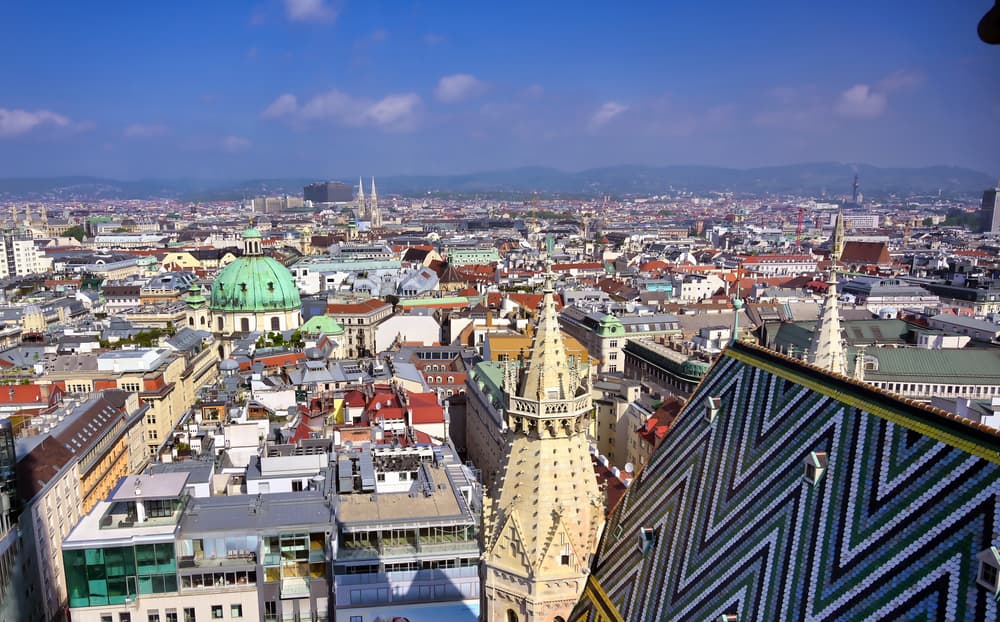
Vienna: a UN capital where you'll ride the tram, not drive
Rent and monthly budgets in dollars, how safe it is, health coverage for newcomers, and whether Vienna works for your retirement.
- 2,028,289
- Population (2025)
- $2,700/mo
- Monthly budget · single
- 53°F / 11°C
- Avg temperature
Plan on about $2,700 a month in U.S. dollars for one person in Vienna, with a realistic range of $2,400 to $3,000 depending on where you live and how often you eat out (2026 figures). Rent is the biggest line: a one-bedroom in the center averages about $1,250 a month.
Vienna suits people who want a full-size European capital they can run on foot and by tram: opera and theater, coffeehouses for long afternoons, and the Danube Island and the Vienna Woods within reach for weekends. It also has a large English-speaking working world, since the United Nations runs one of its four headquarters here.
Here's the catch: Vienna's well-known municipal housing isn't open to you at first. Wiener Wohnen requires at least three years with your main residence in Vienna before you can apply, so plan your first lease, and your budget, around private-market rents.

Reviewed and updated October 9, 2026 · 4 min read
At a glance
$2,700
Monthly budget · single person
$1,250/mo 1-bed rent, center
74/100
Safety index
$35
Internet / month
53°Fannual average
Jan 34° · Jul 71°
Climate
2,028,289
Population (2025)
Expatsi estimates, updated Oct 2026, based on rental listings, government statistics, and local reporting.
Cost of living
What it costs to live in Vienna
Single person
$2,400–$3,000/mo
about 15% below Austin, TX
Couple
$3,300–$4,300/mo
about 15% below Austin, TX
Family of four
$4,900–$6,300/mo
about 30% below Austin, TX
Compared with Austin, TX (Expatsi estimate, 2026).
- $17 −15%
- Inexpensive meal
- $1,100–$1,400/mo −36%
- 1-bed rent, center
- $850–$1,050/mo −30%
- 1-bed rent, outside
- $35/mo −46%
- Internet
- $75/mo +82%
- Transit pass
- $790/sq ft +21%
- Buy price, center
Expatsi estimates, updated Oct 2026, based on rental listings, government statistics, and local reporting.
Daily life
How Vienna lives
- A+ grade, 97th percentile among the cities we track
- Dining & cafésstandout
- A+ grade, 99th percentile among the cities we track
- Arts & culturestandout
- A grade, 91st percentile among the cities we track
- Parks & outdoorsstandout
- A+ grade, 97th percentile among the cities we track
- Schools & educationstandout
- A+ grade, 99th percentile among the cities we track
- Healthcare accessstandout
- A grade, 93rd percentile among the cities we track
- Bike infrastructurestandout
- A+ grade, 96th percentile among the cities we track
- Public transitstandout
- A grade, good physical accessibility
- Accessibilitygood
Graded on OpenStreetMap amenity density relative to the 298 cities we track. Accessibility is the exception: it's graded against a fixed standard (terrain steepness and sidewalk surfaces), not a curve.
Climate
Weather through the year
Annual average 53°F (11°C) · 27 in of rain a year · Source: Meteostat station normals (11035, 1991-2020)
On the ground
Scenes from Vienna
Getting around
Transport in Vienna
You don't need a car to live in Vienna. The U-Bahn, trams, and buses reach every district, and our data puts a typical monthly transit spend at about $75 per person.
If you'll ride most days, buy the Wiener Linien annual pass. It went up in January 2026 from €365, a price that had held since 2012, to €467 a year (€461 for the digital-only version). Riders under 26, and people with disabilities, pay €300. Riding without a ticket gets expensive: the on-the-spot fine is now €135.
The inner districts are compact enough that a lot of errands happen on foot. Where a car helps is weekend trips into the Alps or the countryside, and many residents simply rent one for those days rather than pay to park and insure one all year.
- 85/sq mi
- Transit stops
- 151/sq mi
- Bike infrastructure
- 497/sq mi
- Wheelchair-accessible places
Mapped features per square mile from OpenStreetMap.
Keep exploring
Places like Vienna



Community & practical notes
Settling in: people, healthcare, and access
Who you'll meet
Vienna's international crowd is anchored by the UN. The Vienna International Centre houses 20 UN offices and organizations, and the UN in Vienna employs more than 5,000 people from 125 countries, so English is common at work and in the social circles around it. Day-to-day life outside that world (landlords, district offices, your doctor's front desk) runs in German, and learning it makes a bigger difference here than many newcomers expect.
Health coverage
If you take a job in Vienna, your employer enrolls you in Austria's public insurer, ÖGK, from your first day of work. If you're retired, self-employed through a foreign client, or otherwise not on an Austrian payroll, the usual route is voluntary self-insurance with ÖGK at a flat monthly contribution. Benefits can take up to six months to start unless you can show you had prior coverage, so keep private coverage in place until the public plan kicks in.
Internet
Home internet runs about $35 a month in our data, and the at-a-glance card above has the rest of the day-to-day costs.
LGBTQ expats
Vienna has a long-established queer scene. Vienna Pride has taken over the first district every June since 1996, and the city hosted EuroPride in 2001 and 2019. The Rosa Lila Villa in the 5th district has been an LGBTQ community center since 1982, and much of the nightlife clusters around the Naschmarkt, between the 4th and 6th districts.
Black Americans
Vienna's Black community is organized and easy to find once you know where to look. Black Austria Info keeps a calendar of community events, and February's Black History Month brings programs at the Weltmuseum Wien and the Ebony ball, which celebrates the African diaspora. Local writers are blunt that racism is a structural problem in Austria, so it's worth connecting with community networks early rather than after a bad experience.
Limited mobility
Getting around is one of Vienna's strengths if you use a wheelchair or walk with difficulty. Every U-Bahn station can be reached by elevator or ramp, all bus routes use low-floor buses with folding ramps, and about 90% of tram services run low-floor vehicles. Elevators do go out of service now and then; you can check one before you set out by calling Wiener Linien at +43 1 7909-100.
Retiring in Vienna
Vienna works well for retirees who want culture and transit more than sunshine: winters are gray and near freezing, and summers are warm without being punishing. Austria does have a residence route for people living on their own income, covered on our Austria retirement visa page. Compare it with other countries on our retirement visa hub, and see the full picture of the country on Moving to Austria. Budget for self-insurance from day one, and expect your first home to be a private rental.
Housing
Renting and buying
- 1-bed rent (center)
- $1,100–$1,400/mo
- 1-bed rent (outside center)
- $850–$1,050/mo
- Buy price (center)
- $790/sq ft
- Buy price (outside center)
- $520/sq ft
Expatsi estimates, based on rental listings, government statistics, and local reporting.
Good to know
Frequently asked questions
How much is rent in Vienna?
A one-bedroom apartment in central Vienna typically rents for $1,100 to $1,400 a month in U.S. dollars as of 2026, about $1,250 on average. Outside the center, expect about $850 to $1,050, or around $950 on average. Vienna's subsidized municipal apartments aren't available to newcomers, because Wiener Wohnen requires at least three years of main residence in the city before you can apply.
What is the weather like in Vienna?
Vienna has four distinct seasons. January averages highs near 38F and lows near 30F, while July averages highs near 80F and lows near 62F. Rain and snow add up to about 27 inches a year, spread fairly evenly through the seasons.
Is Vienna safe for Americans?
Yes. Vienna scores 74 on the safety index we use, where higher means safer, and 26 on the matching crime index. Use ordinary big-city care around busy transit hubs and nightlife areas, as you would in any capital.
How much does it cost to live in Vienna?
Most single people spend $2,400 to $3,000 a month in Vienna, in U.S. dollars as of 2026. A couple should plan on about $3,800 a month (roughly $3,300 to $4,300), and a family of four about $5,600 (roughly $4,900 to $6,300). Rent drives most of the difference, so the district you choose matters more than anything else.
Can you live in Vienna without speaking German?
You can get started without it, especially if you work in Vienna's large UN and international community, where English is the working language for many people. Leases, government offices, and most medical front desks operate in German, though, so plan to take lessons in your first year.
Is Vienna a good place to retire?
It can be, if you value culture, transit, and public healthcare over warm weather. Retirees who aren't working in Austria usually join the public insurer, ÖGK, through voluntary self-insurance, and benefits can take up to six months to begin unless you prove prior coverage. Winters are cold and gray, with average January highs near 38F.
Is Vienna LGBTQ-friendly?
Vienna has an established LGBTQ community. Vienna Pride has run every June since 1996, the city hosted EuroPride in 2001 and 2019, and the Rosa Lila Villa has served as a community center since 1982. The bars and cafés concentrate around the Naschmarkt, between the 4th and 6th districts.
Do you need a car in Vienna?
No. Vienna's U-Bahn, trams, and buses cover the whole city. The Wiener Linien annual pass costs €467 a year as of 2026 (€461 digital only), and €300 for riders under 26. Many residents rent a car only for weekend trips out of the city.
See how Vienna fits your life
Take the free Expatsi Test and compare Austria to over 100 countries on what actually matters: cost, healthcare, climate, and safety. About five minutes.
Why not you?