Country guide
So you want to move to Austria
Austria scores skilled workers on a points sheet, and native English counts on it. Here is the 2026 guide: real costs in dollars, the permit that fits, and where Americans end up.
Austria is one of the few countries in Europe that counts your English as a language skill instead of asking you to learn German first. It also runs some seriously literal paperwork. Here's what a month really costs, which permit fits your situation, and the parts nobody warns you about.

Reviewed and updated September 15, 2026 · 11 min read

01 · The case for Austria
Why Austria, and who it actually fits

Austria is a country of about 9 million people wedged between Germany, Italy and Hungary. It runs on the things Americans say they want and rarely get: trains that show up; doctors you can afford without checking a network; a capital where you can live well without owning a car. Vienna placed second in the Economist Intelligence Unit's 2026 liveability ranking, behind Copenhagen. Safety scores 74 out of 100, internet averages 110 Mbps, and a comfortable monthly budget for one person runs about $2,350.
The part that matters most here is the labor market. Austria decides who gets in with a points sheet, and one of the boxes on that sheet is language. Native English counts, with no test. The government's own worked example awards a Canadian applicant the full 10 language points on the strength of English being his first language. That's the reverse of how Australia and Canada treat a U.S. passport, where being a native speaker earns you nothing extra.
Here's the catch
Austria isn't an easy place to land in. German runs everything outside a handful of international offices, and skilled roles are competitive for locals, too. Vienna's cheap apartments are reserved for people who have already lived there for years, so your first lease will be at private market prices. Bureaucracy is slow and literal; the immigration desk in Vienna has a reputation for blowing past its own legal deadlines. If you ever want an Austrian passport, you generally have to give up the American one. Austria doesn't allow dual citizenship for people who naturalize, outside of rare exceptions.
So Austria fits you if you have a trade or a degree in something the country is short of, you like cities and mountains more than coastline, and you're willing to treat learning German as a multi-year project. It fits badly if you want to arrive first and find the job later, or if you need a large American community around you. The U.S. community here is small.
- Cost of living (single)
- $2,350/mo
- Safety index
- 74/100
- Internet speed
- 110 Mbps
- English proficiency
- 65/100
- Capital
- Vienna
- Population
- 9 million
02 · The numbers
What a month in Austria costs
$2,350
Monthly budget, single
all in, comfortable
$3,850
Monthly budget, couple
$6,350 for a family of four
$1,050
One bedroom, city center
$850 further out
$542
Vienna's annual transit pass
467 euros, up from 365
The money, in dollars
Austria's not cheap, but it is cheaper than the coastal American cities a lot of our readers are leaving. The things that wreck a U.S. household budget are already paid for, too. Healthcare comes out of your paycheck. Public university costs a few hundred euros per semester. Childcare is heavily subsidized. The budgets above are all-in figures that hold up better in Graz or Linz than central Vienna.
What things actually cost
A one bedroom in the middle of a city runs about $1,050 a month, and about $850 further out. A cheap restaurant meal is around $18, home internet about $40, and a monthly transit pass about $60. If you commute across state lines, the national KlimaTicket covers nearly every train, tram and bus in the country for 1,400 euros a year, or roughly $1,625. Vienna's own annual pass is 467 euros, about $542. That figure matters, because half the guides online still quote Vienna's famous 365 euro ticket. The price was frozen from 2012 through the end of 2025. It's gone.
The Vienna rent trap
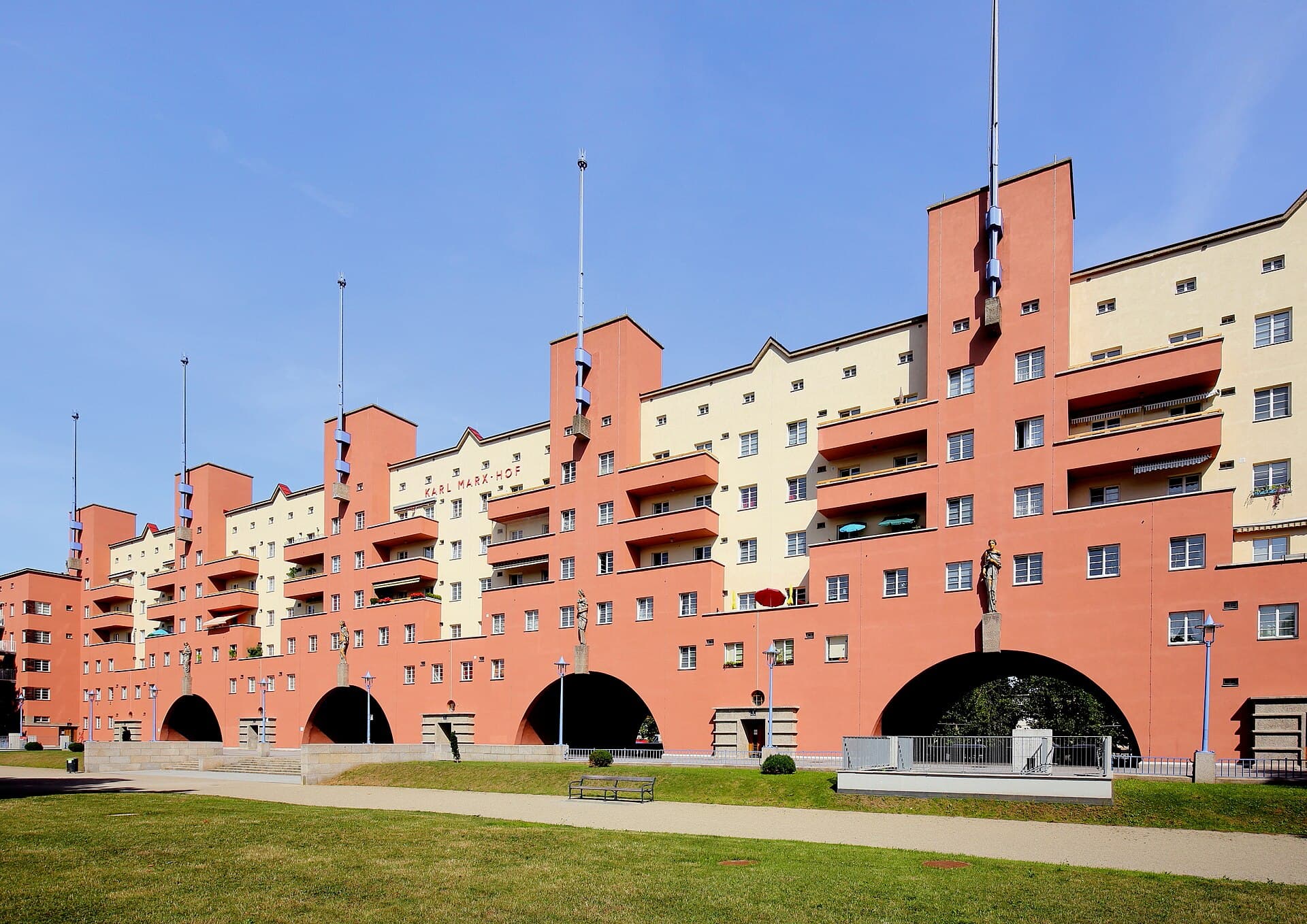
Here is the thing nobody tells Americans. Vienna's rents are low because the city owns about 220,000 apartments and subsidized roughly 200,000 more. Something close to 60 percent of Viennese live inside that system. That pink kilometer of apartments pictured here is the Karl-Marx-Hof, opened in 1930 and still full of tenants. You can't join the system when you arrive. To apply for a Wiener Wohn-Ticket, you need two years of continuous main residence in Vienna, plus either an EU passport or Austria's long-term "Daueraufenthalt-EU" status, which itself takes five years and B1 German to earn. A skilled worker arriving on a Red-White-Red Card has neither. You'll rent privately, at private prices, for years. Budget for that and you'll find Vienna is still good value. Assume you get the subsidized rent on day one and be unpleasantly surprised.
Why an Austrian salary goes further than it looks
Austrian salaries are paid 14 times a year, not 12. A 13th payment lands in the summer and a 14th in November, and both are taxed at a flat 6 percent rather than your marginal rate. Divide any advertised annual salary by 14 to get the real monthly figure, then remember that two of those months arrive almost untaxed. It's worth knowing this math before you read your first Austrian job ad.
03 · Who Austria is hiring
The jobs that get you in

Austria publishes a list every year of the jobs it can't fill; that list is the fastest way in. The rule behind it is mechanical. If fewer than 1.5 job seekers were available for every vacancy reported to the labor office over a year, the occupation goes on the list. For 2026 there are 64 shortage occupations nationwide plus another 66 that apply only in certain states. Get hired into one of them and skip the labor market test entirely because the shortage is already proven.
The shortage list resets every January
This is the trap. The list is reissued each year as the Fachkraefteverordnung; an occupation on the 2026 list isn't guaranteed a place on the 2027 one. Check the current list before you start applying, not after. The 2026 nationwide version runs across nursing and physiotherapy, software development and data science, engineering technicians in power, mechanical and civil work, electricians, welders, roofers, carpenters, train drivers and early childhood educators.
English-language work does exist
Vienna is one of the four headquarters of the United Nations, alongside New York, Geneva and Nairobi. Around 5,000 UN staff from more than 150 countries work at the Vienna International Centre, and the IAEA, OPEC, the OSCE and UNIDO all sit in the city. Austria's foreign ministry counts more than 50 international organizations in the country, supporting roughly 20,000 jobs. Those roles run in English. Outside that cluster, English-first work concentrates in tech, consulting and research. Working German opens far more doors than it closes.
What you will be paid
Median full-time pay is roughly 3,540 euros gross a month, about $4,105, which lands near 49,600 euros a year once you count Austria's 14 payments. Published figures move around depending on whether apprentices and part-timers are included, so treat that as a range instead of a promise. Senior software and engineering salaries in Vienna sit well above it.
On Austria's 2026 shortage list
Nursing and therapy
Graduate nurses and physiotherapists, both on the 2026 national list.
Software and data
Programmers, software developers and data scientists.
Engineering technicians
Power, mechanical and civil engineering technicians.
Building trades
Electricians, welders, roofers and carpenters with completed training.
Early childhood education
Elementary educators, added for 2026.
Train drivers
Rail operations, one of the newer entries on the national list.
04 · The visa paths
Five routes in, and how to tell which is yours

Austria doesn't have just one work visa. It has a family of residence titles; which one you apply for depends on your qualification, salary and whether you already hold an offer. Americans can file either at an Austrian consulate before flying or at the residence authority inside Austria during a visa-free stay.
The Red-White-Red Card
The main skilled worker route, in three versions. Very Highly Qualified Workers need 70 of 100 points and no job offer to begin. Skilled Workers in Shortage Occupations need 55 of 90 points plus completed training that matches the shortage occupation, and face no labor market test. Other Key Workers need 55 of 90 points, a job offer, and gross salary of at least 3,465 euros a month in 2026, about $4,020. Their employer must clear a labor market test. Points come from qualifications, experience, language and age. The card runs 24 months and ties you to one named employer. After 21 qualifying months you can move up to the Red-White-Red Card plus, which drops the employer tie. Full detail on our Red-White-Red Card guide.
The EU Blue Card
The parallel route for degree holders. No points sheet, but a real salary floor: 55,678 euros gross a year in 2026, about $64,600, counted across all 14 payments. It brings mobility to other EU countries after a year. One wrinkle worth knowing is that Red-White-Red Card holders are treated by law as having met the A2 German requirement of the integration agreement, but Blue Card holders are not.
The Job Seeker Visa
A six-month national visa for people who score 70 points on the Very Highly Qualified grid. You may not work on or extend it. Americans usually don't need it because a U.S. passport buys 90 visa-free days in the Schengen area and you can file the Red-White-Red Card application from inside Austria during that window. It's still useful for one reason: the labor office scores your points before you get on a plane. See our Job Seeker Visa guide.
Studying, or not working at all
Students get a renewable permit tied to their enrollment. Retirees and the financially independent use a settlement permit that excludes gainful employment. It's a hard one to land, because each state gets a fixed number of them per year and the income floor is higher than what a couple actually spends here. We break that down on the Austria retirement visa page. Artists have a settlement permit of their own.
Comparing Austria against the rest of Europe? Our work visa hub lines the skilled worker routes up country by country.
Austria's residence permits side by side
| Visa | Category | Application cost | Processing | Difficulty | Guide |
|---|---|---|---|---|---|
| Artist Visa | self employment | $150 | ~90 days | 5/5 | Guide |
| EU Blue Card | skilled work | $160 | ~90 days | 4/5 | Guide |
| Highly Qualified Worker Visa | skilled work | $160 | ~90 days | 4/5 | Guide |
| Job Seeker Visa | jobseeker | $120 | ~90 days | 3/5 | Guide |
| Retirement Visa | retirement | $150 | ~90 days | 5/5 | Guide |
| Student Visa | student | $120 | ~90 days | 3/5 | Guide |
05 · The practical stuff
Your first ninety days

Register within three days
Austria's registration law gives you three days from moving into a place to file a Meldezettel at the local registration office. It's free, and your landlord or main tenant has to sign the form, which means you can't register from a hotel or short-term rental. Everything else waits on it: the bank account, social insurance number, tax account, health card.
Healthcare
Statutory insurance is automatic once you're employed. The total contribution in 2026 is 7.65 percent of gross pay, split roughly evenly between you and your employer, and it comes straight off the payslip. Your e-card arrives by mail at your registered address and can take a few weeks. If you're not employed or covered through a family member, you can insure yourself voluntarily through the public fund for 565.25 euros a month, about $656. Family members without their own income are usually covered at no extra premium.
Taxes
Income tax is progressive. The first 13,539 euros a year, about $15,700, is taxed at zero, then bands of 20, 30, 40, 48, 50 and 55 percent. Employee social security runs around 18 percent of regular pay. There's no special expat tax regime here, unlike Spain or France; as a U.S. citizen, you'll keep filing a U.S. return wherever you live. MyExpatTaxes, one of the partners below, was founded in Vienna for exactly that problem. Lean on them to help you unravel your tax responsibilities.
Your driver's license
A U.S. license stays valid for six months after you register your residence. After that it stops working and you have to convert it. The good news is that Austria exempts American license holders from the practical driving test for category B, which covers ordinary cars. You still need a medical certificate from an approved doctor. Do not let the six months lapse.
German
You don't need German for a Red-White-Red Card: cardholders are deemed to have met the A2 requirement already. You do need B1 German for long-term EU residence at the five-year mark, and B2 or proven integration if you ever want to shorten the ten-year wait for citizenship.
This guide is dated on purpose
Every euro figure here is a 2026 number, converted at about $1.16 to the euro in September 2026. Austria resets its salary floors, income thresholds and shortage occupation list every January, so a 2026 rule is not a 2027 rule. The table above pulls requirements straight from our database, and two rows are behind: the EU Blue Card row still quotes 51,500 euros from 2025 when the 2026 floor is 55,678 euros, and the retirement row quotes about 2,000 euros a month when the 2026 floor is 2,616.78 euros for a single person. We've asked for both to be fixed. Check the government page on the day you apply.
07 · Help
The people who make it easier
Austrian paperwork rewards people who've already done it once. These are partners we work with, grouped by the problem they solve. We name them because the same four questions come up on every Austria call we take: who files the residence application, who fixes the U.S. tax return once you have Austrian income, what happens to your dollars on the way into a euro account, and how you get from no German to B1.

MyExpatTaxes
U.S. Expat Tax Service
A U.S. expat tax service founded in Vienna. Once you have Austrian income you are filing in two countries, and the lightly taxed 13th and 14th salary payments are exactly the kind of thing U.S. tax software handles badly.
Learn more
Moneycorp
Currency Exchange
Currency transfer for people moving dollars into a euro account. Worth a look when you're funding a deposit or first year of rent and the exchange rate is doing real damage.
Learn more
ExpatInsure
Global Health Insurance
Global health insurance for the gap before Austrian statutory coverage kicks in, and for anyone arriving without the employment contract that triggers it automatically.
Learn more
Lingoda
Language Learning
German classes online. You can get a Red-White-Red Card without a word of German, but B1 is the gate on permanent residence at five years, so it's worth starting in year one.
Learn moreQuestions Americans ask about Austria
How long does it take to get permanent residency in Austria?
Five years of continuous settled residence plus Module 2 of the integration agreement, which is B1 German. That earns the long-term residence title Austria calls Daueraufenthalt-EU. It is also what opens Vienna's subsidized housing system to a non-EU citizen.
How long can Americans stay in Austria without a visa?
Ninety days in any 180-day period across the Schengen area. During that stay you can look for work and, if you land a qualifying role, file your Red-White-Red Card application inside Austria rather than flying home to do it.
Do I need to speak German to work in Austria?
Not to get a Red-White-Red Card. Native English actually earns you language points on the application, and card holders are treated by law as having met the A2 German requirement. You do need B1 German for permanent residence at five years, and daily life outside the international offices runs in German.
Is Vienna expensive?
Vienna costs more than the rest of Austria, and still less than many Western European capitals, with rents around 1,000 to 1,800 euros a month. The catch is that the subsidized apartments everyone writes about need two years of Vienna residence plus an EU passport or long-term residence status, so newcomers rent on the private market.
How much money do you need to live in Austria?
Budget about $2,350 a month for one person and $3,850 for a couple, all in. A one bedroom in a city center runs about $1,050 and about $850 further out. Graz and Linz come in below those numbers. Central Vienna comes in above them.
Is healthcare free in Austria?
It is not free, but it is automatic and cheap next to American premiums. Statutory insurance costs 7.65 percent of gross pay in 2026, split roughly evenly between you and your employer, and it is deducted from your paycheck. Family members without their own income are usually covered at no extra premium.
Can I keep my US citizenship if I become Austrian?
Generally no. Austria requires people who naturalize to give up their previous citizenship, with an assurance issued first and renunciation within two years. Exceptions are rare. Naturalization normally takes ten years of residence, or six with B2 German or proven integration.
Can Americans move to Austria without a job offer?
Only on one route. If you score 70 of 100 points on Austria's Very Highly Qualified Workers grid you can start without an offer and get a six-month job seeker visa. Everyone else needs the offer first. A US passport also buys 90 visa-free days in the Schengen area, and you are allowed to job hunt during them.
Sources
- Red-White-Red Card: categories, points and 2026 salary thresholds · Austrian Federal Ministry of the Interior (checked September 14, 2026)
- News on the Red-White-Red Card: shortage occupations in 2026 · Work in Austria, Austrian Business Agency (checked September 14, 2026)
- EU Blue Card residence title · Work in Austria, Austrian Business Agency (checked September 14, 2026)
- Flat types: privately owned, subsidised and city-owned flats · City of Vienna (checked September 14, 2026)
- Wiener Wohn-Ticket: flat allocation criteria and 2026 income limits · Social Housing in Vienna (checked September 14, 2026)
- Foreign driving licences: conversion · oesterreich.gv.at (checked September 14, 2026)
- Health insurance in Austria: contributions and self-insurance rates · Work in Austria, Austrian Business Agency (checked September 14, 2026)
- KlimaTicket Oe 2026 prices · KlimaTicket Oe (checked September 14, 2026)
- The UN family in Vienna · United Nations Information Service Vienna (checked September 14, 2026)

Still deciding between Austria and somewhere else?
Talk to our expat advisor and find your personal visa path.
Why not you?