Austria's EU Blue Card: The Salary Is the Test
Clear about $64,400 a year, which Austria writes into law as 55,678 euros for 2026, and a three-year degree turns a job offer into a two-year residence card.
There's no points grid here. Austria pegs this card to a single number, the average full-time wage, and asks one question first: does your job offer clear it? The good news is that an average isn't a fortune. The harder question comes second. Could someone already in Austria do your job?

EU Blue Card
For highly qualified non-EU professionals with a university degree and a high-paying job offer in Austria. Facilitates mobility within the EU.
- Government cost
- $160
- Processing time
- ~90 days
- Timeline
- Up to 24 months (renewable)
- Difficulty
- Hard
Key requirements
- University degree or equivalent
- Binding job offer in Austria with minimum annual salary (€51,500 in 2025)
- Employment corresponds to qualifications
- Health insurance
- Adequate accommodation
About that data card
Three lines above need a footnote, and we've asked for the fixes. The salary shown is the 2025 rule. For 2026 Austria wants 55,678 euros a year, about $64,400, counted across 14 paychecks. The fee is 218 euros, roughly $250, not the $160 on the card, though the EU's own immigration portal still lists the old one. And the accommodation line doesn't apply: Austria issues this card without asking you to prove housing or means of subsistence.
Who qualifies
A degree, or three years of writing code

The qualification
Austria asks for a completed course of study of at least three years at a university or comparable institution. A four-year American bachelor's degree clears that. Formal recognition of the credential is only required for regulated professions, which means healthcare, teaching and law.
The exception worth reading twice
Austria's guidance lets people in information and communications technology, and service managers, swap the degree for three years of relevant professional experience, as long as it's comparable to a three-year degree and was earned in the seven years before you apply. A self-taught developer with a solid resume can qualify with no diploma at all.
The part nobody mentions
AMS, Austria's public employment service, runs a labor market test on your offer. It checks whether an equally qualified jobseeker already registered in Austria could fill the role. Shortage-occupation applicants on the Red-White-Red Card skip that step. Blue Card applicants do not.
The EU Blue Card by the numbers
$64,400
Minimum salary for 2026
55,678 euros gross, across 14 paychecks
24 months
How long the first card runs
or your contract plus three months
8 weeks
The legal deadline for a decision
Vienna's MA 35 books appointments weeks ahead
21 of 24
Months worked before the employer tie ends
then you move up to the Red-White-Red Card plus
The money
Divide by 14, not by 12
Divide the salary floor by 12 and you get the wrong answer. Austria pays 14 salaries a year: 12 monthly, plus a 13th before the summer and a 14th in November. So the 2026 floor is about $4,600 a month, which Austria counts as 3,977 euros, and not the 4,640 euros that dividing by 12 suggests. Both extra paychecks are taxed at a flat 6 percent rather than your marginal rate.
Why the bar dropped
Austria used to ask for one and a half times the average wage. Under the revised EU rules it asks for the average itself, which took tens of thousands of euros off the threshold and put it in reach of ordinary senior salaries. The figure resets every January, so check the year you apply in.
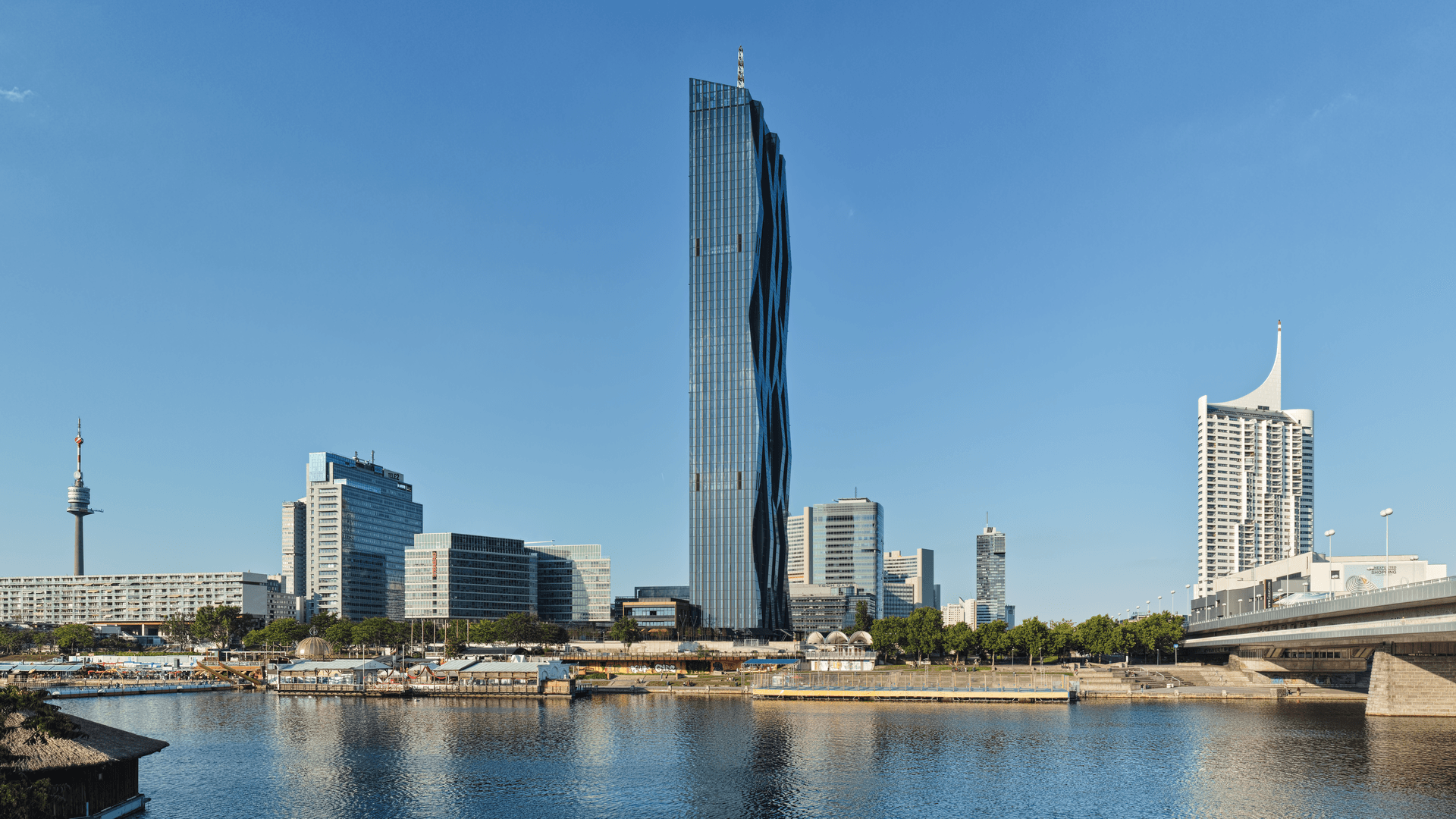
The towers in the photo are Donau City, Vienna's office cluster across the Danube, with the United Nations complex next door.
Your diploma may settle the German requirement
Red-White-Red Card holders are treated by law as having met Austria's A2 German rule. Blue Card holders are not, and get two years from the first card to clear Module 1 of the Integration Agreement. The workaround comes from the authorities themselves: a school certificate admitting you to an Austrian university also counts, and Work in Austria, the government's business agency, says Blue Card holders normally file their own university diploma for it. Budget for an apostille.
Here's the catch
The card has your employer's name on it

Switching jobs
You get fixed-term settlement and work for one specific company. Change employers inside the first year and you file a fresh Blue Card application, then wait 30 days before you can provisionally start the new role. Once you've worked 12 months in Austria on a Blue Card, you can start the new job the day you file, and the labor market test is dropped entirely. Red-White-Red Card holders wait 45 days, so don't copy their number.
Losing the job got less frightening in August 2026
Austria amended its residence law on August 7, 2026. Report the end of your employment without unnecessary delay and the authority generally cannot withdraw your permit for six months, and EU Blue Cards are named in the provision, with three extra months if your employer's conditions were particularly exploitative. What it doesn't do is move the expiry date printed on your card. Check that date the day you're let go.
What the card actually gets you
Public healthcare
You and your family join Austria's public system through the job, with contributions taken from your pay.
A spouse who can work
Family get the Red-White-Red Card plus and free labor market access. A first family application asks for A1 German.
A door into the rest of the EU
After 12 months in Austria you can move to another member state on the card, with no second labor market test.
A residency clock that travels
Blue Card time in different EU countries can be added together toward long-term EU residence at five years.
Schengen travel
The card is your ID and lets you move through the Schengen area without a separate visa.
A side business, within limits
Self-employment on top of the job is allowed as long as it stays secondary to your main employment.
Plan B
Blue Card or Red-White-Red Card?
Austria runs two permits that do a similar job, and your offer letter decides which one you want.
If your salary clears 55,678 euros and you have the degree or the tech experience, the Blue Card is the cleaner option. It moves with you inside the EU, and the job switch gets easy after a year. If the pay falls short, the Red-White-Red Card scores you on points instead: qualifications, experience, age and language, with no salary floor on two of its three tracks and no labor market test in a shortage occupation.
No offer yet? The job seeker visa buys six months to look, though Americans can also hunt on their 90 visa-free days and file inside Austria. Weighing other countries too? Our work visa hub lines the salary floors up side by side.
People who do this for a living

Executive Relocation Austria
Austria Visa and Relocation
An Austria-based specialist for the filing itself and the landing that follows it, from the residence authority appointment to registering your address.
MyExpatTaxes
U.S. Expat Tax Service
A U.S. expat tax service for the return you still owe the IRS each year once your salary is Austrian and your tax is already withheld in Vienna.
Other ways into Austria
Artist Visa
- Valid passport
- Proof of artistic activity and recognition
- Sufficient income from artistic work
Highly Qualified Worker Visa
- Job offer from Austrian employer
- Meet points-based criteria (qualifications, experience, language, age)
- Proof of adequate means of subsistence
Job Seeker Visa
- Proof of qualifications
- Proof of sufficient funds
- Health insurance
Retirement Visa
- Valid passport
- Proof of sufficient retirement income (approx. €2,000/month)
- Comprehensive health insurance
Student Visa
- Letter of acceptance from Austrian educational institution
- Proof of sufficient funds
- Health insurance
Questions Americans actually ask
Do I need to speak German to get an Austrian Blue Card?
Not to be granted the card. Within two years of the first card you do have to satisfy Module 1 of the Integration Agreement, which is A2 German. Red-White-Red Card holders are exempt by law and Blue Card holders are not, but a university entrance qualification can usually be filed instead of a language exam.
Do I need a university degree for the EU Blue Card?
Usually yes, a completed course of study of at least three years. There is one exception: people in information and communications technology and service managers can substitute three years of relevant professional experience earned in the seven years before applying.
How much do you have to earn for an Austrian EU Blue Card in 2026?
About $64,400 gross a year, which Austria sets in law at 55,678 euros for 2026. It counts salary plus the special payments, so across the country's 14 paychecks that is roughly 3,977 euros a month, about $4,600. It resets every January.
What happens to my Blue Card if I lose my job?
Report the end of the employment to the residence authority without delay. Since August 2026 the authority generally cannot withdraw the permit for six months from the start of unemployment, with three more months if the employer's conditions were exploitative. The expiry date printed on your card does not move.
Can I apply for the Blue Card while I'm already in Austria?
Yes. Your employer can file with the residence authority in Austria, or you can file yourself once you've entered legally and are still within a lawful stay. Americans get 90 visa-free days in the Schengen area, enough room to interview, sign and apply.
How long does an Austrian EU Blue Card take?
Austrian law sets a maximum of eight weeks for a Blue Card decision, and the 2026 reform kept that shorter deadline in place. The 90 days quoted in a lot of guides is the new general maximum for other residence titles. In practice a complete file often lands in four to eight weeks, and appointments at Vienna's MA 35 book out weeks ahead.
Does the Blue Card lead to permanent residence or citizenship?
Work 21 of 24 months on the card and you can apply for the Red-White-Red Card plus, which drops the employer tie. Permanent residence comes at five years plus B1 German. Citizenship generally takes 10 years, and Austria expects you to give up your American passport.
Can my spouse work in Austria on my Blue Card?
Yes. Your spouse and minor children get the Red-White-Red Card plus, which carries free labor market access with no separate work permit. A first family application normally asks for A1 German, and the card runs as long as yours.

Not sure Austria is the right bet?
The Expatsi Test matches what you want out of life abroad against the countries that will have you.