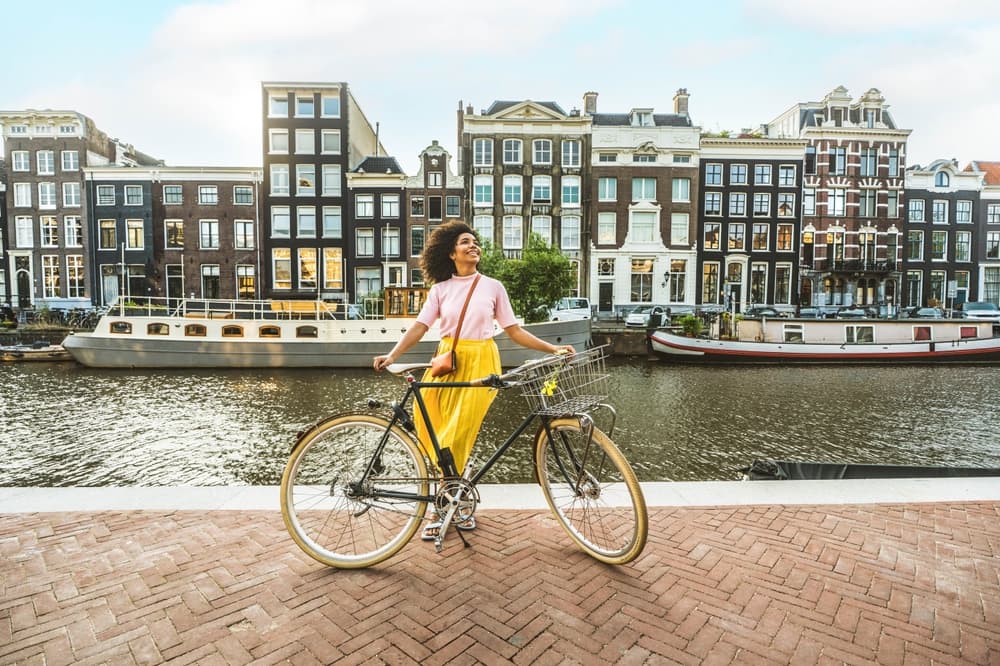
Amsterdam: a world city built for bikes, not cars
English works nearly everywhere, the trams and trains actually run on time, and the hardest part of moving here is finding an apartment.
- 921,468
- Population (2023)
- $4,100/mo
- Monthly budget · single
- 51°F / 10°C
- Avg temperature
Plan on about $4,100 a month in U.S. dollars for one person in Amsterdam, with a couple spending around $5,700 and a family roughly $8,200. Rent is the biggest line item: a one-bedroom averages about $2,400 in the center and about $1,900 outside it. You'll compete for it either way, because the housing shortage here is real and landlords can be picky.
Amsterdam suits people who want a genuinely international city at a human scale. Nearly everyone speaks fluent English, the tech and finance job markets hire foreigners routinely, and the whole place is built for bikes rather than cars. It's a city of about 920,000 that feels smaller, with canals, brick row houses, and neighborhoods like De Pijp, Oud-West, and Jordaan where daily life happens at street level.
The honest drawback is the apartment hunt. Listings go in days, many require proof of income at three to four times the rent, and plenty of newcomers spend their first months in a temporary sublet while they search. Budget time and patience for it before anything else.
At a glance
$4,100
Monthly budget · single person
$2,400/mo 1-bed rent, center
71/100
Safety index
$50
Internet / month
51°Fannual average
Jan 39° · Aug 64°
Climate
921,468
Population (2023)
Expatsi estimates, updated Aug 2026, based on rental listings, government statistics, and local reporting.
Cost of living
What it costs to live in Amsterdam
Single person
$3,600–$4,600/mo
about 30% above Austin, TX
Couple
$5,000–$6,400/mo
about 25% above Austin, TX
Family of four
$7,200–$9,200/mo
about the same as Austin, TX
Compared with Austin, TX (Expatsi estimate, 2026).
- $22 +10%
- Inexpensive meal
- $2,100–$2,700/mo +23%
- 1-bed rent, center
- $1,650–$2,150/mo +41%
- 1-bed rent, outside
- $50/mo −23%
- Internet
- $115/mo +179%
- Transit pass
- $952/sq ft +46%
- Buy price, center
Expatsi estimates, updated Aug 2026, based on rental listings, government statistics, and local reporting.
Daily life
How Amsterdam lives
- A+ grade, 95th percentile among the cities we track
- Dining & cafésstandout
- A+ grade, 97th percentile among the cities we track
- Arts & culturestandout
- B+ grade, 57th percentile among the cities we track
- Parks & outdoorsstrong
- A- grade, 74th percentile among the cities we track
- Schools & educationstrong
- B+ grade, 60th percentile among the cities we track
- Healthcare accessstrong
- A+ grade, 98th percentile among the cities we track
- Bike infrastructurestandout
- A- grade, 72nd percentile among the cities we track
- Public transitstrong
- A grade, good physical accessibility
- Accessibilitygood
Graded on OpenStreetMap amenity density relative to the 298 cities we track. Accessibility is the exception: it's graded against a fixed standard (terrain steepness and sidewalk surfaces), not a curve.
Climate
Weather through the year
Annual average 51°F (10°C) · 31 in of rain a year · Source: Open-Meteo Historical Weather API (temps: ERA5-Land 0.1°; precip/sunshine: ERA5 best-match; 1991-2020 normals)
On the ground
Scenes from Amsterdam
Getting around
Transport in Amsterdam
The bicycle is the default. Separated lanes, dedicated signals, and multi-story bike garages at the stations make cycling the obvious way across town. Most residents, expats included, do most trips by bike within a few months of arriving, in any weather.
For everything else there's GVB, the municipal operator running trams, buses, metro, and the free ferries across the IJ to Amsterdam-Noord. The North-South metro line (Line 52) crosses the city quickly while trams cover the center densely. You tap in and out with a contactless bank card or phone, and the same tap works on trains nationwide; the old OV-chipkaart is being retired by the end of 2027. Expect transit to run about $115 a month if you use it daily.
NS trains from Centraal and Zuid reach Utrecht, Rotterdam, and The Hague in well under an hour, and Schiphol is 15 minutes by rail. The center is compact and walkable, though you'll learn fast to stay out of the bike lanes.
A car makes little sense inside the ring. Parking permits carry multi-year waiting lists centrally, street parking is expensive, and the city keeps converting car space to bikes and pedestrians. Families wanting one for weekend trips usually live outside the ring or use a share service like Greenwheels.
- 48/sq mi
- Transit stops
- 217/sq mi
- Bike infrastructure
- 245/sq mi
- Wheelchair-accessible places
Mapped features per square mile from OpenStreetMap.
Keep exploring
Places like Amsterdam
Community
Community & practical notes
Community: Amsterdam has one of Europe's most established international populations: large American, British, Indian, and German communities alongside long-standing Surinamese, Turkish, and Moroccan ones. English is the working language at many companies, while InterNations chapters and American Book Center events make the first year less lonely than most European capitals. On the flip side, some expats never learn Dutch and find local friendships slow to form.
Healthcare: The Netherlands runs on mandatory private insurance. Within four months of becoming a resident you buy a basic policy (basisverzekering); no insurer may turn you down over your health history. Visits to your own GP cost nothing; the annual 385 euro deductible applies to most other care. The friction is registering with a huisarts, since many Amsterdam practices have closed their lists and the GP gatekeeps every specialist referral. If nobody will take you, your insurer's care mediation desk is legally required to find you a place.
Limited mobility: The ground is genuinely flat, but the historic center still fights you: cobbles, narrow cambered sidewalks, stepped canal bridges, and old houses with famously steep stairs. Transit is the stronger half of the story. Every metro station is marked accessible with lifts, newer trams have level entry and conductors who deploy a ramp, buses are low-floor, and the IJ ferries board over wide ramps. The gap between vehicle and platform varies enough to plan around, and the GVB app's accessible planning setting flags which stops work and which lifts are out. Noord and the newer districts are much easier than the canal belt.
Remote work: Home internet costs about $50 a month for fast fiber, and coverage is excellent citywide. Coworking is abundant, from TQ and B. Amsterdam to neighborhood spaces in every district. Tech (Booking.com, Adyen, Uber's international headquarters) and fintech hire English speakers regularly. The expat tax break long known as the 30% ruling still applies to many qualifying hires, though it drops to 27% in January 2027.
Retirement: The Netherlands has no retirement visa, and that shapes everything. Americans can stay 90 days visa-free, but longer means a permit tied to work, study, family, or the Dutch American Friendship Treaty (DAFT), which grants residency for running a small business with a roughly 4,500 euro investment. Some retirees run a modest freelance practice under DAFT, but pure passive-income retirement isn't a recognized route. Compare countries that do under retirement visa options, and see the full picture in our Netherlands guide.
Housing
Renting and buying
- 1-bed rent (center)
- $2,100–$2,700/mo
- 1-bed rent (outside center)
- $1,650–$2,150/mo
- Buy price (center)
- $952/sq ft
- Buy price (outside center)
- $646/sq ft
Expatsi estimates, based on rental listings, government statistics, and local reporting.
Good to know
Frequently asked questions
Do I need a car in Amsterdam?
No, and most residents don't want one. The city is built around bicycles, GVB trams, buses, metro, and ferries cover the rest for about $115 a month, and national trains reach the whole country quickly. Central parking permits have long waiting lists, so car owners generally live outside the ring.
How much does it cost to live in Amsterdam?
Living in Amsterdam costs roughly $4,100 a month for a single person, $5,700 for a couple, and $8,200 for a family, in U.S. dollars. A central one-bedroom runs around $2,400, or $1,900 further out. Figure $22 for a casual restaurant meal.
What is the weather like in Amsterdam?
Mild, damp, and gray more often than sunny. The annual average is about 51F (10.4C), with roughly 31 inches (794 mm) of rain. Summers are cool, with average highs near 69F in July and August. January days average about 42F and nights about 35F, so expect wind and drizzle rather than deep snow. Rain actually peaks in summer; December is the darkest month.
Can I retire in Amsterdam?
The Netherlands has no retirement or passive-income visa, so there's no direct path for retirees. Some Americans use the DAFT treaty to run a small freelance business into their retirement years, but that requires genuine business activity. If a straightforward retirement visa matters to you, other European countries are a better fit.
How does healthcare work for expats in Amsterdam?
Every resident must buy basic Dutch health insurance, which averaged about 157 euros monthly per adult in 2026, and no insurer can reject you. You then sign up with a neighborhood GP, who handles routine care and controls specialist referrals. Landing one is the main hassle for newcomers, because many Amsterdam practices are full.
How do Americans move to Amsterdam?
The common routes are a skilled-work visa through a Dutch employer (many sponsor, and the expat tax ruling sweetens offers), a student visa, family reunification, or the Dutch American Friendship Treaty (DAFT), which lets Americans get residency by starting a small business with about 4,500 euros in capital. There's no move-first, figure-it-out-later option beyond the 90-day visa-free window.
Is Amsterdam safe?
Yes, by American big-city standards. Amsterdam scores 71 on the safety index with a crime index of 29, and violent crime is rare. The main risks are bike theft, which is close to a rite of passage, and pickpocketing in the tourist core.
Is it hard to find an apartment in Amsterdam?
It's the hardest part of moving here. Demand far outstrips supply, listings can go within days, and landlords commonly ask for income of three to four times the rent. Expect to pay about $2,400 a month for a central one-bedroom, and consider a temporary furnished rental while you search.
See how Amsterdam fits your life
Take the free Expatsi Test and compare Netherlands to nearly 200 countries on what actually matters: cost, healthcare, climate, and safety. About five minutes.
Why not you?