Luxembourg guide for Americans
Moving to Luxembourg: the 2026 guide for Americans
A wealthy, multilingual country where nearly half the residents hold a foreign passport and buses, trams and trains cost nothing. Here's who can get residency, what it costs, and what changes on October 1, 2026.
Luxembourg works best for people arriving with a job offer, a business plan or serious capital. It's a hard fit for retirees on U.S. income, and we'll show you exactly why.

Reviewed and updated October 22, 2026 · 13 min read

01 · The case for Luxembourg
A small, rich country that runs on newcomers

Luxembourg had 690,959 residents on January 1, 2026; 46.6% of them aren't Luxembourg citizens. The national statistics office counts about 180 nationalities, with the Portuguese alone making up 12.8% of the population. That shapes daily life more than any ranking does. Your coworkers, your neighbors and your kids' classmates come from all over, and a new arrival isn't a novelty.
The pull is practical. Pay is high: from June 2026, the minimum wage for a qualified worker is about $3,790 a month gross (€3,325.59). Buses, trams and second-class trains have been free across the whole country since March 2020, so a car is optional for a lot of daily life. Our data scores Luxembourg 80 out of 100 on safety, and home internet runs around 120 Mbps. It borders France, Belgium and Germany, so a weekend in another country is just a short trip away.
Language is less of a wall than people expect. English is the second most-used language at work, after French. Outside the office it's a different story: nearly half of job postings in 2019 asked for all three of Luxembourgish, French and German. You can work in English. Settling in fully takes more.
Here's the catch
Luxembourg is a great place to land with a paycheck and a tough one to land without. Three things rule it out for a lot of Americans.
First, there's no retirement visa or digital nomad visa. The permit that financially independent people used to rely on changed in May 2023. It now accepts a pension only if it's paid by a social security institution in Luxembourg or another EU or Schengen country. U.S. Social Security, a 401(k) or savings don't get you in on their own.
Second, housing is expensive. A one-bedroom in the center runs about $2,000 a month in our data, and advertised rents rose 4.4% in the year to the first quarter of 2026.
Third, getting in takes a real reason to be there. Most ordinary jobs must be offered to candidates registered with the national employment agency for three weeks before an employer can hire from outside the EU. The investor route starts at about $570,000 (€500,000) in a business.
Two smaller things: the entry rules change on October 1, 2026, and there's no nonstop flight to the U.S. until April 2027. If you're still reading, you're probably moving for a job, a company or a school, and Luxembourg rewards that.
- Cost of living (single)
- $3,250/mo
- Safety index
- 80/100
- English proficiency
- 70/100
- Internet speed
- 120 Mbps
- Capital
- Luxembourg City
- Currency
- Euro (EUR)
02 · The numbers
What a month in Luxembourg costs
$4,750
Monthly budget, couple
all in, 2026
$3,250
Monthly budget, single
all in, 2026
$7,850
Monthly budget, family
housing included
$2,000
Rent, 1-bed city center
$1,700 outside center
$23
Inexpensive meal out
one person
$0
Public transit
buses, trams, 2nd-class trains
$59
Home internet, monthly
about 120 Mbps
80/100
Safety index
low crime
Where the money goes, and where it comes from

In our 2026 data, a couple lives comfortably in Luxembourg on about $4,750 a month, a single person on about $3,250, and a family on about $7,850 with housing included. Rent drives most of that.
A one-bedroom in the center averages about $2,000 a month, and moving out of the center only brings that down to about $1,700. Buying isn't an escape hatch. Existing apartments sold for roughly $825 per square foot in the second quarter of 2025 (€7,800 per square meter); new-builds for roughly $1,060 per square foot (€10,028 per square meter). Rents are still climbing: advertised rents rose 4.4% year over year in early 2026, according to the national housing observatory, while furnished rooms rose 4.7% during the same period.
The rest of the budget is easier. Transit is free. A simple meal out runs about $23 and home internet about $59.
The other side of the ledger is pay. From June 2026, the gross minimum wage is about $3,160 a month for unskilled workers (€2,771.33) and about $3,790 for qualified workers (€3,325.59). Luxembourg's costs are set for people earning Luxembourg salaries. If your income comes from a U.S. pension or a U.S. remote job, the math gets tight fast; as you'll see below, so do the permits.
A Luxembourg paycheck solves two problems at once
The EU Blue Card's salary floor is about $74,800 a year gross (€65,652), or roughly $6,200 a month before tax. That covers the couple's budget above with room to spare, and the same job is what gets you the permit. That's the pattern across this country: the job is the visa, and the salary is the budget. Here's how each route works.
03 · The right path for you
The routes Americans can use, and the ones they can't

Luxembourg sorts newcomers by what they'll do there. Pick the route that matches your situation, then know the new entry step every route now shares.
Starting October 1, 2026, anyone from outside the EU who plans to stay longer than 90 days applies for a long-stay D visa before arriving, at a Luxembourg consulate or, where there isn't one, a Belgian one. The government says this covers all third-country nationals, Americans included, and it replaces the old temporary authorization issued by the immigration directorate. The D visa is valid for six months and lets you travel in the Schengen Area while your residence permit is processed. Within three days of arriving you declare your address at your commune, then you do a medical check with TB screening and file for the residence permit. The permit fee is about $90 (€80).
Working for a Luxembourg employer: the EU Blue Card
This is the cleanest route for professionals. Since March 3, 2026 the salary floor is about $74,800 a year gross (€65,652), on a contract of at least six months. There's no labor market test, the card runs four years (or the contract plus three months if that's shorter), and your spouse and kids can join you right away with no waiting period. Family members who come this way are allowed to work.
Other salaried jobs: the work permit
If the job doesn't hit the Blue Card bar, your employer first has to post it with ADEM, the national employment agency. Only if no registered candidate fills it within three weeks can they hire you. Your first permit lasts up to one year and ties you to one profession in one sector. A draft law, No. 8586, would bring in the EU single permit with processing of about 90 days instead of 120 and the right to change employers. It wasn't law as of September 2026.
Running your own business: the self-employed permit
Freelancers and founders need a business and financing plan, proof of resources and qualifications, and an activity that needs you physically in Luxembourg. The permit lasts up to three years. Luxembourg has no digital nomad visa; this is the permit remote freelancers usually use instead. If you plan to keep a salaried job with a U.S. employer, we couldn't find an official route that covers it. Talk to an immigration lawyer before you commit.
Investing: the investor permit
The options are about $570,000 (€500,000) in an existing company or a new one, about $3.4 million (€3 million) in a management and investment structure, or a deposit of about $22.8 million (€20 million) with a Luxembourg bank. A new business has to create at least five jobs within three years. Buying or renting property doesn't count at all. The permit lasts up to three years and renews. Since 2023, lawyers point financially independent people here.
Retiring: the straight answer
There's no retirement visa. The private-reasons permit for people living on their own means now requires income from work in an EU or Schengen country, or a pension paid by a social security institution in one of those countries. Before May 2023, showing enough money was enough. If your income is U.S. Social Security, a U.S. pension or investments, this door is closed. Your real options are the investor permit, coming as the spouse of someone who works here, or a different country.
Studying and family
Students enroll full-time and can work up to 15 hours a week during term. For family reunification, the sponsor shows stable income at least equal to the unskilled minimum wage averaged over 12 months, and housing with at least 12 square meters (about 130 square feet) for the first person and 9 square meters (about 97 square feet) for each additional person.
The long game: permanent residence and a second passport
After five years of continuous legal residence you can apply for long-term resident status, valid five years. Absences under six months in a row, and no more than ten months in total, don't break the clock. Citizenship also comes after five years, with the final year uninterrupted. You'll need Luxembourgish at A2 for speaking and B1 for listening, plus a 24-hour civic course. The procedure is free, though the language exam costs about $86 (€75). Luxembourg allows dual nationality, so you keep your U.S. passport.
National Visa (Type D)
The first step for every route above
From October 1, 2026, Americans apply for this long-stay visa at a Luxembourg or Belgian consulate before moving, whether they're coming to work, study, invest or join family.
- Valid passport
- Proof of accommodation
- Proof of sufficient funds
04 · The practical stuff
Doctors, taxes, driving and the dog
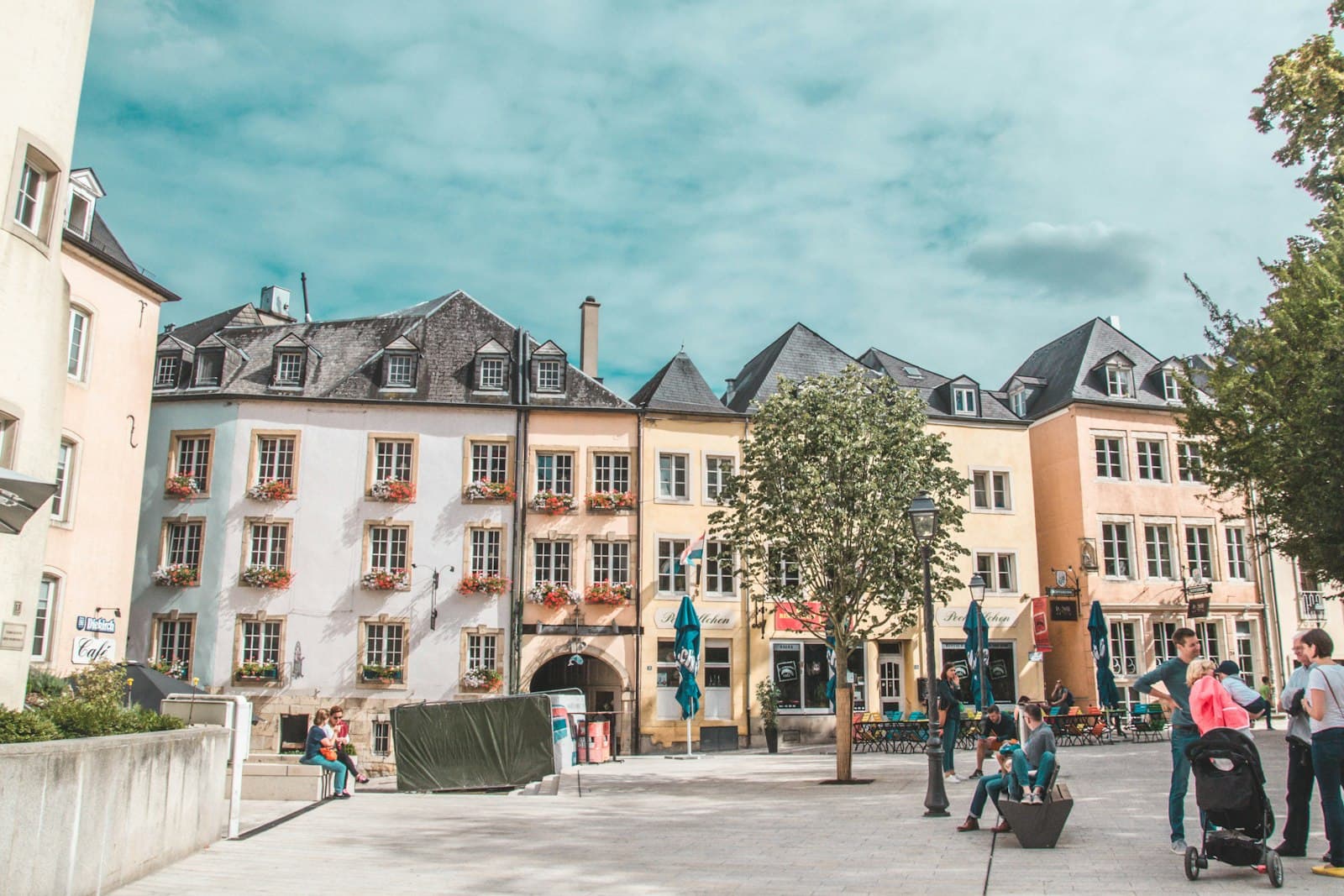
The day-to-day systems work well once you're in them. Here's what to expect in your first year.
Healthcare
If you have a Luxembourg employer, you're enrolled in the public health insurance fund, the CNS, automatically. It reimburses 88% of a doctor's visit for adults and 100% for children under 18, and you can see a specialist without a referral. With a doctor on the direct payment system (PID), you pay only your share at the visit instead of paying up front and waiting for a refund.
If you won't have a local employer, for instance on an investor permit or as a family member who doesn't work, you can join the CNS voluntarily once you're a resident. The contribution is 5.60% of a minimum base, currently about $177 a month (€155.19) in September 2026. Here's the gap people miss: nothing is reimbursed for the first three months. Plan on private coverage to bridge it, which is where ExpatInsure comes in. Hunter Schultz, our healthcare coach, can walk you through what to look for before you choose.
Taxes
Luxembourg taxes its residents on worldwide income. For 2025 about the first $15,100 of income (€13,230) is tax-free, and the top rate of 42% applies above about $268,000 (€234,870), plus a 7% solidarity surcharge that rises to 9% for high earners. How much you pay depends on your tax class: class 1 for single people, 1a for single parents and people 65 and over, and class 2 for married couples. The U.S. keeps taxing you as a citizen wherever you live, so you'll file in both countries. A Social Security totalization agreement between the two countries keeps workers from paying into both systems and lets you combine work credits toward benefits. MyExpatTaxes handles the U.S. return, and Beacon Global Advisors keeps your 401(k), IRA and investments working after you leave.
Banking and money
You'll want a local account for rent and payroll. Before you go, ask your U.S. brokerage and bank what happens to your accounts once you have a foreign address, since the answer shapes where your money should live. Moneycorp moves dollars into euros and sets up the recurring transfers.
Driving
You can drive on your U.S. license for up to one year after taking up residence. Convert it within that year and you skip both the theory and road tests. The fee is about $34 (€30), and you'll need a medical certificate from an approved doctor.
Pets
Dogs and cats need an ISO microchip before their rabies shot, then a wait of at least 21 days after a first vaccination. An EU health certificate has to be endorsed by USDA within 10 days of arrival, and you can bring up to five pets on a personal move. Bodzin Pet Travel Solutions handles the paperwork trail.
Flying home
There's no nonstop to the U.S. right now, so trips connect through hubs such as Frankfurt, Munich, Amsterdam, Paris or Zurich. United plans a daily Newark nonstop starting April 2, 2027. Luxembourg is usually six hours ahead of Eastern time.
This guide is dated on purpose
Luxembourg's entry process changes on October 1, 2026, the Blue Card salary floor moved in March 2026, and a single-permit law is still in draft. Everything here reflects the rules as of September 2026. Confirm the current version with a licensed professional before you file anything.

05 · Finding your spot
Picking a home base in a country this size
In most countries, where you live decides your commute and your social life. In Luxembourg, free trains and buses blur that line. Living outside the capital's center saves about $300 a month on a one-bedroom in our data, and a train pass costs nothing, so the trade-off is mostly time.
Start with where the job, the school or the business is, then look at what the rail and bus lines reach from there. With 46.6% of residents holding a foreign passport, you won't be the only newcomer on your street. Our Luxembourg city guides appear below as we publish them.
06 · You don't do this alone
Your move team
You've met a few of these people already. They're the Expatsi-vetted partners who handle the documents, the health coverage, the money and the details that eat weekends.
Luxembourg's paperwork comes with tight deadlines, like the three-day arrival declaration. An FBI background check with an apostille, a health policy that covers the first three months, a currency plan for a euro salary: each one is easy for someone who does it every week. Here's who we trust, grouped by job.

Plan-B Outbound Migration
Multi-Country Visa Support
A U.S.-based consultancy that works on outbound migration, residence visas and citizenship across several countries. A good first call for mapping which permit fits your plan.
Learn more
Legalize That Doc
Document Preparation
Melissa Di Nardo's team gets U.S. documents ready for use abroad: FBI background checks, birth and marriage certificates, apostilles and legalizations, in the right order so nothing expires.
Learn more
Hunter Schultz
Healthcare Coach
A healthcare coach with more than 20 years of expat living and a background in air medical transport. His one-hour consultation builds a care plan for your destination.
Learn more
ExpatInsure
Global Health Insurance
Expatsi's international health insurance partner. They find private coverage for your permit application and for the three months before voluntary public insurance starts paying.
Learn more
MyExpatTaxes
U.S. Expat Tax Service
Tax software built for Americans abroad, filing U.S. expat returns since 2018, with support for more complex cases when you need it.
Learn more
Beacon Global Advisors
Financial Planning
Financial planners for Americans living overseas: 401(k)s, IRAs and investment accounts, kept working and compliant after you move.
Learn more
Moneycorp
Currency Exchange
A currency and international payments firm working since 1979. They convert dollars to euros and schedule the regular transfers for rent and bills.
Learn more
Bodzin Pet Travel Solutions
Pet Relocation
Aliza Bodzin's pet travel concierge plans the microchip, vaccine timing, health certificate and flight so your dog or cat arrives with the right stamps.
Learn more
Aqua Moving Services
Worldwide Shipping and Moving Service
International movers who survey your belongings once and return three competing quotes from vetted partners, with one point of contact.
Learn more
Lingoda
Language Learning
Small live online language classes on your schedule, for the language you'll lean on most at work and at the commune office.
Learn more
Culturosity Co.
Cultural Skills Coach
Jennifer and Janka coach individuals and families on adapting to a new culture, with research-backed frameworks and one-on-one sessions.
Learn more07 · Quick answers
Luxembourg questions, answered
Can I keep my U.S. citizenship if I become a Luxembourg citizen?
Yes. Luxembourg allows dual nationality, so Americans can naturalize without giving up a U.S. passport. You need at least five years of legal residence with the final year uninterrupted, a Luxembourgish language test and a 24-hour civic course. The naturalization procedure itself is free.
Is public transport free in Luxembourg?
Yes. Since March 1, 2020, buses, trams and second-class trains have been free across Luxembourg for residents and visitors alike. Only first-class train travel is charged.
How much does it cost to live in Luxembourg?
Expatsi's 2026 data puts a comfortable budget at about $3,250 a month for a single person and about $4,750 for a couple, with rent as the biggest line. A one-bedroom apartment in a city center averages about $2,000 a month. Public transit is free, which offsets some of the housing cost.
Do I need to speak French or Luxembourgish to live in Luxembourg?
Not to work in many jobs. English is the second most-used language in Luxembourg workplaces, after French. Plenty of employers still want Luxembourgish, French or German: nearly half of job postings in 2019 asked for all three. To become a citizen you must pass a Luxembourgish test at A2 for speaking and B1 for listening.
Can Americans retire in Luxembourg?
Not easily. Luxembourg has no retirement visa, and since May 2023 its permit for self-sufficient people only accepts a pension paid by a social security institution in Luxembourg or another EU or Schengen country, or income from work in one of those countries. U.S. Social Security, U.S. pensions and savings don't qualify on their own. The main alternatives are the investor permit, which starts at about $570,000 (€500,000) in a business, or joining a spouse who works in Luxembourg.
What visa do Americans need to move to Luxembourg in 2026?
From October 1, 2026, Americans staying longer than 90 days apply for a long-stay D visa at a Luxembourg consulate, or a Belgian one where Luxembourg has no consulate, before they travel. The D visa is valid for six months. After arriving you declare your address at your commune within three days, complete a medical check and apply for the residence permit that matches your reason for moving, such as work, study or family.
Does Luxembourg have a digital nomad visa?
No. Luxembourg doesn't offer a digital nomad or remote work visa. Freelancers and founders usually apply for the self-employed residence permit, which requires a business and financing plan, proof of resources and qualifications, and work that needs you physically present in Luxembourg. Anyone planning to keep a salaried job with a U.S. employer should get advice from an immigration lawyer first.
Is healthcare free in Luxembourg?
Not free, but heavily covered. Employees are enrolled in the public health insurance fund, the CNS, automatically, and it reimburses 88% of doctor visits for adults and 100% for children under 18. Residents without a local employer can join voluntarily for a contribution of about $177 a month (€155.19), but nothing is reimbursed during the first three months, so plan on private coverage for that gap.
Sources
- New immigration procedures from October 1, 2026 · Government of Luxembourg (checked September 2026)
- Moving to Luxembourg: D visas can be applied for from 1 October · Paperjam (checked September 2026)
- Salaried work for highly qualified workers (EU Blue Card) · Guichet.lu (checked September 2026)
- EU Blue Card: increase of minimum salary threshold · Arendt (checked September 2026)
- Conditions of residence for third-country salaried workers · Guichet.lu (checked September 2026)
- Conditions of residence for investors from third countries · Guichet.lu (checked September 2026)
- Conditions of residence for private reasons · Guichet.lu (checked September 2026)
- Immigration: new restrictions on residence permits for personal reasons · Lexgo (checked September 2026)
- Acquiring Luxembourgish nationality by naturalisation · Guichet.lu (checked September 2026)
- Voluntary health insurance affiliation · CCSS (checked September 2026)
- Doctors: reimbursed services · CNS (checked September 2026)
- Luxembourg: taxes on personal income · PwC Worldwide Tax Summaries (checked September 2026)
- Population on January 1, 2026 · STATEC (checked September 2026)
- Minimum remuneration from June 1, 2026 · Inspection du travail et des mines (checked September 2026)
- Cost of living and country data for Luxembourg · Expatsi (checked September 2026)
Compare Luxembourg with the other places on your list
Take the free Expatsi Test and weigh Luxembourg against other countries on cost, healthcare, climate and safety.
Why not you?