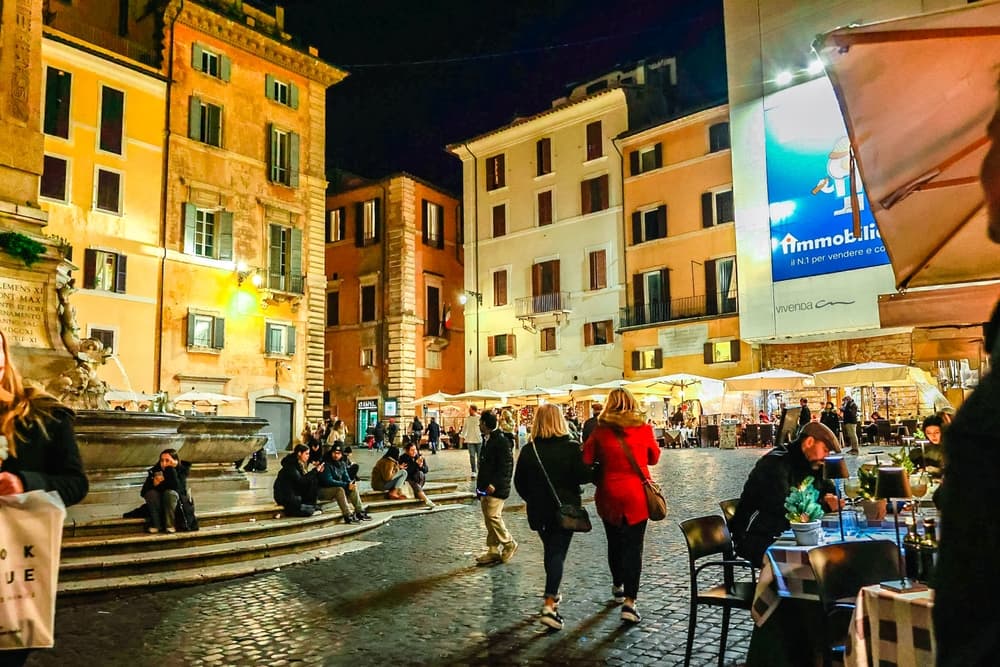
Rome: a full-sized capital, not a postcard town
A full-sized capital with embassies, international schools, and a long-established American community in neighborhoods like Trastevere and Prati.
- 2,748,109
- Population (2023)
- $2,400/mo
- Monthly budget · single
- 61°F / 16°C
- Avg temperature
Plan on about $2,400 a month in U.S. dollars for one person in Rome, around $3,600 for a couple, and roughly $5,800 for a family. A one-bedroom apartment runs about $1,250 in the center and about $900 outside it, and an inexpensive restaurant meal costs around $17.
Rome suits people who want a full-sized capital city, not a postcard town. It has embassies, international schools, the UN's food agencies, a big university population, and a long-established American community. Retirees, remote workers with U.S. incomes, and families all find a foothold, usually in neighborhoods like Trastevere, Monteverde, Prati, or Testaccio.
The trade-off is bureaucracy. Registering residency, opening utilities, and getting your permesso di soggiorno appointment can each take months. Roman administrative offices are slow, even by Italian standards. Most new arrivals underestimate how long the paperwork phase will take.
At a glance
$2,400
Monthly budget · single person
$1,250/mo 1-bed rent, center
58/100
Safety index
$30
Internet / month
61°Fannual average
Jan 46° · Aug 78°
Climate
2,748,109
Population (2023)
Expatsi estimates, updated Aug 2026, based on rental listings, government statistics, and local reporting.
Cost of living
What it costs to live in Rome
Single person
$2,100–$2,600/mo
about 25% below Austin, TX
Couple
$3,100–$4,000/mo
about 20% below Austin, TX
Family of four
$5,100–$6,500/mo
about 25% below Austin, TX
Compared with Austin, TX (Expatsi estimate, 2026).
- $17 −15%
- Inexpensive meal
- $1,100–$1,350/mo −36%
- 1-bed rent, center
- $800–$1,000/mo −33%
- 1-bed rent, outside
- $30/mo −54%
- Internet
- $40/mo −3%
- Transit pass
- $632/sq ft −3%
- Buy price, center
Expatsi estimates, updated Aug 2026, based on rental listings, government statistics, and local reporting.
Daily life
How Rome lives
- A grade, 91st percentile among the cities we track
- Dining & cafésstandout
- A grade, 91st percentile among the cities we track
- Arts & culturestandout
- B+ grade, 68th percentile among the cities we track
- Parks & outdoorsstrong
- A grade, 88th percentile among the cities we track
- Schools & educationstandout
- A- grade, 72nd percentile among the cities we track
- Healthcare accessstrong
- A- grade, 71st percentile among the cities we track
- Bike infrastructurestrong
- A+ grade, 96th percentile among the cities we track
- Public transitstandout
- A grade, good physical accessibility
- Accessibilitygood
Graded on OpenStreetMap amenity density relative to the 298 cities we track. Accessibility is the exception: it's graded against a fixed standard (terrain steepness and sidewalk surfaces), not a curve.
Climate
Weather through the year
Annual average 61°F (16°C) · 32 in of rain a year · Source: Meteostat station normals (16239, 1991-2020; no sunshine data)
On the ground
Scenes from Rome
Getting around
Transport in Rome
Rome's transit is run by ATAC; it comes down to the Metro, a very large bus network, and the trams. The Metro is small for a city this size because every new tunnel runs into archaeological remains; the newest stations, Colosseo/Fori Imperiali and Porta Metronia, only opened in December 2025. Buses do most of the daily work. Figure about $40 a month for transport, which covers a monthly pass.
Check the trams before you rely on them. The network has spent long stretches of 2025 and 2026 replaced by buses while ATAC renews track and electrical substations, so service comes back in stages.
The historic center is genuinely walkable; many residents cross it on foot faster than any bus would manage. The cobblestones, the famous sampietrini, are both charming and hard on ankles, strollers, and wheeled luggage.
A car makes little sense inside the city. The center is a restricted traffic zone (ZTL) with cameras that fine unauthorized vehicles, scarce parking, and Roman driving takes some acclimation. Most expats skip car ownership and rent one for weekend trips into Lazio, Tuscany, or Umbria.
Beyond the city, Termini and Tiburtina connect Rome to the national rail network, with the fastest trains reaching Florence in about an hour and a half and Naples in just over an hour. Fiumicino has direct flights to several U.S. cities.
- 87/sq mi
- Transit stops
- 31/sq mi
- Bike infrastructure
- 81/sq mi
- Wheelchair-accessible places
Mapped features per square mile from OpenStreetMap.
Keep exploring
Places like Rome
Community
Community & practical notes
Community: Rome has hosted foreigners for two millennia and it shows. The American International Club of Rome has been running since 1953, still holding monthly happy hours, alongside American university programs, English-language churches, and meetup groups. English is common in central neighborhoods and among younger Romans. Errands, landlords, and government offices run in Italian, so learning the language changes your experience from tolerated tourist to actual resident.
Healthcare: Italy's national health service covers legal residents. Once your residency paperwork is done you register and choose a family doctor, either automatically through certain visa types or, for retirees on elective residency, by paying an income-based annual contribution with a floor of 2,000 euros. In the health ministry's 2024 review, Lazio cleared the national standard in all three graded areas but landed mid-table, well behind Veneto, Emilia-Romagna, and Tuscany. Rome's teaching hospitals are strong, and private specialist visits cost far less than in the U.S.
Schools: Families have real English-language options. The American Overseas School of Rome (founded 1947, near Via Cassia) offers the American diploma and the IB. St. Stephen's, on the Aventine, takes day and boarding students from age 14. Marymount International runs a full IB program north of the center. Apply early and check the school bus route before you sign a lease.
Remote work: Home internet runs about $30 a month; fiber is widely available. Coworking is easy to find, from international chains to spaces like Talent Garden in Ostiense. Hiring for English speakers concentrates in tourism, teaching, international organizations (FAO, WFP, and IFAD are headquartered here), and multinationals, though most American expats keep U.S. clients or employers. Italy's digital nomad visa, introduced in 2024, gives remote workers a legal route that didn't exist a few years ago.
Limited mobility: Honest verdict, hard. Rome is not flat, and the sampietrini paving of the center is rough going in a wheelchair even when well maintained. The vibrations pose a real problem for anyone with a spine condition. Wheelchair users who have written up the city prefer buses to the Metro, since nearly all buses carry a ramp while station lifts are less dependable. They warn that older bars and restaurants often have a step at the door and no adapted toilet. Rome's tourism site publishes checked accessibility details for the major museums; it's the best place to plan excursions. Modern districts like EUR are far easier than the centro storico, so test your neighborhood in person before signing a lease.
Retirement: Italy's elective residency visa is the standard path for retirees. It requires documented passive income (pensions, Social Security, investment income; employment income doesn't count), and you cannot work on it. Approval standards vary by consulate, so start with the one that covers your U.S. state. After five years of legal residency, you can apply for long-term EU resident status. Compare the details at retirement visa options and see the full picture in our Italy guide.
Housing
Renting and buying
- 1-bed rent (center)
- $1,100–$1,350/mo
- 1-bed rent (outside center)
- $800–$1,000/mo
- Buy price (center)
- $632/sq ft
- Buy price (outside center)
- $307/sq ft
Expatsi estimates, based on rental listings, government statistics, and local reporting.
Good to know
Frequently asked questions
How does healthcare work for expats in Rome?
You sign up at your local ASL office once your residency is registered, get a tessera sanitaria, and pick a family doctor. Depending on the visa, that enrollment is either automatic or paid for with an annual contribution. Most new arrivals also keep private cover at first, since visas require it and it buys shorter waits and English-speaking doctors.
Do I need a car in Rome?
No, and inside the city a car is usually a liability. The historic center is a camera-enforced restricted traffic zone, parking is scarce, and the Metro and buses cover daily needs for around $40 a month in transport costs. Most expats walk the center and rent a car only for countryside trips.
How do I move to Rome from the US?
Americans need a long-stay visa before arriving: the elective residency visa for people with passive income, the digital nomad visa for remote workers, work or study visas, or citizenship by descent if you have Italian ancestors. You apply at the Italian consulate covering your state, then convert to a permesso di soggiorno within eight days of landing.
Can I retire in Rome?
Yes, and most retirees use the elective residency visa, which is built for people living on passive income rather than work. At roughly $3,600 a month for a couple, Rome is workable on a solid retirement income, though quieter Italian cities cost less. Income requirements are enforced strictly and vary by consulate, so budget above the minimum.
Is Rome safe for Americans?
Rome scores 58 on the safety index with a crime index of 42, which puts it in the moderate range for a major European capital. The U.S. State Department's OSAC security reporting for Italy describes violent crime as rare and theft as the main problem. Pickpocketing clusters around tourist sites, stations, and crowded buses.
How much does it cost to live in Rome?
Budget about $2,400 a month for a single person, around $3,600 for a couple, and roughly $5,800 for a family, all in U.S. dollars. A one-bedroom averages about $1,250 in the center and $900 outside it. An inexpensive restaurant meal runs about $17.
Is Rome good for remote workers?
Yes, with caveats. Home fiber internet costs about $30 a month, coworking spaces are plentiful, and Italy's digital nomad visa gives remote workers a legal residency route. The catch is the time zone: Rome is six hours ahead of U.S. Eastern time, so meetings with West Coast teams land in your evening.
What is the weather like in Rome?
Rome has a Mediterranean climate with an annual average of about 61F (16C) and around 32 inches (806 mm) of rain a year. Summers are hot and dry, with August averaging highs near 88F and July the driest month. Winters are mild, with January averaging highs near 54F and nights near 38F. Most of the rain falls between October and December.
See how Rome fits your life
Take the free Expatsi Test and compare Italy to nearly 200 countries on what actually matters: cost, healthcare, climate, and safety. About five minutes.
Why not you?