Living in Kumasi: Ghana's Ashanti capital on roughly $1,000 a month
Real monthly budgets, safety, healthcare and daily life in Ghana's second city, plus the honest limits before you sign a lease.
- 3,903,480
- Population (2024)
- $1,000/mo
- Monthly budget · single
- 81°F / 27°C
- Avg temperature
A month in Kumasi costs roughly $1,000 for one person, $1,400 for a couple and $2,000 for a family, in U.S. dollars. Rent is where the variation lives. A central one-bedroom goes for around $350 in neighborhoods like Nhyiaeso and Ahodwo. Those figures carry a low-confidence flag, because fewer residents report prices in Kumasi than in the capital.
The city suits people who want Ghana's cultural heart rather than its business capital. Kumasi is the seat of the Ashanti kingdom; the Asantehene still holds court at Manhyia Palace every six weeks. Americans who settle here usually have a specific reason: the university, an NGO posting, a family business, or Ashanti roots. Official business happens in English. The street speaks Twi.
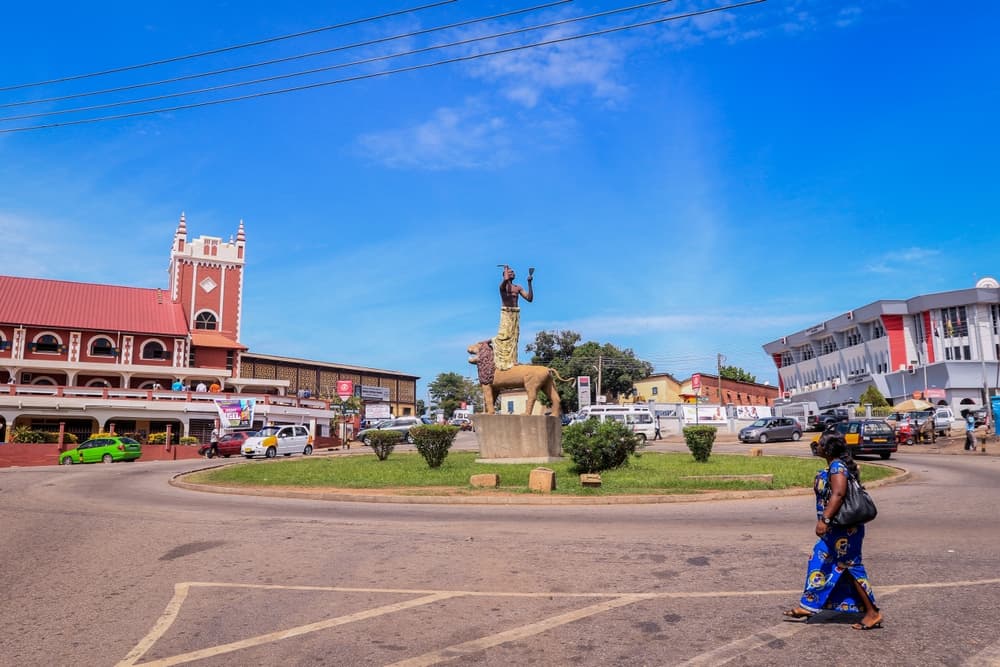
The trade-off is that this is an inland, crowded, working city. There's no coastline, the main roundabouts clog for hours, and the services built around foreigners in Accra are much thinner here. Long-haul flights still leave from Accra, four to five hours away by road.
At a glance
$1,000
Monthly budget · single person
$350/mo 1-bed rent, center
58/100
Safety index
$40
Internet / month
81°Fannual average
Aug 77° · Feb 84°
Climate
3,903,480
Population (2024)
Expatsi estimates, updated Aug 2026, based on rental listings, government statistics, and local reporting. Coverage here is thin, so treat these as a rough guide.
Cost of living
What it costs to live in Kumasi
Single person
$800–$1,300/mo
about 70% below Austin, TX
Couple
$1,100–$1,800/mo
about 70% below Austin, TX
Family of four
$1,600–$2,400/mo
about 75% below Austin, TX
Compared with Austin, TX (Expatsi estimate, 2026).
- $3 −85%
- Inexpensive meal
- $250–$450/mo −82%
- 1-bed rent, center
- $150–$300/mo −85%
- 1-bed rent, outside
- $40/mo −38%
- Internet
Expatsi estimates, updated Aug 2026, based on rental listings, government statistics, and local reporting. Coverage here is thin, so treat these as a rough guide.
Daily life
How Kumasi lives
- C grade, 9th percentile among the cities we track
- Dining & cafésmodest
- B- grade, 25th percentile among the cities we track
- Arts & culturetypical
- C+ grade, 24th percentile among the cities we track
- Parks & outdoorsmodest
- B- grade, 27th percentile among the cities we track
- Schools & educationtypical
- B- grade, 39th percentile among the cities we track
- Healthcare accesstypical
- C- grade, 0th percentile among the cities we track
- Bike infrastructuremodest
- C grade, 12th percentile among the cities we track
- Public transitmodest
Graded on OpenStreetMap amenity density relative to the 369 cities we track. Accessibility is the exception: it's graded against a fixed standard (terrain steepness and sidewalk surfaces), not a curve.
Climate
Weather through the year
Annual average 81°F (27°C) · 53 in of rain a year · Source: Meteostat station normals (65442, 1991-2020)
On the ground
Scenes from Kumasi
Getting around
Transport in Kumasi
Tro-tros do the heavy lifting here. These privately-owned minibuses pull out of Kejetia and the other lorry parks once they fill, for a couple of cedis per ride. Nobody publishes a map or a timetable, so you learn the routes by asking. Four-seat shared taxis work the same way. A dropping taxi goes door to door for a fare you settle before you get in. Three-wheelers, called pragia here, cover the short hops.
For newcomers, the apps are simpler. Bolt lists Kumasi as one of its service cities; Uber and Yango operate here, too. Fares are low by American standards, though drivers often want cash or mobile money. The State Department tells its own staff in Ghana to use ride-hailing instead of street taxis or tro-tros.
Walking works inside a neighborhood, rarely between them. Adum and the market district are busy on foot, but paving starts and stops, drains run open beside the road, and the ground rises and falls enough to make a short walk warm work.
A car pays for itself if you leave the city often for the kente villages at Bonwire, Lake Bosomtwe, or the long haul to Accra. Traffic is the real cost of owning one. The city's junctions have outgrown their capacity. Two fixes are underway: a Japanese-funded widening between the Santasi and Ahodwo roundabouts, and a new outer ring road started in January 2026 and due in late 2027. VIP and STC coaches run to Accra, and the airport four miles out flies short hops there on PassionAir and Africa World Airlines.
- 1.1/sq mi
- Transit stops
- 0.0/sq mi
- Bike infrastructure
- 0.1/sq mi
- Wheelchair-accessible places
Mapped features per square mile from OpenStreetMap.
Keep exploring
Places like Kumasi

Community
Community & practical notes
The expat scene: Kumasi's foreign population is small and attached to institutions rather than to a social circuit. KNUST, the science and technology university founded in 1952, brings in international students and visiting academics and runs an international programmes office for them. Past the university, you'll find NGO staff, missionaries, traders, and Ashanti diaspora families back from Britain, the U.S. and Canada, most of them living in Nhyiaeso, Ahodwo or Danyame. You meet people through work, through church and on your own street, not at a newcomers' mixer.
Healthcare: Komfo Anokye Teaching Hospital, which locals just call Gee, is the region's referral hospital. It has about 1,200 beds, teaches KNUST's medical students, and takes patients sent from most of northern and central Ghana. It accepts the National Health Insurance Scheme, which foreign residents can join once they have a permit. Private clinics handle routine care cheaply out of pocket. The limit is emergencies. The State Department says emergency medical services outside Accra are limited and that serious cases require medical evacuation, so buy a policy that will pay for an air ambulance. Ambulances are scarce, and most families drive themselves to the hospital.
Limited mobility: Getting around Kumasi in a wheelchair is genuinely difficult. Ghanaian law bans disability discrimination and goes unenforced. The Persons with Disability Act set an August 2016 deadline for public buildings to be made usable by everyone, but most owners never complied. The accessible places tend to be the big hospitals, newer hotels and a few attractions. The street is the real obstacle: patchy paving, open drains, curbs without ramps, and ground that keeps climbing and dropping. A Daily Graphic survey of public facilities named KNUST among campuses that stay largely inaccessible. No tro-tro or pragia can take a chair, so budget for a hired car and driver, and rent at street level. Scout the city in person before you commit.
Getting online: Home internet is cheap here and fast enough for video calls. MTN and the other big networks sell SIM cards all over the city, and mobile data makes a solid backup. The power cuts, and a router without an inverter is dead weight when it does. The city has a small but real tech scene. Kumasi Hive runs a makerspace and coworking desks in Kentinkrono, and hapaSpace sits in the Adum business district. Local hiring outside the university, health and trade is thin, so income here usually comes from outside Ghana.
Retiring here: Ghana runs no retirement visa, so older Americans live here on renewable residence status. Those with African ancestry have a second route, the right of abode, which Ghana opened to the diaspora as permanent status. What draws retirees to Kumasi is cost and family ties. What sends them back to Accra is specialist care. See which retirement visa routes Americans actually use, and our Ghana guide for the country-level view.
Housing
Renting and buying
- 1-bed rent (center)
- $250–$450/mo
- 1-bed rent (outside center)
- $150–$300/mo
Expatsi estimates, based on rental listings, government statistics, and local reporting. Coverage here is thin, so treat these as a rough guide.
Good to know
Frequently asked questions
What is the weather like in Kumasi?
Warm and green all year, averaging about 81 F, with roughly 53 inches of rain. There are two wet peaks, June and again in October, and the cloudiest, coolest stretch comes in August. December and January are the dry months, when Harmattan winds carry Saharan dust south and the air turns hazy. Nights average in the low 70s F.
Do I need a car in Kumasi?
Not for city life. Tro-tros, shared taxis and ride-hailing apps cover almost everything inside Kumasi, and many foreign residents keep a trusted driver on call instead of buying a vehicle. A car starts to make sense if you commute across town daily or take regular trips into the Ashanti countryside, where shared transport thins out.
Is Kumasi safe for Americans?
Kumasi rates 58 out of 100 for safety, with a crime index of 42, which reads middling rather than alarming. The State Department has Ghana at Level 2, exercise increased caution, as of July 2026, citing crime, poor health infrastructure, and violence against women and gay travelers. The practical risks are pickpockets in the crowded market lanes, petty theft, and road travel after dark.
Can I retire in Kumasi?
Yes, and diaspora families do it regularly. There is no retiree visa in Ghana, so plan on renewing your status each year, or on qualifying for right of abode if you have African ancestry. The money side is easy at these budgets. The harder question is medical care, since complex treatment usually means a trip to Accra.
How much does it cost to live in Kumasi, Ghana?
One person lives here on about $1,000 a month. Rent is the swing factor: roughly $350 for a one-bedroom in the central neighborhoods and closer to $200 outside them. A plate of local food costs around $3, and home internet about $40 a month. Treat all of it as a low-confidence estimate and check prices on the ground.
How do I move to Kumasi from the US?
Americans need a Ghanaian visa before they board, so apply through a Ghana mission rather than expecting a stamp on arrival. Staying longer means a permit from the Ghana Immigration Service once you are in the country. Spend 90 days or more in a year and you also register with the National Identification Authority for a non-citizen Ghana card, which banks ask for.
Is the internet in Kumasi good enough for remote work?
For most jobs, yes. Fixed home service is inexpensive and handles calls fine, and a couple of coworking spots exist if you want somewhere reliable to sit. Plan for power cuts, which are shorter than they used to be but still happen. An inverter or a power bank, plus mobile data on a second network, is what remote workers here rely on.
See how Kumasi fits your life
Take the free Expatsi Test and compare Ghana to nearly 200 countries on what actually matters: cost, healthcare, climate, and safety. About five minutes.
Why not you?