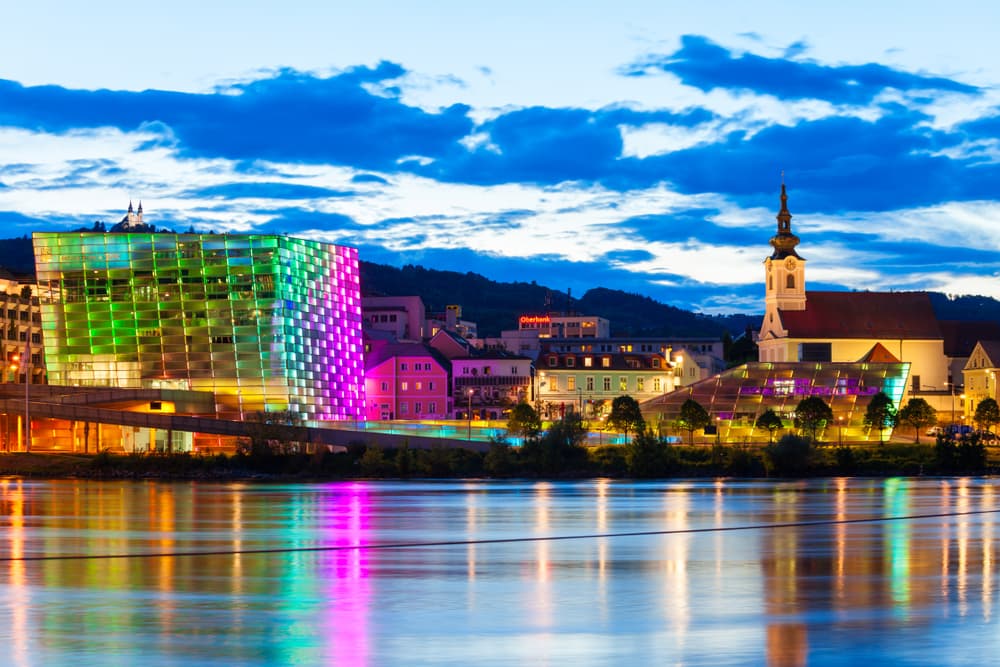
Linz: a Danube steel city that made room for media art
Upper Austria's capital pairs a university hospital, a tram up the Pöstlingberg and hourly trains to Vienna with a small expat crowd and plenty of German.
- 211,944
- Population (2024)
- $2,400/mo
- Monthly budget · single
- 50°F / 10°C
- Avg temperature
Plan on about $2,400 a month for one person in Linz, with most single budgets falling between $2,000 and $2,800. A couple needs around $3,400, a family of four about $5,000, and a one-bedroom in the center rents for roughly $1,000 a month ($800 farther out). All figures are U.S. dollars, as of 2026.
Linz is the capital of Upper Austria, a Danube city of about 212,000 people. The voestalpine steelworks are still its largest employer, but the city also hosts the Ars Electronica festival and was European Capital of Culture in 2009. It suits people who want a working Austrian city with a university hospital and fast trains to Vienna, and who are ready to learn German.
It's a weaker fit if you want postcard old-town charm or a ready-made circle of Americans. The expat community here is very small, so your social life gets built through work, classes and clubs.

Reviewed and updated October 9, 2026 · 4 min read
At a glance
$2,400
Monthly budget · single person
$1,000/mo 1-bed rent, center
76/100
Safety index
$35
Internet / month
50°Fannual average
Jan 32° · Jul 68°
Climate
211,944
Population (2024)
Expatsi estimates, updated Oct 2026, based on rental listings, government statistics, and local reporting.
Cost of living
What it costs to live in Linz
Single person
$2,000–$2,800/mo
about 25% below Austin, TX
Couple
$2,800–$4,000/mo
about 25% below Austin, TX
Family of four
$4,400–$5,500/mo
about 35% below Austin, TX
Compared with Austin, TX (Expatsi estimate, 2026).
- $15 −25%
- Inexpensive meal
- $800–$1,200/mo −49%
- 1-bed rent, center
- $650–$950/mo −41%
- 1-bed rent, outside
- $35/mo −46%
- Internet
- $75/mo +82%
- Transit pass
- $465/sq ft −29%
- Buy price, center
Expatsi estimates, updated Oct 2026, based on rental listings, government statistics, and local reporting.
Daily life
How Linz lives
- B+ grade, 58th percentile among the cities we track
- Dining & cafésstrong
- A- grade, 75th percentile among the cities we track
- Arts & culturestrong
- A+ grade, 98th percentile among the cities we track
- Parks & outdoorsstandout
- A- grade, 78th percentile among the cities we track
- Schools & educationstrong
- A- grade, 76th percentile among the cities we track
- Healthcare accessstrong
- A- grade, 76th percentile among the cities we track
- Bike infrastructurestrong
- B+ grade, 67th percentile among the cities we track
- Public transitstrong
- A grade, good physical accessibility
- Accessibilitygood
Graded on OpenStreetMap amenity density relative to the 298 cities we track. Accessibility is the exception: it's graded against a fixed standard (terrain steepness and sidewalk surfaces), not a curve.
Climate
Weather through the year
Annual average 50°F (10°C) · 33 in of rain a year · Source: Open-Meteo Historical Weather API (temps: ERA5-Land 0.1°; precip/sunshine: ERA5 best-match; 1991-2020 normals)
On the ground
Scenes from Linz
Getting around
Transport in Linz
Linz Linien runs the city's trams, buses and trolleybuses. The tram network includes the Pöstlingbergbahn, which opened in 1898 and is billed as the world's steepest adhesion railway; it climbs to the Pöstlingberg lookout above the city. Near the main station (Hauptbahnhof) the trams dip into a short tunnel, then run at street level again. A monthly transit budget runs about $75.
Rail is the big draw. Trains between Linz and Vienna's main station run hourly and take about 1 hour 16 minutes, and Vienna Airport is about 1 hour 43 minutes away by train. Linz sits on the western line toward Salzburg, and a direct Railjet runs to Munich every two hours.
Do you need a car? Not if you live in the center or along a tram line. A car helps if you settle in an outer district or want regular weekend trips into the Mühlviertel hills north of the Danube.
- 44/sq mi
- Transit stops
- 40/sq mi
- Bike infrastructure
- 167/sq mi
- Wheelchair-accessible places
Mapped features per square mile from OpenStreetMap.
Keep exploring
Places like Linz


Community & practical notes
Settling into Linz
The expat scene: Small. Don't expect an American club; plan on meeting people through work, German courses and hobby groups. The Tabakfabrik, a former tobacco factory that's now a listed office and event complex, is a good place to start: factory300 runs a coworking space in its Strada del Startup that mixes startups, freelancers and staff from local companies, and a second space in the FALK building is aimed at artists and creative entrepreneurs.
Healthcare: The Kepler Universitätsklinikum grew out of the founding of the Johannes Kepler University medical faculty and opened in 2015. As of 2023, it offered top-level care across 50 specialties, and its doctors also teach at the faculty. Plan on handling forms, letters and booking systems in German.
Remote work: Home internet runs about $35 a month. Local salaries won't match a U.S. paycheck, so Linz works best when your income comes from elsewhere.
International schools: Linz International School Auhof (LISA) is a public secondary school, one branch of the Europagymnasium Auhof. Classes are in German and English in grades 5 and 6, then in English, and students can take the IB Diploma alongside the Austrian Matura. It's been authorized for the IB Diploma since November 1997. We couldn't confirm entry requirements, so contact the school early.
LGBTQ expats: Same-sex marriage has been legal in Austria since January 2019, following a Constitutional Court ruling in December 2017. HOSI Linz, on Schillerstraße, has represented queer people in Upper Austria for more than 40 years and organizes linzpride; more than 10,000 people take part. The 2025 parade set off from the Volksgarten in June. HOSI's office hours are by arrangement, so email or call before you drop by.
Black Americans: We couldn't find reliable figures on how many Black Americans live in Linz, or a community group for them, so look for connections through work, the universities and Austria-wide expat networks. If you run into discrimination, Upper Austria's Antidiskriminierungsstelle in Linz gives free, independent and confidential advice, and ethnic background is among the grounds it covers. Book an appointment before visiting; it advises but doesn't represent people in court.
Limited mobility: Local reporting from April 2024 found the trams and buses themselves workable for wheelchair users, but curb heights at some stops, including Hauptplatz, don't line up with low-floor vehicles, and bus ramps have to be unfolded by the driver. High curbs elsewhere can push wheelchair users onto bike lanes or the road. Check your building's elevator and your daily route before you sign a lease.
Retirement: Linz suits retirees who want a real city with a university hospital and trains to Vienna every hour, on a budget of about $3,400 a month for a couple. Winters are the main adjustment: January averages highs near 38F and lows near 26F. Our Austria retirement visa guide covers the paperwork, our retirement visa overview compares other countries, and our Austria moving guide covers the rest.
Housing
Renting and buying
- 1-bed rent (center)
- $800–$1,200/mo
- 1-bed rent (outside center)
- $650–$950/mo
- Buy price (center)
- $465/sq ft
- Buy price (outside center)
- $353/sq ft
Expatsi estimates, based on rental listings, government statistics, and local reporting.
Good to know
Frequently asked questions
Is Linz safe?
Yes, by the numbers. Expatsi's data gives Linz a safety index of 76 out of 100 and a crime index of 24, where lower crime scores are better. Normal city precautions still apply.
Do you need a car to live in Linz?
Not if you live in the center or near a tram line. Linz Linien runs trams, buses and trolleybuses across the city, and a monthly transit budget is about $75. A car is mainly useful in outer districts or for weekend trips into the countryside.
How do you get from Linz to Vienna?
By train. Trains between Linz and Vienna's main station run hourly and take about 1 hour 16 minutes, and the trip from Linz to Vienna Airport takes about 1 hour 43 minutes by train.
What does it cost to live in Linz, Austria?
Plan on about $2,400 a month for one person in Linz (most budgets fall between $2,000 and $2,800), about $3,400 for a couple and about $5,000 for a family of four, in U.S. dollars as of 2026. A one-bedroom apartment in the center rents for roughly $1,000 a month, or about $800 outside the center.
Is Linz a good place to retire?
It can be, if you want a working city rather than a resort town. A couple should plan on about $3,400 a month, the Kepler Universitätsklinikum offered university hospital care across 50 specialties as of 2023, and trains reach Vienna in about 1 hour 16 minutes. Winters are cold, with January highs averaging near 38F, and you'll need German for daily paperwork.
Are there English-speaking schools in Linz?
Yes. Linz International School Auhof (LISA) is a public secondary school that teaches in English after grades 5 and 6 and offers the IB Diploma alongside the Austrian Matura. It has been authorized for the IB Diploma since November 1997.
Is Linz LGBTQ-friendly?
Linz has an organized queer community. Same-sex marriage has been legal in Austria since January 2019, and HOSI Linz, which has represented queer people in Upper Austria for more than 40 years, organizes the yearly linzpride, which draws more than 10,000 people.
What is the weather like in Linz?
Linz has four real seasons. January averages highs near 38F and lows near 26F, while July averages highs near 76F and lows near 59F. The city gets about 33 inches of precipitation a year, with the wettest months in summer.
See how Linz fits your life
Take the free Expatsi Test and compare Austria to over 100 countries on what actually matters: cost, healthcare, climate, and safety. About five minutes.
Why not you?