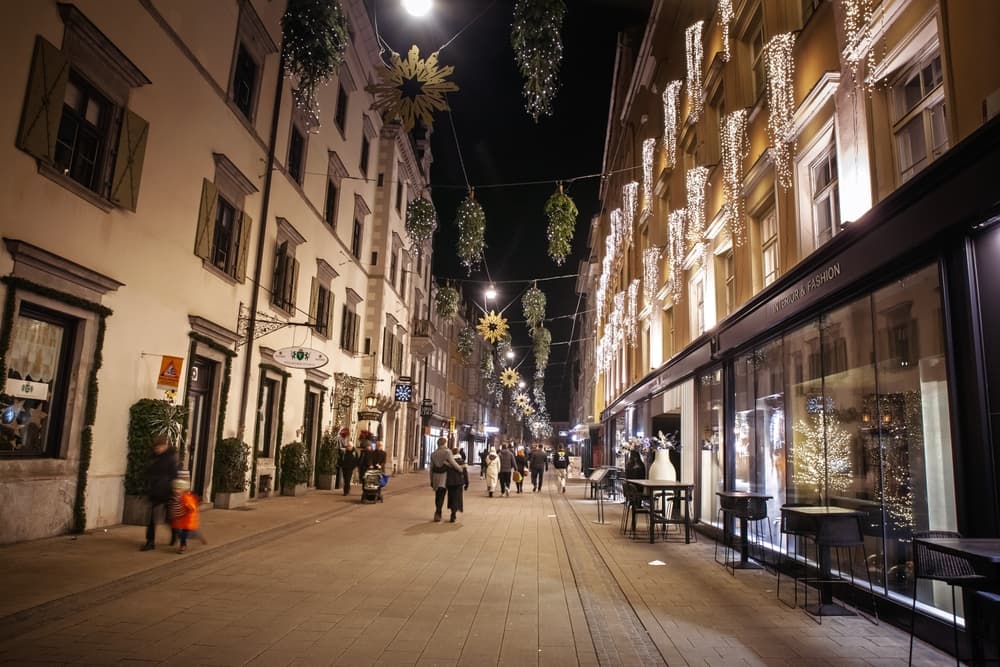
Graz: a student city with a castle hill in the middle
Austria's second-largest city pairs a walkable old town and a major university hospital with rents well below Vienna's, as long as you're ready to live in German.
- 306,971
- Population (2026)
- $2,300/mo
- Monthly budget · single
- 51°F / 11°C
- Avg temperature
Plan on roughly $2,300 a month for one person in Graz, with most single budgets landing between $1,900 and $2,700. A couple runs about $3,300 and a family of four about $4,800. A one-bedroom in the center rents for around $950, and closer to $750 once you move farther out.
Graz is Austria's second-largest city, home to about 307,000 people, and it's a university town first: more than 60,000 students study at its universities and colleges. It suits remote workers earning in U.S. dollars, academics and researchers, and retirees who want a walkable old town with a major hospital close by.
The trade-off is language and work. Daily life runs in German, the University of Graz teaches mainly in German, and English-language jobs are thin outside academia, so most Americans arrive with their income already sorted.

Reviewed and updated October 8, 2026 · 4 min read
At a glance
$2,300
Monthly budget · single person
$950/mo 1-bed rent, center
77/100
Safety index
$35
Internet / month
51°Fannual average
Jan 31° · Jul 70°
Climate
306,971
Population (2026)
Expatsi estimates, updated Oct 2026, based on rental listings, government statistics, and local reporting.
Cost of living
What it costs to live in Graz
Single person
$1,900–$2,700/mo
about 25% below Austin, TX
Couple
$2,700–$3,900/mo
about 30% below Austin, TX
Family of four
$4,200–$5,400/mo
about 40% below Austin, TX
Compared with Austin, TX (Expatsi estimate, 2026).
- $15 −25%
- Inexpensive meal
- $800–$1,100/mo −51%
- 1-bed rent, center
- $600–$900/mo −44%
- 1-bed rent, outside
- $35/mo −46%
- Internet
- $80/mo +94%
- Transit pass
- $483/sq ft −26%
- Buy price, center
Expatsi estimates, updated Oct 2026, based on rental listings, government statistics, and local reporting.
Daily life
How Graz lives
- A- grade, 71st percentile among the cities we track
- Dining & cafésstrong
- A grade, 86th percentile among the cities we track
- Arts & culturestandout
- A+ grade, 97th percentile among the cities we track
- Parks & outdoorsstandout
- A grade, 93rd percentile among the cities we track
- Schools & educationstandout
- A+ grade, 100th percentile among the cities we track
- Healthcare accessstandout
- A grade, 95th percentile among the cities we track
- Bike infrastructurestandout
- A+ grade, 95th percentile among the cities we track
- Public transitstandout
- A grade, good physical accessibility
- Accessibilitygood
Graded on OpenStreetMap amenity density relative to the 298 cities we track. Accessibility is the exception: it's graded against a fixed standard (terrain steepness and sidewalk surfaces), not a curve.
Climate
Weather through the year
Annual average 51°F (11°C) · 34 in of rain a year · Source: Meteostat station normals (11240, 1991-2020)
On the ground
Scenes from Graz
Getting around
Transport in Graz
The old town around Hauptplatz is compact enough to cover on foot, and Graz Linien's trams and buses handle the rest of the city. Budget about $80 a month for local transport. Register Graz as your main residence and the city also subsidizes the annual KlimaTicket, Austria's flat-rate transit pass.
The Schlossberg, the hill in the middle of town, has a 77-meter (253-foot) lift cut into the rock that runs from Schlossbergplatz up to the Clock Tower, plus a funicular on the other side.
For trips out, the Hauptbahnhof is the hub. Since the Koralmbahn opened in December 2025, the fastest Railjet Xpress trains reach Klagenfurt in 41 minutes, and trains to Vienna leave every half hour, 33 a day. Graz Airport sits about 10 km (6 miles) south of the center, and the S5 train from the main station gets there in about 12 minutes. Flights from the U.S. connect through hubs such as Vienna, Munich, Frankfurt or Zurich.
You don't need a car inside the city. Parking fees apply across the center, and trams cover most errands. A car earns its keep for weekends in the Styrian countryside and the mountains.
- 84/sq mi
- Transit stops
- 192/sq mi
- Bike infrastructure
- 304/sq mi
- Wheelchair-accessible places
Mapped features per square mile from OpenStreetMap.
Keep exploring
Places like Graz
Community & practical notes
Living in Graz day to day
The expat scene: Built around the universities. TU Graz alone has about 13,500 students, and more than a quarter of them come from abroad, so the international crowd skews young, academic and European. We couldn't find a count of Americans in Graz; plan on making friends through work, classes and German courses rather than an established American club.
Healthcare: LKH-Universitätsklinikum Graz, run jointly with the Medical University of Graz, is one of Austria's largest hospitals, with 1,556 beds. Specialist care you'd travel for in a smaller city is here in town. Expect most doctors to speak some English, but forms, letters and appointment systems are in German.
Remote work: Home internet runs about $35 a month. Local salaries won't match a U.S. paycheck, so Graz works best when your income comes from elsewhere.
International schools: The Graz International Bilingual School (GIBS) is a state school teaching in German and English for ages 10 to 18, and it's been authorized for the IB Diploma since 2017. It's the only school in Styria offering the IB Diploma, and entry is limited, so contact the school early.
LGBTQ expats: Same-sex marriage has been legal in Austria since January 2019. Graz's queer community is smaller than Vienna's but organized: RosaLila PantherInnen, on Annenstraße, runs the yearly CSD Graz parade and park festival in the Stadtpark area each summer.
Black Americans: We couldn't find reliable figures on how many Black Americans live in Graz, though you should expect to be noticed in a mostly white Central European city. Graz declared itself Europe's first Human Rights City in February 2001. The Antidiskriminierungsstelle Steiermark, set up by the state of Styria and the city, takes reports of racial discrimination and helps people follow up.
Limited mobility: Graz Tourismus publishes barrier-free guides for the city and says all city buses are low-floor. The Schlossberg lift and the funicular are both accessible, though most footpaths on the hill itself are steep. The old town is flat but cobbled in places, and many older apartment buildings lack elevators, so check the building and your daily route before signing a lease.
Retirement: Graz suits retirees who want a real city on a moderate budget: about $3,300 a month for a couple, with a university hospital in town and trains to Vienna every half hour. Austria's retirement route has an annual quota, which is the hard part; our Austria retirement visa guide walks through it, our retirement visa overview compares other countries, and our Austria moving guide covers the rest. Winters are the main adjustment: January averages highs near 38F and lows near 25F.
Housing
Renting and buying
- 1-bed rent (center)
- $800–$1,100/mo
- 1-bed rent (outside center)
- $600–$900/mo
- Buy price (center)
- $483/sq ft
- Buy price (outside center)
- $372/sq ft
Expatsi estimates, based on rental listings, government statistics, and local reporting.
Good to know
Frequently asked questions
What is the weather like in Graz?
Graz has warm summers and cold winters. July averages highs near 80F, January averages highs near 38F and lows near 25F, and the city gets about 34 inches of precipitation a year, most of it from June through August.
What is the cost of living in Graz, Austria?
Expect about $2,300 a month for one person in Graz, with most single budgets between $1,900 and $2,700 (2026 estimates in U.S. dollars). A couple spends about $3,300 a month and a family of four about $4,800. A one-bedroom apartment in the center rents for around $950 a month.
Can I retire in Graz?
Yes, but the visa is the hard part. Austria's retirement residence permit is subject to an annual quota, so start early and plan for paperwork in German. A retired couple should budget about $3,300 a month in Graz, and LKH-Universitätsklinikum Graz, one of Austria's largest hospitals, is in the city.
Is Graz LGBTQ friendly?
Graz has an organized LGBTQ community and a yearly CSD Pride parade run by RosaLila PantherInnen. Same-sex marriage has been legal in Austria since January 2019.
How far is Graz from Vienna?
Trains run between Graz and Vienna every half hour, 33 times a day, since the December 2025 timetable change. Before that change, the fastest Railjet took 2 hours 35 minutes.
Do you need a car in Graz?
No. Trams and buses cover the city, the old town is walkable, and parking fees apply throughout the center. A car helps only for weekend trips into the countryside and the mountains.
Is Graz safe for Americans?
Yes. Graz scores 77 on our safety index, and its crime index is 23. Normal city precautions apply, mainly around nightlife areas and on late trams.
Do I need to speak German to live in Graz?
For daily life, yes, sooner or later. Students and university staff often speak English, but landlords, doctors' offices and government forms work in German, and the University of Graz teaches mainly in German. Most Americans who settle in take German classes in their first year.
See how Graz fits your life
Take the free Expatsi Test and compare Austria to over 100 countries on what actually matters: cost, healthcare, climate, and safety. About five minutes.
Why not you?