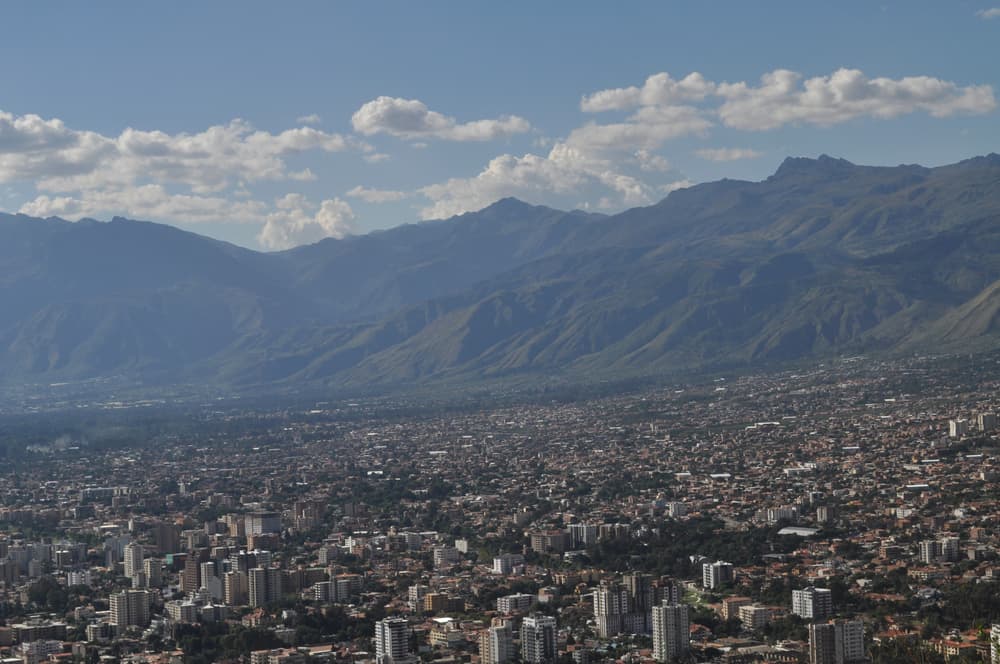
Cochabamba: Bolivia's spring-like valley city on about $1,000 a month
What it costs to live in Cochabamba, how safe it is, and what moving or retiring there looks like in a year of road blockades and a newly floating currency.
- 632,013
- Population (2012)
- $1,000/mo
- Monthly budget · single
- 65°F / 18°C
- Avg temperature
One person lives comfortably in Cochabamba on about $1,000 a month in U.S. dollars, and our 2026 range for a single budget runs from $800 to $1,100. Couples spend around $1,500, and a family of four around $2,200. Rent is the easy part: about $300 for a one-bedroom in the center and $200 toward the edges of town.
Bolivia's third city fills a wide valley at about 8,400 feet, with mild days, dry sunny winters and a short rainy season. It suits people who want a working Bolivian city rather than a tourist town, who'll live in Spanish, and who like the idea of a modest budget without La Paz's thin air.
It's a harder fit if you need English every day, an easy flight home, or calm politics. Cochabamba sits on the main road linking La Paz and Santa Cruz, and in 2026 that made it a target: a local business federation counted 22 blockade days by mid-May.

Reviewed and updated October 15, 2026 · 4 min read
At a glance
$1,000
Monthly budget · single person
$300/mo 1-bed rent, center
52/100
Safety index
$30
Internet / month
65°Fannual average
Jun 59° · Nov 69°
Climate
632,013
Population (2012)
Expatsi estimates, updated Oct 2026, based on rental listings, government statistics, and local reporting.
Cost of living
What it costs to live in Cochabamba
Single person
$800–$1,100/mo
about 70% below Austin, TX
Couple
$1,200–$1,800/mo
about 65% below Austin, TX
Family of four
$1,700–$2,700/mo
about 70% below Austin, TX
Compared with Austin, TX (Expatsi estimate, 2026).
- $4 −80%
- Inexpensive meal
- $250–$350/mo −85%
- 1-bed rent, center
- $150–$250/mo −85%
- 1-bed rent, outside
- $30/mo −54%
- Internet
- $107/sq ft −84%
- Buy price, center
Expatsi estimates, updated Oct 2026, based on rental listings, government statistics, and local reporting.
Daily life
How Cochabamba lives
- B+ grade, 64th percentile among the cities we track
- Dining & cafésstrong
- A- grade, 83rd percentile among the cities we track
- Arts & culturestrong
- A grade, 94th percentile among the cities we track
- Parks & outdoorsstandout
- A grade, 92nd percentile among the cities we track
- Schools & educationstandout
- A+ grade, 95th percentile among the cities we track
- Healthcare accessstandout
- B+ grade, 70th percentile among the cities we track
- Bike infrastructurestrong
- A- grade, 73rd percentile among the cities we track
- Public transitstrong
- A- grade, good physical accessibility
- Accessibilitygood
Graded on OpenStreetMap amenity density relative to the 369 cities we track. Accessibility is the exception: it's graded against a fixed standard (terrain steepness and sidewalk surfaces), not a curve.
Climate
Weather through the year
Annual average 65°F (18°C) · 20 in of rain a year · Source: Meteostat station normals (85223, 1991-2020; no sunshine data)
On the ground
Scenes from Cochabamba
Getting around
Transport in Cochabamba
Day to day, most people ride micros (minibuses) and trufis, shared taxis on fixed routes. Both are inexpensive, and there are no real stops: you flag one down and tell the driver where you want off. Spanish helps a lot here.
Mi Tren, the light rail that opened in September 2022, now runs three lines. The Green Line heads west toward Quillacollo and Suticollo, the Red Line runs south to the university's Agronomy station, and the Yellow Line, which opened in September 2025, stops at the airport. It's useful along those corridors, but it isn't a network that covers the whole city.
You don't need a car in town, and the airport is only 2 to 3 miles from downtown. Its scheduled flights were all domestic as of January 2026, so getting home means connecting through Santa Cruz or La Paz. If you do drive, you'll need an International Driving Permit plus your U.S. license. In 2026, diesel shortages and blockades made long road trips unpredictable: the State Department says to carry food, water and fuel for several days and never to cross a roadblock.
- 46/sq mi
- Transit stops
- 27/sq mi
- Bike infrastructure
- 171/sq mi
- Wheelchair-accessible places
Mapped features per square mile from OpenStreetMap.
Keep exploring
Places like Cochabamba
Community & practical notes
Settling into Cochabamba: neighbors, doctors, money and the roads
Who's here: The foreign community is small, and much of it lives in the northern neighborhoods such as Cala Cala, Queru Queru and La Recoleta. You'll use Spanish with your landlord, at the market and at the doctor's office, so build in time for lessons before or right after you land.
Healthcare: Foreign residents use private clinics. Los Olivos, Belga, Copacabana and Boliviana Americana are the main names in town, and Hospital Viedma is the regional public hospital, with a 24-hour emergency service. Complex heart surgery, major trauma and advanced cancer care often mean moving the patient elsewhere, so carry coverage with medical evacuation. Hospitals often want payment upfront, and Medicare doesn't cover care abroad. Healthcare coach Hunter Schultz, one of our partners, can map out a care plan with you, and ExpatInsure can quote the coverage.
Money: Bolivia dropped its long-standing 6.96-per-dollar peg in June 2026 and let the boliviano float; the central bank's official rate was 12.22 per dollar in September 2026. Local prices can move fast, so recheck any quote in bolivianos. Bring clean, unfolded U.S. bills, because banks may reject worn ones, and don't count on ATMs: the State Department says they're often out of order. Tap water isn't safe to drink.
Working remotely: Home internet runs about $30 a month in our data. Keep a mobile hotspot as backup.
Protests and the roads: Roadblocks are a normal protest tool in Bolivia, and 2026 was a hard year. After weeks of blockades in May and June, the government declared a 90-day state of emergency on June 20, 2026; Congress extended it in September. Keep a week of groceries and medication at home. The State Department rates Bolivia Level 2, Exercise Increased Caution, says not to travel to the Chapare region at all, and flags Coronilla Hill next to the main bus terminal for crime.
Limited mobility: Expect a hard time on a wheelchair or walker. The State Department says accessibility is very limited in transport, lodging and public spaces, and the disability law is unevenly enforced. Mi Tren's newer trains are the exception, and local press credited them with a big step up for wheelchair users. Choose a rental near a station and check the route from your door.
LGBTQ expats: Bolivia's constitution bans discrimination based on sexual orientation and gender identity, and same-sex civil unions have been recognized since March 2023, though marriage is limited to opposite-sex couples. Reports of discrimination in daily life still aren't uncommon, and many people keep a lower profile in public than they would at home.
Black Americans: We couldn't find reporting on Black Americans' experience in Cochabamba, and with so few long-term foreigners you'll likely stand out. Talk to Black expats living elsewhere in Bolivia before you commit, and try a stay of a few weeks first.
Retiring here: Cochabamba works for retirees who want mild weather, a budget near $1,000 a month and daily life in Spanish, and who can ride out political disruption. Americans can now visit visa-free for up to 90 days, which makes a trial stay easy. Our retirement visa guide compares residency routes, and our Bolivia moving guide covers residency, taxes and safety in full.
Housing
Renting and buying
- 1-bed rent (center)
- $250–$350/mo
- 1-bed rent (outside center)
- $150–$250/mo
- Buy price (center)
- $107/sq ft
- Buy price (outside center)
- $74/sq ft
Expatsi estimates, based on rental listings, government statistics, and local reporting.
Good to know
Frequently asked questions
Is Cochabamba a good place to retire?
It can be, if you want mild weather, low costs and daily life in Spanish. A single retiree's budget runs about $1,000 a month in our 2026 data. Private clinics handle routine care, but serious cases often mean a transfer elsewhere, so carry international insurance with medical evacuation. Expect political disruption and road blockades some years.
What is the weather like in Cochabamba?
Mild most of the year. Average daytime highs run from the upper 70s to the mid 80s F, and the annual average is about 65F. June and July nights average lows near 38F, and most of the city's roughly 20 inches of rain a year falls from December through March.
Do Americans need a visa to visit Bolivia?
No, not for short stays. Since December 1, 2025, U.S. citizens can enter Bolivia for tourism or business with a valid passport for up to 90 days in a year. Living there longer takes a residence permit.
How do road blockades affect life in Cochabamba?
They can cut the city off from the rest of Bolivia for days and disrupt food and fuel deliveries. A local business federation counted 22 blockade days in Cochabamba by mid-May 2026, more often than in 2025. Keep a week of groceries, water and medication at home, and never try to cross a roadblock.
Is Cochabamba safe for Americans?
Cochabamba scores 52 out of 100 on safety in our data. The State Department rates Bolivia Level 2, Exercise Increased Caution, for crime, unrest and health, and it singles out Coronilla Hill next to the main bus terminal for crime. The bigger day-to-day issue is road blockades, which were frequent around Cochabamba in 2026. Don't travel to the Chapare region, which the State Department rates Do Not Travel.
How much does it cost to live in Cochabamba, Bolivia?
Plan on about $1,000 a month for one person, with most single budgets between $800 and $1,100 in our 2026 data. A couple spends about $1,500 and a family of four about $2,200. A one-bedroom apartment in the center rents for about $300 a month, or about $200 outside the center.
How do you get around Cochabamba without a car?
Most people ride micros (minibuses) and trufis, shared taxis on fixed routes that you flag down anywhere. Mi Tren, the light rail, runs three lines, including one to the airport. You don't need a car to live in town.
Do you need to speak Spanish to live in Cochabamba?
Yes. The foreign community is small, and landlords, clinics, markets and drivers work in Spanish. Plan on lessons before you move, and expect to use Spanish every day.
See how Cochabamba fits your life
Take the free Expatsi Test and compare Bolivia to over 100 countries on what actually matters: cost, healthcare, climate, and safety. About five minutes.
Why not you?