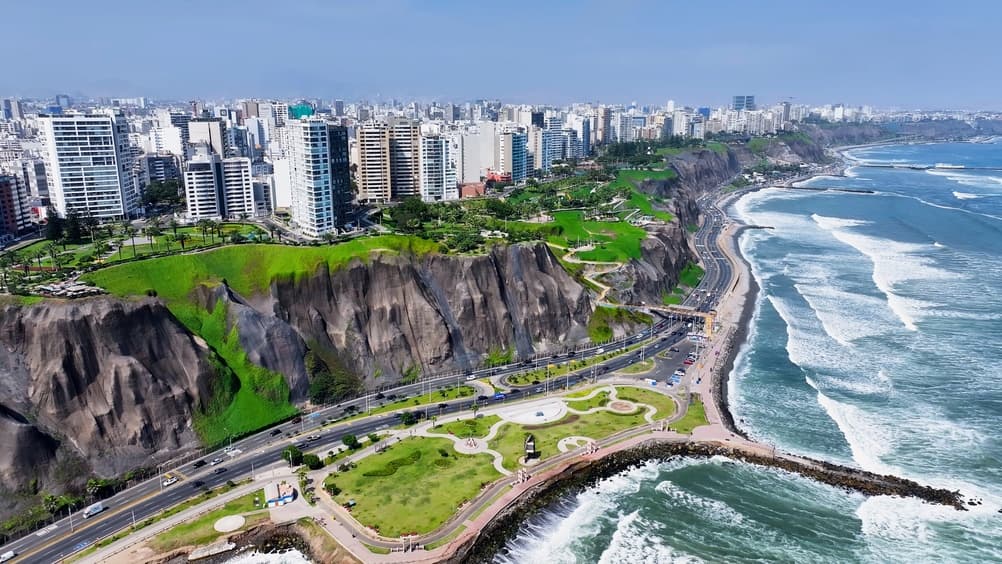
Living in Lima: Pacific cliffs, private clinics and about $1,400 a month
Where Americans settle in a city of nearly 10 million, how to stay safe there, and what the long gray winter is like.
- 9,943,800
- Population (2022)
- $1,400/mo
- Monthly budget · single
- 68°F / 20°C
- Avg temperature
One person in Lima typically spends $1,300 to $1,600 a month in U.S. dollars, and about $1,400 covers a comfortable middle. A couple lands near $2,300 and a family of four near $3,300. A one-bedroom near the center rents for around $800, or about $550 farther out, and home internet runs about $20.
Lima suits people who want a true capital: direct flights home, private clinics, a big food scene and nearly 10 million neighbors. Most newcomers settle in Miraflores, San Isidro or Barranco, the districts along and near the ocean cliffs.
Two things to plan around. Street crime is real, so app taxis and a little caution at night become habit. And from about May to November a low gray fog, the garúa, hides the sun for weeks at a time, even though it almost never rains.

Reviewed and updated October 9, 2026 · 4 min read
At a glance
$1,400
Monthly budget · single person
$800/mo 1-bed rent, center
42/100
Safety index
$20
Internet / month
68°Fannual average
Aug 62° · Feb 75°
Climate
9,943,800
Population (2022)
Expatsi estimates, updated Oct 2026, based on rental listings, government statistics, and local reporting.
Cost of living
What it costs to live in Lima
Single person
$1,300–$1,600/mo
about 55% below Austin, TX
Couple
$2,000–$2,600/mo
about 50% below Austin, TX
Family of four
$2,700–$3,900/mo
about 60% below Austin, TX
Compared with Austin, TX (Expatsi estimate, 2026).
- $5 −75%
- Inexpensive meal
- $700–$900/mo −59%
- 1-bed rent, center
- $500–$600/mo −59%
- 1-bed rent, outside
- $20/mo −69%
- Internet
- $242/sq ft −63%
- Buy price, center
Expatsi estimates, updated Oct 2026, based on rental listings, government statistics, and local reporting.
Daily life
How Lima lives
- B+ grade, 68th percentile among the cities we track
- Dining & cafésstrong
- A grade, 86th percentile among the cities we track
- Arts & culturestandout
- A- grade, 80th percentile among the cities we track
- Parks & outdoorsstrong
- A+ grade, 99th percentile among the cities we track
- Schools & educationstandout
- A grade, 91st percentile among the cities we track
- Healthcare accessstandout
- B grade, 54th percentile among the cities we track
- Bike infrastructuretypical
- B grade, 41st percentile among the cities we track
- Public transittypical
- A grade, good physical accessibility
- Accessibilitygood
Graded on OpenStreetMap amenity density relative to the 298 cities we track. Accessibility is the exception: it's graded against a fixed standard (terrain steepness and sidewalk surfaces), not a curve.
Climate
Weather through the year
Annual average 68°F (20°C) · 0 in of rain a year · Source: Meteostat station normals (84628, 1991-2020)
On the ground
Scenes from Lima
Getting around
Transport in Lima
If you live in Miraflores, San Isidro or Barranco, you can skip the car. Daily errands are walkable, and ride-hailing apps cover the rest. The U.S. State Department advises using app-based taxis, a taxi ordered by phone or a hotel service rather than hailing one on the street, since people have been robbed after flagging down unknown cabs. Drivers move fast and don't always yield, so cross with care.
The Metropolitano is Lima's bus rapid transit line, with its own lanes and stations in Barranco, Miraflores and San Isidro on the way downtown. You pay with a prepaid card bought and topped up at stations, and the machines don't take bank cards. The elevated Metro's Line 1 links Villa El Salvador in the south with downtown and San Juan de Lurigancho, but it doesn't reach the coastal districts where most foreigners live. A first short stretch of Line 2 opened in December 2023, and a line for Miraflores and Barranco is still only planned.
The new terminal at Jorge Chávez International Airport opened in June 2025 in Callao, about 11 miles from Miraflores. Book a ride through an app or take the Airport Express Lima bus, and leave extra time at rush hour.
- 17/sq mi
- Transit stops
- 8.8/sq mi
- Bike infrastructure
- 38/sq mi
- Wheelchair-accessible places
Mapped features per square mile from OpenStreetMap.
Keep exploring
Places like Lima
Oaxaca
Mexico
300.1K people · $1,500/mo

New Taipei City
Taiwan
4M people · $1,400/mo
Guadalajara
Mexico
1.4M people · $1,600/mo
 Coming soon
Taichung
Taiwan
2.9M people · $1,400/mo
Córdoba
Argentina
1.5M people · $1,200/mo
 Coming soon
São Paulo
Brazil
11.5M people · $1,700/mo
Community & practical notes
Settling in on the coast: districts, doctors and community
Where newcomers land
Miraflores is the usual first stop for expats and retirees, with ocean views, parks and the clifftop boardwalk. San Isidro is quieter and more upscale, with green space and an olive grove. Barranco is the arty district, known for street art, galleries and live music. Families who want more room often look inland at La Molina or San Borja.
Healthcare
Foreigners mostly use private clinics. Clínica Anglo Americana and Clínica Internacional both have locations in or near Miraflores, and Clínica Ricardo Palma and Clínica San Felipe serve San Isidro. Budget for private health coverage. The State Department notes that ambulance service is far more dependable in Lima and other big cities than in the rest of Peru, which matters if you plan to travel the country often.
Remote work
Home internet runs about $20 a month. Service varies by building, so test the connection at a specific apartment before you sign a lease.
Retiring in Lima
Retirees come for private hospitals, the food and a mild climate with no real rain. Peru's pension-based route is the Rentista residence; our Rentista guide explains the income rule. The Peru moving guide covers the rest of the move. The retirement visa roundup shows how Peru compares with other countries.
LGBTQ expats
Same-sex relationships are legal in Peru, but same-sex marriage and civil unions are not. A U.S. marriage won't give your partner status here. Each of you will usually need your own residence route. The State Department describes societal discrimination as high, and most LGBTQ newcomers keep a lower profile than they would at home.
Black Americans
Lima is a center of Afro-Peruvian life. The National Afro-Peruvian Museum covers the community's music, dance, food and traditions, and the Verano Negro festival in El Carmen each summer is a good first introduction to the culture. We haven't found solid reporting on how Black Americans are treated day to day in Lima, so talk to people already living there before you commit.
Limited mobility
Lima is mostly flat, but access is uneven. Residents describe San Isidro's sidewalks as wide with ramps and Miraflores's as narrower. Many shops have retrofitted ramps that can be steep or narrow, and the State Department says public transit accessibility is limited, so plan on ride apps. The beaches sit below steep cliffs, so check how you'd reach them before you count on an ocean-view walk.
Housing
Renting and buying
- 1-bed rent (center)
- $700–$900/mo
- 1-bed rent (outside center)
- $500–$600/mo
- Buy price (center)
- $242/sq ft
- Buy price (outside center)
- $130/sq ft
Expatsi estimates, based on rental listings, government statistics, and local reporting.
Good to know
Frequently asked questions
How much does it cost to live in Lima, Peru per month?
A single person in Lima typically spends $1,300 to $1,600 a month in U.S. dollars, with about $1,400 as a comfortable middle. A couple spends about $2,300 and a family of four about $3,300. A one-bedroom apartment near the center rents for around $800 a month.
Can Americans retire in Lima?
Yes. Peru's Rentista residence is the usual route for Americans living on a pension or other steady passive income. Retirees in Lima tend to settle in Miraflores, San Isidro or Barranco, close to the city's private clinics.
Which neighborhoods do expats live in Lima?
Most foreigners choose Miraflores, which has ocean views and a clifftop boardwalk, quieter and more upscale San Isidro, or arty Barranco. Families wanting more space often look at La Molina or San Borja, farther from the coast.
Can same-sex couples live in Lima?
Yes, but without legal recognition. Same-sex relationships are legal in Peru, but same-sex marriage and civil unions are not, so each partner usually needs a separate residence route. The U.S. State Department describes societal discrimination against gay and lesbian people as high.
What is the weather like in Lima?
Lima is mild and almost rainless. Summer (January to March) brings sun and average highs near 81F in February. From about May to November a low gray fog called the garúa covers the city, and average highs drop to about 65F in August. Average rainfall is about 0.3 inches a year.
Does Lima have good healthcare for expats?
Yes, through private clinics. Foreigners commonly use Clínica Anglo Americana, Clínica Internacional, Clínica Ricardo Palma and Clínica San Felipe, so plan on private health coverage. Ambulance service is also far more dependable in Lima than in most of Peru.
Is Lima safe for Americans?
Lima is livable with sensible habits, but street crime is common. As of September 2026, the U.S. State Department rates Peru Level 2, exercise increased caution, and Lima isn't on its list of areas to avoid. It warns that crime rises at night and that people have been robbed after hailing taxis on the street, so use app-based taxis instead.
Do you need a car in Lima?
Not if you live in Miraflores, San Isidro or Barranco. Those districts are walkable for daily errands, ride-hailing apps cover longer trips, and the Metropolitano bus rapid transit line runs from them to downtown.
See how Lima fits your life
Take the free Expatsi Test and compare Peru to over 100 countries on what actually matters: cost, healthcare, climate, and safety. About five minutes.
Why not you?