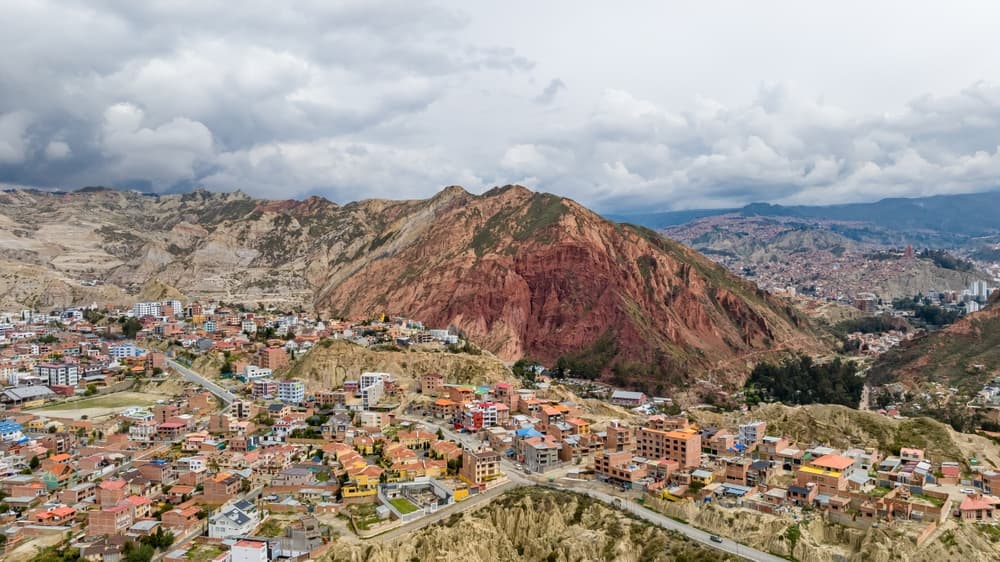
La Paz, Bolivia: a canyon city at 11,900 feet, on about $1,000 a month
What living in Bolivia's seat of government costs, how safe it is, how the cable cars fit into daily life, and who should think twice about retiring this high.
- 755,732
- Population (2024)
- $1,000/mo
- Monthly budget · single
- 48°F / 9°C
- Avg temperature
Plan on roughly $1,000 a month in U.S. dollars if you're living alone in La Paz, as of October 2026. A couple runs about $1,600, and a family of four about $2,400. Housing takes a small bite: around $400 for a one-bedroom near the center, or $300 farther out.
Bolivia's seat of government fills a steep canyon at about 11,900 feet, with El Alto spread across the plateau on the rim. It suits people who want a big, busy Andean city on a modest budget, who are comfortable living in Spanish, and whose bodies handle thin air well.
That last part decides it. The State Department warns that high altitude can harm anyone, whatever their fitness, and says to see a doctor first if you're pregnant or have a pre-existing condition. Most foreigners live in Zona Sur, lower and warmer than the center.

Reviewed and updated October 15, 2026 · 4 min read
At a glance
$1,000
Monthly budget · single person
$400/mo 1-bed rent, center
47/100
Safety index
$30
Internet / month
48°Fannual average
Jul 45° · Dec 50°
Climate
755,732
Population (2024)
Expatsi estimates, updated Oct 2026, based on rental listings, government statistics, and local reporting.
Cost of living
What it costs to live in La Paz
Single person
$900–$1,200/mo
about 70% below Austin, TX
Couple
$1,400–$1,900/mo
about 65% below Austin, TX
Family of four
$1,900–$2,900/mo
about 70% below Austin, TX
Compared with Austin, TX (Expatsi estimate, 2026).
- $4 −80%
- Inexpensive meal
- $350–$450/mo −79%
- 1-bed rent, center
- $250–$350/mo −78%
- 1-bed rent, outside
- $30/mo −54%
- Internet
- $139/sq ft −79%
- Buy price, center
Expatsi estimates, updated Oct 2026, based on rental listings, government statistics, and local reporting.
Daily life
How La Paz lives
- A- grade, 74th percentile among the cities we track
- Dining & cafésstrong
- A- grade, 76th percentile among the cities we track
- Arts & culturestrong
- A grade, 89th percentile among the cities we track
- Parks & outdoorsstandout
- A grade, 91st percentile among the cities we track
- Schools & educationstandout
- A+ grade, 98th percentile among the cities we track
- Healthcare accessstandout
- B- grade, 35th percentile among the cities we track
- Bike infrastructuretypical
- B+ grade, 56th percentile among the cities we track
- Public transitstrong
- C+ grade, challenging physical accessibility
- Accessibilitychallenging
Graded on OpenStreetMap amenity density relative to the 369 cities we track. Accessibility is the exception: it's graded against a fixed standard (terrain steepness and sidewalk surfaces), not a curve.
Climate
Weather through the year
Annual average 48°F (9°C) · 28 in of rain a year · Source: Open-Meteo Historical Weather API (temps: ERA5-Land 0.1°; precip/sunshine: ERA5 best-match; 1991-2020 normals)
On the ground
Scenes from La Paz
Getting around
Transport in La Paz
Most people get around on minibuses, which carry the bulk of city trips in Bolivia, and on Mi Teleférico, the cable car system linking downtown La Paz with El Alto above it. It holds the Guinness record for the largest public-transit cable car network. Residents describe it as a calm ride with big views that rarely beats a car, unless the roads below are jammed.
For taxis, the State Department says to use only marked radio taxis, which show the company's name and phone number on the roof. Don't get into unmarked cars, including ones driven by people claiming to be police.
You can skip owning a car, especially if you rent in Zona Sur near a cable car station. Driving means steep streets and the risk of roadblocks, a common protest tactic that can close routes for days. Never try to cross one. December through February are the wettest months, and flash floods can hit the city then.
- 28/sq mi
- Transit stops
- 0.9/sq mi
- Bike infrastructure
- 46/sq mi
- Wheelchair-accessible places
Mapped features per square mile from OpenStreetMap.
Keep exploring
Places like La Paz
Community & practical notes
Settling into La Paz: altitude, doctors, money and neighbors
Where people live: Expats mostly settle in Zona Sur, in neighborhoods like Calacoto, San Miguel and Achumani. It's where the diplomatic community lives, and being lower than the center makes the first weeks easier on your lungs.
Your first days: Rest and keep activity light until you've adjusted. Book the movers for a week after you land, not the day you arrive.
Healthcare: Foreign residents use private clinics. Clínica Alemana on Avenida 6 de Agosto and Clínica del Sur in Obrajes are both on the British government's list of facilities with English-speaking staff. Hospitals and doctors often want payment before they treat you, and Medicare doesn't cover care abroad. Healthcare coach Hunter Schultz, one of our partners, can help you build a care plan, and ExpatInsure can quote international coverage.
Money and water: Bolivia ended its 15-year dollar peg in June 2026, and the boliviano now floats under central bank oversight, so prices quoted in bolivianos can shift quickly. Bring crisp U.S. bills, since banks and exchange houses often turn down folded or worn ones, and don't rely on ATMs, which are frequently out of order. Tap water isn't safe for drinking, cooking or brushing your teeth.
Working remotely: We couldn't confirm which coworking spaces are operating now, so plan to work from home. Test the connection on a video call before you sign a lease.
Safety: The State Department rates Bolivia Level 2, Exercise Increased Caution. It flags petty crime in El Alto, says to skip its 16 de Julio market because of pickpockets, and warns Americans not to go to Chapare Province at all. Real estate scams are common too, so use your own lawyer before you buy anything.
Limited mobility: This is a hard city on a wheelchair or walker. The streets climb the canyon walls, the State Department says accessibility is very limited across transport, lodging and public spaces, and the disability law is unevenly enforced. Visit before you commit, and check every route from the front door.
LGBTQ expats: The State Department describes La Paz as generally tolerant of gay and lesbian travelers. Bolivia's constitutional court upheld recognition of same-sex civil unions in 2023. In August 2026, a court order led to the country's first registered marriage between two women. That ruling covers only that couple while the court reviews it, so marriage is not open to same-sex couples in general.
Black Americans: We didn't find reporting on Black Americans' day-to-day experience in La Paz. Before you move, reach out to Black expats already living in Bolivia, and spend a few weeks in the city first.
Retiring here: La Paz works for retirees who are healthy at altitude, want city life in Spanish, and can live with protests that close roads. Americans can visit for less than 90 days a year without a visa, which makes a trial stay simple. If your doctor is wary of the altitude, look lower: Cochabamba sits at about 8,400 feet, Sucre at about 9,200, and Santa Cruz de la Sierra at about 1,400. Our retirement visa guide compares residency routes, and our Bolivia moving guide covers residency, taxes and safety.
Housing
Renting and buying
- 1-bed rent (center)
- $350–$450/mo
- 1-bed rent (outside center)
- $250–$350/mo
- Buy price (center)
- $139/sq ft
- Buy price (outside center)
- $88/sq ft
Expatsi estimates, based on rental listings, government statistics, and local reporting.
Good to know
Frequently asked questions
Is La Paz a good place to retire?
It can be, if you're healthy at high altitude. La Paz sits at about 11,900 feet, and the State Department says altitude can harm anyone, so get a doctor's opinion first, especially with heart or lung problems. If altitude is a concern, Bolivia's lower cities include Cochabamba, Sucre and Santa Cruz de la Sierra.
How much does it cost to live in La Paz, Bolivia?
One person typically spends $900 to $1,200 a month in La Paz, and a couple $1,400 to $1,900, based on our October 2026 data in U.S. dollars. For housing, a one-bedroom apartment near the center runs about $350 to $450 a month. Bolivia let its currency float in June 2026, so prices quoted in bolivianos can move.
Do Americans need a visa for Bolivia?
Not for short visits anymore. A December 2025 decree dropped the tourist visa for U.S. citizens, and the State Department says Americans can visit for tourism or business without a visa for less than 90 days a year. Your passport needs six months of validity. Living there longer takes a residence permit.
Where do expats live in La Paz?
Most foreigners, including diplomats, live in Zona Sur, the lowest part of the city, in neighborhoods such as Calacoto, San Miguel and Achumani. It's also warmer than the center.
What's the weather like in La Paz?
Cool all year. Average highs stay around 56F to 60F every month, and July nights average near 35F. December through February bring most of the rain, while May through August are dry and sunny. Pack warm layers whatever month you arrive.
Is La Paz safe for Americans?
La Paz is livable with ordinary big-city care. The State Department rates Bolivia Level 2, Exercise Increased Caution, citing crime, unrest and health. It flags petty crime in neighboring El Alto, advises using only marked radio taxis, and warns that protests and roadblocks can start with little notice. It says not to travel to Chapare Province at all.
How high is La Paz, and will the altitude affect me?
La Paz is at about 11,900 feet, and El Alto on the plateau above is higher still. The State Department says to rest and limit activity until you adjust, and to see a doctor before you go if you're pregnant or have a pre-existing medical condition.
See how La Paz fits your life
Take the free Expatsi Test and compare Bolivia to over 100 countries on what actually matters: cost, healthcare, climate, and safety. About five minutes.
Why not you?