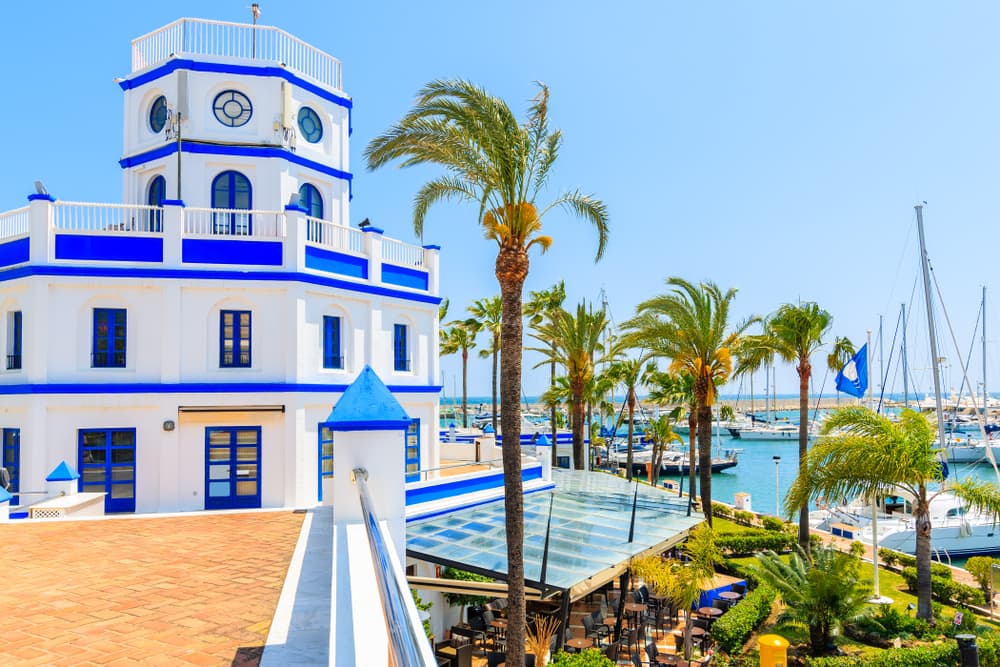
Estepona: the garden town at the quiet end of the Costa del Sol
Living in Estepona: what it costs, how safe it feels, and whether it works for retirement, west of Marbella on Spain's southern coast.
- 79,621
- Population (2025)
- $2,300/mo
- Monthly budget · single
- 66°F / 19°C
- Avg temperature
Plan on about $2,300 a month in U.S. dollars for one person in Estepona, roughly $3,300 for a couple, and around $4,800 for a family of four (2026 figures). A one-bedroom in the center rents for about $1,200, and closer to $900 farther out. That's a step below Malaga, where one person needs about $2,400 and a central one-bedroom runs about $1,400.
Estepona suits people who want the Costa del Sol at a slower pace: retirees, remote workers who don't need a big-city office, and anyone who'd rather walk to the beach than drive to it. The town has close to 80,000 residents, a seafront promenade that runs for miles, and an old town the council has rebuilt street by street, with more than 60 murals on building walls and over 130 streets remodeled and planted with flowers.
It's a weaker fit if you need a local job market, late nights, or a train at your door. There's no rail line, a lot of the housing sits in developments outside the center, and the town fills up in July and August.

Reviewed and updated October 1, 2026 · 4 min read
At a glance
$2,300
Monthly budget · single person
$1,200/mo 1-bed rent, center
75/100
Safety index
$35
Internet / month
66°Fannual average
Jan 57° · Aug 77°
Climate
79,621
Population (2025)
Expatsi estimates, updated Aug 2026, based on rental listings, government statistics, and local reporting.
Cost of living
What it costs to live in Estepona
Single person
$1,900–$2,700/mo
about 25% below Austin, TX
Couple
$2,700–$3,900/mo
about 30% below Austin, TX
Family of four
$3,900–$5,700/mo
about 40% below Austin, TX
Compared with Austin, TX (Expatsi estimate, 2026).
- $17 −15%
- Inexpensive meal
- $950–$1,400/mo −38%
- 1-bed rent, center
- $750–$1,050/mo −33%
- 1-bed rent, outside
- $35/mo −46%
- Internet
- $404/sq ft −38%
- Buy price, center
Expatsi estimates, updated Aug 2026, based on rental listings, government statistics, and local reporting.
Daily life
How Estepona lives
- C+ grade, 21st percentile among the cities we track
- Dining & cafésmodest
- B- grade, 28th percentile among the cities we track
- Arts & culturetypical
- A grade, 90th percentile among the cities we track
- Parks & outdoorsstandout
- C+ grade, 24th percentile among the cities we track
- Schools & educationmodest
- B- grade, 29th percentile among the cities we track
- Healthcare accesstypical
- B grade, 51st percentile among the cities we track
- Bike infrastructuretypical
- B- grade, 28th percentile among the cities we track
- Public transittypical
- A- grade, good physical accessibility
- Accessibilitygood
Graded on OpenStreetMap amenity density relative to the 369 cities we track. Accessibility is the exception: it's graded against a fixed standard (terrain steepness and sidewalk surfaces), not a curve.
Climate
Weather through the year
Annual average 66°F (19°C) · 31 in of rain a year · Source: Meteostat station normals (08495, 1991-2020)
On the ground
Scenes from Estepona
Getting around
Transport in Estepona
If you live in or near the old town, you can get by on foot. The town counts more than 130 pedestrian or traffic-restricted streets and plazas in its historic center, and the promenade links the center with the beaches on either side. Groceries, the market, cafés and the beach are all a walk away.
Three local bus lines, run by Autocares Ricardo, cover the town itself. For anything farther, Avanza runs the coastal coaches. Its L-613 express goes straight between Estepona and Malaga airport in about an hour and 15 minutes, and several other Avanza lines stop in Marbella and the towns in between.
There's no train. The Cercanías commuter line from Malaga ends at Fuengirola, so trips to Madrid or Seville start with a bus or a drive to Malaga's María Zambrano station.
That's why most people who live outside the center own a car. Many homes sit in hillside urbanizaciones (residential developments) where buses are thin on the ground, and exploring inland Andalusia is far easier with your own wheels. Rent in the old town or along the seafront and you can skip the car for daily life.
- 5.0/sq mi
- Transit stops
- 5.7/sq mi
- Bike infrastructure
- 4.0/sq mi
- Wheelchair-accessible places
Mapped features per square mile from OpenStreetMap.
Keep exploring
Places like Estepona
Community
Community & practical notes
The expat scene: Estepona's foreign community has been here for decades, and English goes a long way in shops, real estate offices and private clinics. Town hall paperwork, your padrón (town hall registration) and most of the public system still run in Spanish, so a few months of lessons pays off fast. The crowd skews older and settled; if you want a big social calendar of young remote workers, Malaga is a better match.
Healthcare: The town's public hospital, the Hospital de Alta Resolución de Estepona, opened in February 2021 and has been adding services in stages, with full operation expected in 2026. It was built for emergencies, specialist appointments and day surgery so residents make fewer trips to the province's larger hospitals, which still handle the most complex cases. Getting onto the public system takes your residency card and padrón first. Plenty of residents also keep private coverage for faster specialist access and English-speaking doctors.
Limited mobility: The council lists removing architectural barriers as a priority, and the traffic-restricted old town and long, level promenade help. In summer, Playa de La Rada and Playa El Cristo offer assisted bathing with amphibious chairs, and public beach entrances have boardwalks wide enough for wheelchairs. The town's own accessibility guide doesn't cover curb ramps, street gradients or adapted taxis, and homes up in the hillside developments mean steep driving roads, not sidewalks. Walk the streets around any apartment before you sign.
Getting online: Home internet runs about $35 a month. Estepona isn't a hiring town for Americans, so most people here bring their income with them. If that income is a remote job, Spain's digital nomad visa is built for exactly that.
Retiring here: Estepona fits retirees well: mild winters, a walkable center, and a public hospital in town. Spain's non-lucrative visa is the usual route. It asks for proof of passive income, private health insurance and a clean background check, and it doesn't let you work. Spain taxes worldwide income once you're a tax resident, so talk to a cross-border tax advisor before you commit. Compare retirement visa options worldwide, or read our full Spain guide.
Housing
Renting and buying
- 1-bed rent (center)
- $950–$1,400/mo
- 1-bed rent (outside center)
- $750–$1,050/mo
- Buy price (center)
- $404/sq ft
- Buy price (outside center)
- $358/sq ft
Expatsi estimates, based on rental listings, government statistics, and local reporting.
Good to know
Frequently asked questions
Do you need a car to live in Estepona?
Only if you live outside the center. The old town and promenade are walkable, three local bus lines cover the town, and Avanza coaches run along the coast to Marbella and Malaga airport. Estepona has no train station, though, and many homes are in hillside developments where a car is close to essential.
What is the weather like in Estepona year-round?
Estepona has a mild Mediterranean climate. Average highs sit near 82F to 83F in July and August and around 62F in January, with January lows near 52F. Summers are almost completely dry, and most rain falls from November through February, with December the wettest month.
Is Estepona safe for Americans?
Yes. Estepona scores 75 out of 100 on our safety index, higher than Malaga's 69. Violent crime against residents is not a common worry; the usual precautions with bags and phones in crowded summer spots are enough for most people.
Is Estepona a good place to retire?
For many retirees, yes. Winters are mild, the old town and seafront are walkable, there's a public hospital in town, and English is widely spoken by the established foreign community. Most Americans retire to Spain on the non-lucrative visa, which requires passive income and private health insurance and doesn't allow work. The trade-offs are a quiet nightlife, no train, and a car if you live outside the center.
How much does it cost to live in Estepona, Spain?
One person typically spends between $1,900 and $2,700 a month in Estepona, with about $2,300 a good planning number (2026 figures, in U.S. dollars). A couple should plan on roughly $3,300. Rent is the biggest line: a one-bedroom in the center usually runs $950 to $1,400 a month.
Do people speak English in Estepona?
In much of daily life, yes. Estepona has a long-established foreign community, and English is common in shops, restaurants, real estate offices and private clinics. Government offices and the public health system work in Spanish, so it helps to learn the basics or bring a translator to appointments.
How do you get from Malaga airport to Estepona?
Avanza's L-613 express coach runs directly between Malaga airport and Estepona in about an hour and 15 minutes. Several other Avanza lines make the same trip with more stops. There's no train to Estepona, so it's the bus, a taxi or a rental car.
Is Estepona cheaper than Malaga?
A little. One person needs about $2,300 a month in Estepona versus about $2,400 in Malaga, and a one-bedroom in the center rents for about $1,200 versus $1,400 (2026 figures, in U.S. dollars). Malaga gives you a bigger city, more jobs and a train; Estepona gives you a smaller town and a quieter beach life.
See how Estepona fits your life
Take the free Expatsi Test and compare Spain to over 100 countries on what actually matters: cost, healthcare, climate, and safety. About five minutes.
Why not you?