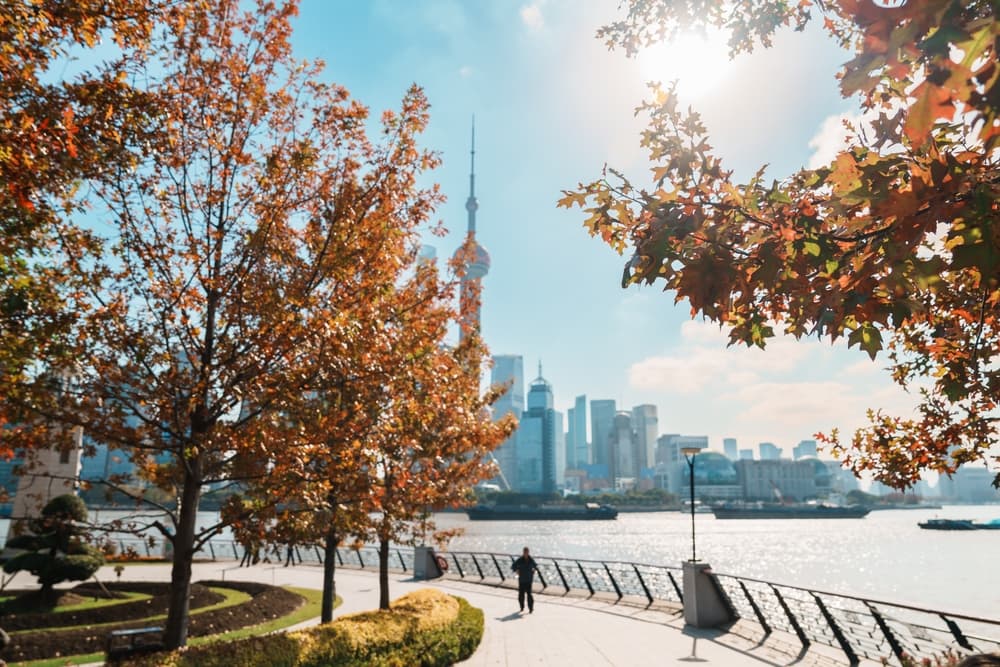
Shanghai: a job-first move to plane-tree streets and a tap-and-go metro
What living in Shanghai costs, how safe it is, and why the usual way in for Americans is a job, not a retirement plan.
- 24,870,895
- Population (2020)
- $2,700/mo
- Monthly budget · single
- 63°F / 17°C
- Avg temperature
One person can live well in Shanghai on about $2,700 a month, and our range runs from $2,200 to $3,200 depending on where you rent and how often you eat out. A couple should budget around $3,900, and a family of four about $5,700. Rent is the swing factor: a one-bedroom in the center averages about $1,500 a month, and about $900 farther out.
Shanghai works best for people who arrive with a job: teachers, finance and company staff, and families on corporate packages looking at family-oriented areas such as Hongqiao, Gubei or Jinqiao. Singles and couples often look at the tree-lined streets of the Former French Concession or central Jing'an.
It's a poor fit if you plan to retire or keep working remotely for a U.S. employer. China's visa list has no category for either, and Americans aren't on its 30-day visa-free list.

Reviewed and updated October 15, 2026 · 4 min read
At a glance
$2,700
Monthly budget · single person
$1,500/mo 1-bed rent, center
78/100
Safety index
$15
Internet / month
63°Fannual average
Jan 41° · Jul 84°
Climate
24,870,895
Population (2020)
Expatsi estimates, updated Oct 2026, based on rental listings, government statistics, and local reporting.
Cost of living
What it costs to live in Shanghai
Single person
$2,200–$3,200/mo
about 15% below Austin, TX
Couple
$3,200–$4,600/mo
about 15% below Austin, TX
Family of four
$4,700–$6,700/mo
about 30% below Austin, TX
Compared with Austin, TX (Expatsi estimate, 2026).
- $5 −75%
- Inexpensive meal
- $1,250–$1,750/mo −23%
- 1-bed rent, center
- $750–$1,050/mo −33%
- 1-bed rent, outside
- $15/mo −77%
- Internet
- $35/mo −15%
- Transit pass
- $1,301/sq ft +100%
- Buy price, center
Expatsi estimates, updated Oct 2026, based on rental listings, government statistics, and local reporting.
Daily life
How Shanghai lives
- A grade, 87th percentile among the cities we track
- Dining & cafésstandout
- A grade, 85th percentile among the cities we track
- Arts & culturestandout
- B- grade, 27th percentile among the cities we track
- Parks & outdoorstypical
- A- grade, 76th percentile among the cities we track
- Schools & educationstrong
- B grade, 49th percentile among the cities we track
- Healthcare accesstypical
- A- grade, 78th percentile among the cities we track
- Bike infrastructurestrong
- A- grade, 83rd percentile among the cities we track
- Public transitstrong
- A grade, good physical accessibility
- Accessibilitygood
Graded on OpenStreetMap amenity density relative to the 369 cities we track. Accessibility is the exception: it's graded against a fixed standard (terrain steepness and sidewalk surfaces), not a curve.
Climate
Weather through the year
Annual average 63°F (17°C) · 48 in of rain a year · Source: Meteostat station normals (58367, 1981-2010; no sunshine data); sunshine: Shanghai (Xujiahui) elevation 5 m (16 ft) (1991–2020 normals extremes 1951–present) via en.wikipedia.org/wiki/Shanghai
On the ground
Scenes from Shanghai
Getting around
Transport in Shanghai
Skip the car. The metro is how Shanghai gets around, and since June 28, 2025 you can tap a contactless Visa, Mastercard or American Express card at any gate on the network. Switch on your card's small-amount, no-PIN payment setting first, or the gate won't open. You can also pay with a QR code: the Shanghai Metro Daduhui app takes Alipay, WeChat Pay or a foreign card, and the Suishenxing app gives you one code for the metro, buses and ferries. Plan on about $35 a month for transit.
Landing at Pudong, the Maglev reaches Longyang Road metro station in about eight minutes, and it takes tapped foreign cards too.
Driving isn't an option when you arrive. The State Department says you can't drive in China on a U.S. or international license. On foot, keep its other warning in mind: pedestrians don't have the right of way.
- 56/sq mi
- Transit stops
- 40/sq mi
- Bike infrastructure
- 23/sq mi
- Wheelchair-accessible places
Mapped features per square mile from OpenStreetMap.
Keep exploring
Places like Shanghai

Settling in
Community and practical notes
Who lives where: Foreign Shanghai sorts itself by life stage. Families on company packages tend to look at Hongqiao, known for its international schools, at Gubei, or at Jinqiao, a planned Pudong neighborhood with a large expat population. Lujiazui, Pudong's financial district, suits people working in finance. Popular international schools include Shanghai American School, Shanghai British International School and Shanghai Community International School. Julie Marx, our China guide, can walk you through how the neighborhoods compare.
Healthcare: Foreigners can choose from several private hospitals with English-speaking staff. Shanghai United Family (main hospital in Changning), Jiahui (in Xuhui) and SinoUnited all run 24-hour urgent care, and the international department of a public hospital such as Huashan or Ruijin is a lower-cost middle ground. Two things catch newcomers out: U.S. health insurance generally isn't accepted, and a 120 ambulance usually takes you to the nearest public hospital, not the international one you'd choose. Shanghai United Family bills more than 40 international insurers directly, so the right policy matters. ExpatInsure can set that up, and Hunter Schultz, our healthcare coach, can help you work out what coverage you need.
The air: Shanghai averaged 26 micrograms of PM2.5 per cubic meter in 2025, and the city rated its air good or excellent on 88.5% of days.
Internet and work: Home internet runs about $15 a month. Many U.S. sites and apps won't load without a VPN, and the State Department says VPN use is illegal in most cases and can lead to a confiscated device, a fine or detention. There's no visa for working remotely for a U.S. company; the realistic route is a job with a China-incorporated employer on a Z work visa.
First weeks: Register your address within 24 hours of arrival, at your hotel or residence. Opening a bank account usually means a trip to a branch in person with your passport, visa and proof of address.
LGBTQ expats: Same-sex relationships are legal, but China doesn't recognize same-sex marriage and has no law against discrimination based on sexual orientation or gender identity. Visibility has shrunk: ShanghaiPRIDE, running since 2009, stopped all events in 2020. Some LGBTQ venues closed around the same time, though queer cafes and parties kept going.
Black Americans: Experiences vary a lot. Shanghai has a Black business network, Black X, started by a Black entrepreneur who also organizes Shanghai Black Fashion Week. In English teaching, NBC has reported recruiters and schools openly preferring white teachers, so ask schools direct questions before you sign and talk to Black teachers already there. Americans of Chinese descent should know the State Department warns they may face extra scrutiny and harassment.
Limited mobility: Plan ahead. Metro stations have elevators, but wheelchair users report that usually only one entrance has one and some are kept locked until staff come. City buses aren't wheelchair accessible. The State Department notes that sidewalks can be uneven and often lack curb ramps, though public restrooms at tourist sites in major cities usually have an accessible toilet.
Retirement: Shanghai is a hard place to retire because China has no retirement visa. Summers are hot and humid, with average July highs near 90F. If retiring abroad is the plan, our retirement visa hub compares countries that have one, and the guide to moving to China covers the work, study and family routes.
Housing
Renting and buying
- 1-bed rent (center)
- $1,250–$1,750/mo
- 1-bed rent (outside center)
- $750–$1,050/mo
- Buy price (center)
- $1,301/sq ft
- Buy price (outside center)
- $697/sq ft
Expatsi estimates, based on rental listings, government statistics, and local reporting.
Good to know
Frequently asked questions
Is Shanghai safe for Americans?
For everyday street safety, yes: Shanghai scores 78 on Expatsi's safety index. The bigger risks are legal. As of September 2026, the State Department rates mainland China Level 2, exercise increased caution, because of arbitrary enforcement of local laws. It also says VPN use is illegal in most cases and that some U.S. citizens learn of exit bans only when they try to leave.
Can I move to Shanghai without a job?
In practice, very few Americans can. The main route is a Z work visa, which needs an employer incorporated in China. Americans aren't on China's 30-day visa-free list, and 240-hour visa-free transit only covers short trips onward to a third country, so it can't be used to settle in.
Can you use a U.S. credit card on the Shanghai metro?
Yes. Since June 28, 2025, every Shanghai Metro gate accepts tapped contactless Visa, Mastercard, American Express and JCB cards. You need to turn on the card's small-amount payment without a PIN. The Maglev from Pudong airport accepts tapped foreign cards too.
How much does it cost to live in Shanghai?
As of 2026, one person needs about $2,700 a month in Shanghai, and a typical single budget falls between $2,200 and $3,200. A couple needs about $3,900 and a family of four about $5,700. A one-bedroom apartment in the center rents for about $1,500 a month, and about $900 outside the center.
Do you need a VPN in Shanghai?
Many U.S. sites and apps don't load in China without one, but the State Department says VPN use there is illegal in most cases and can lead to device confiscation, a fine or detention. Weigh that risk before you rely on one for work or banking.
What is the weather like in Shanghai?
Shanghai has hot, humid summers and cool, damp winters. July average highs are near 90F, and January averages a high near 47F and a low near 35F. June is the wettest month, and the city gets about 48 inches of rain a year.
Where do expats live in Shanghai?
Family-oriented areas include Hongqiao, known for its international schools, Gubei, and Jinqiao in Pudong. Lujiazui, Pudong's financial district, suits people working in finance, while the Former French Concession and Jing'an draw people who want tree-lined streets, cafes and a central address.
Can Americans retire in Shanghai?
Not easily. China has no retirement visa, so living in Shanghai means qualifying through work, study or family. If retiring abroad is the goal, a country with a dedicated retirement or passive-income visa is the more practical choice.
See how Shanghai fits your life
Take the free Expatsi Test and compare China to over 100 countries on what actually matters: cost, healthcare, climate, and safety. About five minutes.
Why not you?