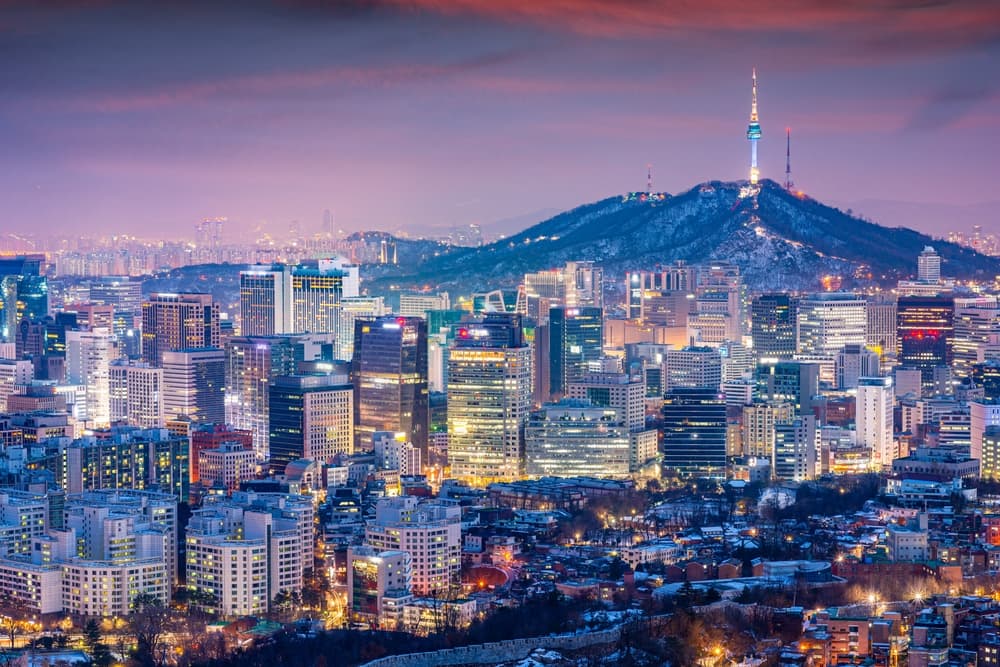
Living in Seoul: big-city Korea on about $2,200 a month
Cost of living, safety, retiring and moving to Seoul, a city where the subway reaches nearly everywhere and English help is one phone call away.
- 9,668,465
- Population (2020)
- $2,200/mo
- Monthly budget · single
- 56°F / 13°C
- Avg temperature
Our 2026 estimates put one person in Seoul at $1,900 to $2,500 a month in U.S. dollars. Where you live moves that number most: a one-bedroom near the center rents for about $1,000 a month, against about $750 farther out.
Seoul suits Americans who want a huge city that runs without a car: remote workers, people who'd rather ride the subway than drive, and anyone drawn to a serious food culture. Hannam, Itaewon and Mapo are where newcomers find the easiest foreigner-friendly services.
Here's the catch: apartments are small, and leases come with large deposits, so plan for move-in cash well beyond your first month's rent.

Reviewed and updated October 23, 2026 · 4 min read
At a glance
$2,200
Monthly budget · single person
$1,000/mo 1-bed rent, center
78/100
Safety index
$20
Internet / month
56°Fannual average
Jan 29° · Aug 80°
Climate
9,668,465
Population (2020)
Expatsi estimates, updated Oct 2026, based on rental listings, government statistics, and local reporting.
Cost of living
What it costs to live in Seoul
Single person
$1,900–$2,500/mo
about 30% below Austin, TX
Couple
$2,900–$3,700/mo
about 30% below Austin, TX
Family of four
$4,000–$5,800/mo
about 40% below Austin, TX
Compared with Austin, TX (Expatsi estimate, 2026).
- $8 −60%
- Inexpensive meal
- $900–$1,100/mo −49%
- 1-bed rent, center
- $650–$850/mo −44%
- 1-bed rent, outside
- $20/mo −69%
- Internet
- $50/mo +21%
- Transit pass
- $1,254/sq ft +93%
- Buy price, center
Expatsi estimates, updated Oct 2026, based on rental listings, government statistics, and local reporting.
Daily life
How Seoul lives
- A+ grade, 100th percentile among the cities we track
- Dining & cafésstandout
- A+ grade, 100th percentile among the cities we track
- Arts & culturestandout
- B+ grade, 62nd percentile among the cities we track
- Parks & outdoorsstrong
- A- grade, 77th percentile among the cities we track
- Schools & educationstrong
- A grade, 89th percentile among the cities we track
- Healthcare accessstandout
- B+ grade, 59th percentile among the cities we track
- Bike infrastructurestrong
- A grade, 90th percentile among the cities we track
- Public transitstandout
- B+ grade, moderate physical accessibility
- Accessibilitymoderate
Graded on OpenStreetMap amenity density relative to the 436 cities we track. Accessibility is the exception: it's graded against a fixed standard (terrain steepness and sidewalk surfaces), not a curve.
Climate
Weather through the year
Annual average 56°F (13°C) · 58 in of rain a year · Source: Meteostat station normals (47108, 1991-2020)
On the ground
Scenes from Seoul
Getting around
Transport in Seoul
The subway is how most of Seoul gets around, and it reaches nearly every neighborhood you'd consider living in. Tap in with T-money, Korea's standard rechargeable transit card. Our data puts a month of transit at about $50.
Monthly passes are in flux. The flat-rate Climate Card, about $42 (₩62,000) a month in 2026 for unlimited city buses and subway rides, stopped working after August 29, 2026. Its replacement, Climate Card Plus, will give its refunds and discounts only to Seoul residents, and as of August 2026 it was still waiting on approval from the national transport ministry. In the meantime, Seoul residents can sign up for the national K-Pass, also called the Modu Card, which refunds part of what you spend on fares.
From Incheon International Airport, the AREX express train reaches Seoul Station in about 43 minutes from Terminal 1. The all-stop train takes around 59 minutes and serves stations such as Hongik University and Gimpo Airport on the way. For short hops, Ttareungi, the city's public bike share, fills the gaps.
Do you need a car? Not if you live near a station. Choose an apartment by its walk to the subway, and a car becomes optional.
- 64/sq mi
- Transit stops
- 9.0/sq mi
- Bike infrastructure
- 14/sq mi
- Wheelchair-accessible places
Mapped features per square mile from OpenStreetMap.
Keep exploring
Places like Seoul


Community & practical notes
Getting settled in Seoul
Finding help in English: Seoul Global Center, next to exit 6 of Jonggak Station in Jongno, counsels foreign residents in 13 languages and runs free Korean classes and orientation seminars for newcomers. For quick questions about city services, call the 120 Dasan line (02-120, then 9, then 1 for English) on weekdays from 9 a.m. to 6 p.m. In Itaewon, an American who came to Korea 16 years earlier told the Korea Herald that there he's one of hundreds of foreigners and nobody pays him much attention.
Healthcare: Severance Hospital's International Health Care Center opened in 1962 as Korea's first international clinic, and its specialists speak English. Seoul Global Center also runs a 24-hour medical referral service with English-speaking, medically trained staff who can point you to the right hospital. Once you've lived in Korea more than six months, you must join National Health Insurance, the same public plan Koreans use, with premiums set by household income and property. Fall behind on premiums and immigration can refuse your visa extension. Arrange private coverage for the first six months.
Schools: Seoul Foreign School, founded in 1912 in western Seoul, teaches the International Baccalaureate and the English National Curriculum, and admits students who meet Korea's legal foreign-status rules. Yongsan International School of Seoul is a Christian international school in Hannam-dong. Ask each school about current tuition and openings.
Remote work: Home internet runs about $20 a month. Korea doesn't use daylight saving time, so Seoul is 13 to 14 hours ahead of Eastern, by season. Seoul counts as the capital region for the F-1-D workation visa, so the 2026 income floor is about $55,400 a year (₩78.6 million) if you're 18 to 34 and about $73,900 (₩104.8 million) if you're 35 or older.
LGBTQ expats: The 27th Seoul Queer Parade moved through central Seoul on June 13, 2026. Organizers expected 50,000 people, and a conservative Christian counter-rally gathered about 800 yards away. South Korea doesn't recognize same-sex marriage, but the Supreme Court ruled in July 2024 that same-sex partners qualify for spousal coverage under national health insurance. Expect a visible, organized community alongside organized opposition.
Black Americans: A 2022 academic study of Black residents in Korea found that Black Americans were treated better than Black Africans but were less liked than white Americans and more likely to face discrimination. A Black American student who wrote about Seoul for the study-abroad group CIEE described occasional stares and a few requests to touch her hair, and said she hadn't felt much different than at home. She also noted that other Black people she talked to had very different experiences.
Limited mobility: Since December 2025, every station on Seoul's city-run subway has an elevator route from street to platform, after the city finished 338 elevators at 338 stations. The gaps are on lines run by the national rail operator Korail: the Korea Herald reported seven stations in greater Seoul without elevators reaching both platforms. City open data lists where the wheelchair-accessible cars and platform elevators are on Lines 1 to 3. Before you sign a lease, check the building's elevator and the route to your nearest station.
Retirement: South Korea has no retirement visa. Americans of Korean heritage may qualify for the F-4 overseas Korean visa; for most others the routes are investment-based, like the F-5-5 investor visa, which asks for $500,000 and five Korean hires. Compare options in our guide to retirement visas and the full guide to moving to South Korea.
Housing
Renting and buying
- 1-bed rent (center)
- $900–$1,100/mo
- 1-bed rent (outside center)
- $650–$850/mo
- Buy price (center)
- $1,254/sq ft
- Buy price (outside center)
- $650/sq ft
Expatsi estimates, based on rental listings, government statistics, and local reporting.
Good to know
Frequently asked questions
How much does it cost to live in Seoul?
For a couple, our 2026 estimate is about $3,300 a month in U.S. dollars, within a range of $2,900 to $3,700. A family of four should plan on about $4,900 a month. Housing is the biggest swing: Seoul leases come with large deposits, so set aside move-in cash on top of the monthly budget.
Do I need to speak Korean to live in Seoul?
Not for the basics. Seoul Global Center counsels foreign residents in 13 languages, the city's 120 Dasan line has English-speaking counselors on weekdays (dial 02-120, then 9), and Severance Hospital runs an international clinic with English-speaking specialists. Learning some Korean still makes daily life easier, and Seoul Global Center offers free Korean classes.
Is Seoul safe for Americans?
Yes. In our 2026 data, Seoul has a safety index of 78 (higher is safer) and a crime index of 22 (lower is better). For emergencies, dial 119 for an ambulance or fire and 112 to report a crime.
Can I live in Seoul and work remotely for a U.S. company?
Yes, on South Korea's F-1-D workation visa, which lets you live in Korea while working for a company outside it, for up to three years in total. Because Seoul is in the capital region, you face the higher income floor: 1.5 times Korea's GNI per capita if you're 18 to 34, and 2 times if you're 35 or older. The floors reset each year.
Do I need health insurance to live in Seoul?
Yes. Foreign residents must join National Health Insurance after six months in Korea, with premiums based on household income and property, and unpaid premiums can block a visa extension. For your first six months, you'll need private coverage.
What is the weather like in Seoul?
Seoul has four distinct seasons. January averages lows near 22F and highs near 36F, while August averages highs near 86F. July and August bring the most rain, so expect a wet stretch in midsummer.
Can I retire in Seoul?
Not on a retirement visa, because South Korea doesn't offer one. Americans of Korean heritage may qualify for the F-4 overseas Korean visa. Others can look at investment routes such as the F-5-5 investor visa, which requires $500,000 and five Korean hires. Once you've lived in Korea more than six months, you join National Health Insurance, the public plan Koreans use.
See how Seoul fits your life
Take the free Expatsi Test to see how South Korea stacks up against other countries on cost, healthcare, climate, and safety.
Why not you?