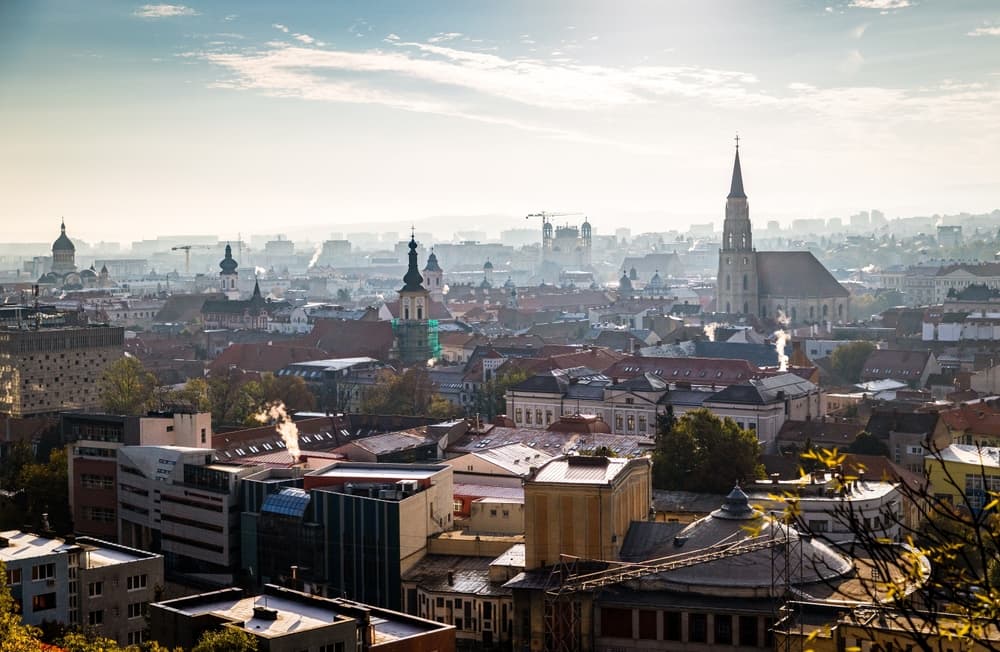
Cluj-Napoca: Transylvania's student and tech city, with real winters
What it costs to live in Cluj, how safe it is, how you get around without a car, and what retirees need to sort out before they move.
- 286,598
- Population (2021)
- $1,600/mo
- Monthly budget · single
- 50°F / 10°C
- Avg temperature
One person lives comfortably in Cluj-Napoca on about $1,600 a month, a couple on about $2,400, and a family of four on about $3,600. A one-bedroom in the center rents for around $800, and about $550 once you move farther out. Rents here run higher than in most Romanian cities, because Cluj is a university and tech city of about 287,000 people (2021 census) with plenty of people competing for central apartments.
It suits remote workers earning in dollars, younger movers who want a walkable center with English in the cafes and offices, and anyone who likes a city with a festival calendar led by the big summer Untold festival. Our safety index puts it at 75 out of 100.
It's a harder sell if you want sun or an easy retirement. January average highs sit near 34F, winter skies stay gray for weeks, and Romania has no visa built for retirees. There are no nonstop flights to the U.S. either, so trips home start with a connection in Europe or Istanbul.

Reviewed and updated October 22, 2026 · 4 min read
At a glance
$1,600
Monthly budget · single person
$800/mo 1-bed rent, center
75/100
Safety index
$10
Internet / month
50°Fannual average
Jan 28° · Aug 69°
Climate
286,598
Population (2021)
Expatsi estimates, updated Oct 2026, based on rental listings, government statistics, and local reporting.
Cost of living
What it costs to live in Cluj-Napoca
Single person
$1,300–$1,900/mo
about 50% below Austin, TX
Couple
$2,000–$2,900/mo
about 50% below Austin, TX
Family of four
$2,900–$4,200/mo
about 55% below Austin, TX
Compared with Austin, TX (Expatsi estimate, 2026).
- $12 −40%
- Inexpensive meal
- $650–$950/mo −59%
- 1-bed rent, center
- $450–$650/mo −59%
- 1-bed rent, outside
- $10/mo −85%
- Internet
- $45/mo +9%
- Transit pass
- $381/sq ft −41%
- Buy price, center
Expatsi estimates, updated Oct 2026, based on rental listings, government statistics, and local reporting.
Daily life
How Cluj-Napoca lives
- B+ grade, 66th percentile among the cities we track
- Dining & cafésstrong
- A- grade, 78th percentile among the cities we track
- Arts & culturestrong
- B+ grade, 58th percentile among the cities we track
- Parks & outdoorsstrong
- A- grade, 71st percentile among the cities we track
- Schools & educationstrong
- A grade, 93rd percentile among the cities we track
- Healthcare accessstandout
- A- grade, 70th percentile among the cities we track
- Bike infrastructurestrong
- B grade, 52nd percentile among the cities we track
- Public transittypical
- B+ grade, moderate physical accessibility
- Accessibilitymoderate
Graded on OpenStreetMap amenity density relative to the 436 cities we track. Accessibility is the exception: it's graded against a fixed standard (terrain steepness and sidewalk surfaces), not a curve.
Climate
Weather through the year
Annual average 50°F (10°C) · 24 in of rain a year · Source: Meteostat station normals (15120, 1991-2020)
On the ground
Scenes from Cluj-Napoca
Getting around
Transport in Cluj-Napoca
The old center around Piața Unirii is compact and mostly flat, so if you live in or near it, most errands happen on foot.
For longer trips, the city transit company CTP runs buses, trolleybuses and trams. The fleet has been heavily renewed: City Hall said in 2020 that half of it was already electric and two thirds of its roughly 370 vehicles were new. A single trip costs 3.50 lei, about 75 cents. On most vehicles you can tap a contactless bank card or phone at the validator, or buy through the 24BT app and scan the QR code when you board. Transit is free for everyone on Fridays, in Cluj-Napoca and in the neighboring communes of Florești, Apahida, Gilău and Baciu.
Avram Iancu Cluj International Airport is the other piece. As of its June 2026 schedule it served more than 40 destinations directly, including Munich and Frankfurt on Lufthansa, Istanbul on Turkish Airlines, Madrid, Rome and London's Luton and Stansted airports. There's no direct flight to the U.S., so Munich, Frankfurt and Istanbul are the usual connections home.
You don't need a car inside the city. You'll want one, or a rental for the weekend, if you plan to spend your free time in the Transylvanian countryside.
- 23/sq mi
- Transit stops
- 23/sq mi
- Bike infrastructure
- 36/sq mi
- Wheelchair-accessible places
Mapped features per square mile from OpenStreetMap.
Keep exploring
Places like Cluj-Napoca

Community & practical notes
Living in Cluj-Napoca day to day
The expat scene: Young and work-focused. Cluj's foreign residents lean toward remote workers, tech staff and students, and the city's English comes mostly from that crowd and from people under 40. Older neighbors, landlords and government offices work in Romanian, so plan on lessons if you're staying. Expect to make friends through coworking spaces, language classes and the festival circuit rather than a ready-made American scene.
Healthcare: Cluj is a medical city, home to the Iuliu Hațieganu University of Medicine and Pharmacy and its teaching hospitals. Most foreign residents use private networks for routine care. MedLife has operated here since 2008 and opened what it called the largest private clinic in the city in 2015, and Regina Maria announced a private hospital in Cluj with maternity care and a 24/7 on-call room for adults and children. Our Romania moving guide covers the public insurance opt-in and clinic subscription costs.
Remote work: Home internet runs about $10 a month. Coworking options include Cluj Hub and Impact Hub Cluj-Napoca. Local salaries are low by U.S. standards, so this works best when your income comes from outside Romania.
International schools: Transylvania College, which started as a kindergarten in 1993, runs a British track with IGCSE and A level courses from Year 10 and holds British School Overseas status. It also runs a Romanian track, so ask which one your child would join.
LGBTQ expats: Cluj held its ninth Pride march in June 2026, and thousands of people took part, with a small counter-rally in Piața Avram Iancu. The legal picture is the bigger issue: Romanian law bans same-sex marriage, and in May 2023 the European Court of Human Rights ruled that Romania must give same-sex couples some form of legal recognition. Check where that stands before you plan a partner's residence around a U.S. marriage.
Black Americans: Romania's Black population is small, and we couldn't find accounts written from Cluj itself. An Afro-Brazilian woman living in Romania, interviewed by Travel Noire in 2021, described frequent stares that read as curiosity, one incident of teenagers making monkey sounds at a mall, and a country she found very safe overall. Expect to be noticed. Before you commit, talk with Black residents through local expat and international-student groups.
Limited mobility: The center is mostly flat, which helps. Older buildings vary a lot, so check the entrance steps and whether there's an elevator before you sign anything. City Hall announced plans in 2019 for tactile maps for visually impaired residents at sites including the railway station and the airport, and for accessible tourist routes. Treat those as plans rather than finished work, and walk your street and bus stop in person.
Retirement: Cluj works for retirees who want a lively city and can handle winter. A couple's $2,400 a month covers a comfortable life, and a U.S.-Romania Social Security agreement took effect in September 2026. The catch is the visa: Romania has no retirement permit; Americans who get in on a pension use a catch-all "other purposes" permit that's decided case by case. Start with our retirement visa guide and the visa section of our Romania moving guide before you sign a lease.
Housing
Renting and buying
- 1-bed rent (center)
- $650–$950/mo
- 1-bed rent (outside center)
- $450–$650/mo
- Buy price (center)
- $381/sq ft
- Buy price (outside center)
- $307/sq ft
Expatsi estimates, based on rental listings, government statistics, and local reporting.
Good to know
Frequently asked questions
Can you fly direct from Cluj-Napoca to the U.S.?
No. Cluj's airport has no nonstop U.S. flights, so Americans connect through European or Turkish hubs. Lufthansa flies to Munich and Frankfurt and Turkish Airlines flies to Istanbul, all common connection points for flights home.
What's the weather like in Cluj-Napoca?
Cluj has cold winters and warm summers. January average highs are near 34F with lows near 22F, while July and August highs average about 80F. The city gets about 24.5 inches of precipitation a year, and winter brings long stretches of gray skies.
Can Americans retire in Cluj-Napoca?
Yes, but there's no retirement visa. Romania has no residence permit built for pensioners, so retirees apply under a general "other purposes" long-stay visa that consulates and the immigration office decide case by case. One U.S. retiree in Cluj reported showing pension income, a one-year lease and private health insurance. Use a lawyer and have a backup plan.
Is Cluj-Napoca safe for Americans?
Yes. Our safety index rates Cluj-Napoca 75 out of 100, and the U.S. State Department puts Romania at Level 1, its lowest travel advisory. Normal city habits around your phone and wallet are enough for most people. The bigger day-to-day risk in Romania is the roads, especially driving at night.
How much does it cost to live in Cluj-Napoca?
Plan on about $1,600 a month for one person, $2,400 for a couple and $3,600 for a family of four. A one-bedroom apartment in the center rents for around $800 a month, and about $550 outside it. Rents in Cluj run higher than in most Romanian cities because of demand from students and tech workers.
Do people speak English in Cluj-Napoca?
Many do, especially people under 40 and anyone working in tech, cafes or universities. Romania ranked 11th of 123 countries and regions in the 2025 EF English Proficiency Index. You'll still need Romanian for landlords, paperwork and older neighbors, and you'll need it at the B1 level if you ever apply for citizenship.
Do you need a car to live in Cluj-Napoca?
No. The center is walkable, and the city runs buses, trolleybuses and trams, with a single trip costing 3.50 lei (about 75 cents) and free rides for everyone on Fridays. A car helps mainly for weekend trips into the countryside.
See how Cluj-Napoca fits your life
Take the free Expatsi Test and compare Romania to over 100 countries on what actually matters: cost, healthcare, climate, and safety. About five minutes.
Why not you?