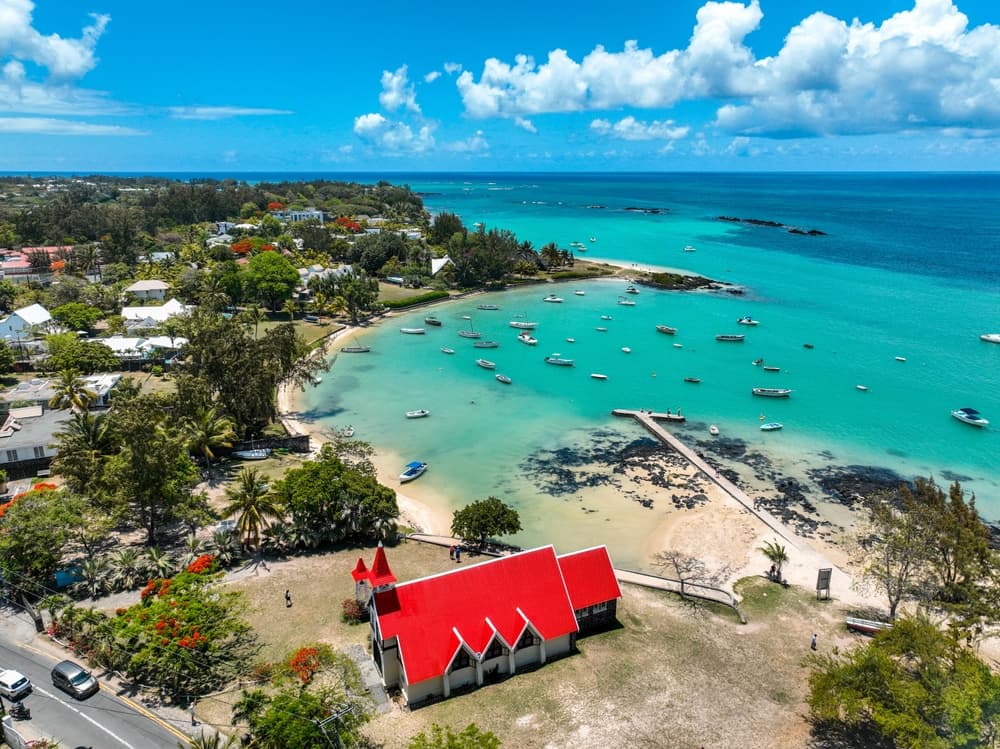
Grand Baie, Mauritius: a boat-filled bay with a 24-hour clinic up the road
What it costs to live in the north coast's main town, how you get around without the light rail, and who it fits.
- $1,300/mo
- Monthly budget · single
- 76°F / 24°C
- Avg temperature
Budget about $1,300 a month for one person in Grand Baie, with a realistic range of $1,100 to $1,500 depending on your rent. A couple should plan on around $2,100 and a family of four on about $3,400. A one-bedroom near the center averages $600 a month, and about $400 a few streets back from the water.
Grand Baie is a working town wrapped around a sheltered bay full of moored boats, with supermarkets, banks, restaurants, a private hospital with a 24-hour emergency room and a coworking center all close by. Daily errands don't require a trip to the capital, which matters on an island where the light rail stops well short of the north.
It fits remote workers paid in dollars, retirees on the island's 10-year retiree permit, and couples who want to walk to dinner. It's a weaker fit if you want somewhere quiet and local, or if you'll commute to an office in Port Louis every day.

Reviewed and updated October 22, 2026 · 4 min read
At a glance
$1,300
Monthly budget · single person
$600/mo 1-bed rent, center
62/100
Safety index
$30
Internet / month
76°Fannual average
Aug 71° · Feb 80°
Climate
Expatsi estimates, updated Oct 2026, based on rental listings, government statistics, and local reporting.
Cost of living
What it costs to live in Grand Baie
Single person
$1,100–$1,500/mo
about 60% below Austin, TX
Couple
$1,700–$2,500/mo
about 55% below Austin, TX
Family of four
$2,600–$4,100/mo
about 55% below Austin, TX
Compared with Austin, TX (Expatsi estimate, 2026).
- $6 −70%
- Inexpensive meal
- $500–$750/mo −69%
- 1-bed rent, center
- $350–$450/mo −70%
- 1-bed rent, outside
- $30/mo −54%
- Internet
- $353/sq ft −46%
- Buy price, center
Expatsi estimates, updated Oct 2026, based on rental listings, government statistics, and local reporting.
Daily life
How Grand Baie lives
- C+ grade, 20th percentile among the cities we track
- Dining & cafésmodest
- C grade, 5th percentile among the cities we track
- Arts & culturemodest
- C grade, 11th percentile among the cities we track
- Parks & outdoorsmodest
- C grade, 8th percentile among the cities we track
- Schools & educationmodest
- C+ grade, 16th percentile among the cities we track
- Healthcare accessmodest
- C- grade, 0th percentile among the cities we track
- Bike infrastructuremodest
- C+ grade, 24th percentile among the cities we track
- Public transitmodest
Graded on OpenStreetMap amenity density relative to the 436 cities we track. Accessibility is the exception: it's graded against a fixed standard (terrain steepness and sidewalk surfaces), not a curve.
Climate
Weather through the year
Annual average 76°F (24°C) · 26 in of rain a year · Source: Open-Meteo Historical Weather API (temps: ERA5-Land 0.1°; precip/sunshine: ERA5 best-match; 1991-2020 normals)
On the ground
Scenes from Grand Baie
Getting around
Transport in Grand Baie
Inside Grand Baie you can get by on foot. The town sits right at sea level and is flat, so the beach, the shops and most restaurants are a walk apart. Beyond town, plan on a car or regular taxis. The north coast is spread out, and the Metro Express light rail runs between Port Louis and Curepipe through the central towns, not up here.
Buses do link Grand Baie with Port Louis and the neighboring villages. The government sets the fares, but several companies run the routes and no single ticket works on all of them. The U.S. State Department says buses between main towns run from 5 a.m. to 9 p.m., so they won't get you home from a late dinner or to an early flight.
If you drive, it's on the left. The State Department describes most roads as narrow and uneven, without guardrails and lined with deep ditches, so take it slowly after dark. You can use your U.S. license for your first year before switching to a Mauritian one. The international airport is at Plaine Magnien in the southeast, on the opposite end of the island, so most people book a car or a transfer for arrivals instead of hauling luggage onto a bus.
- 3.3/sq mi
- Transit stops
- 0.0/sq mi
- Bike infrastructure
- 0.3/sq mi
- Wheelchair-accessible places
Mapped features per square mile from OpenStreetMap.
Keep exploring
Places like Grand Baie
San Ignacio
Belize
26.2K people · $1,500/mo
Mombasa
Kenya
1.2M people · $1,200/mo
Flic en Flac
Mauritius
$1,200/mo
Salinas
Ecuador
35.1K people · $1,200/mo
 Coming soon
San Juan del Sur
Nicaragua
14.7K people · $1,200/mo

Hurghada
Egypt
214.2K people · $1,000/mo
Living here
Community and practical notes
The expat scene: The north coast around Grand Baie is where many of the island's foreign residents and visitors end up, so you won't be the only new arrival in town. That cuts both ways. You'll find people to ask and businesses used to foreigners, but you'll also pay for the address: a one-bedroom in Quatre Bornes, up on the central plateau, runs about $380 a month against $600 near the center here.
Healthcare: C-Care Grand Baie, at Mont Choisy Smart City, has a 24-hour emergency department, an operating theater, day-care procedures, and X-ray, ultrasound and CT scans. It's served the north since 2014. For bigger specialist work, people head to the private hospitals in the middle of the island, such as C-Care Wellkin in Moka. The State Department rates care at major hospitals and private clinics as adequate, and notes that most providers, ambulances included, expect payment in rupees before treatment. Medicare doesn't cover you abroad, so arrive with international coverage. If you dive, know that the island's decompression chamber is at Victoria Hospital in Quatre Bornes, not on the coast.
Remote work: Home internet runs about $30 a month. Regus's Grand Bay Central, in the Coeur de Ville complex, sells coworking day passes and private offices by the day. The harder part is the clock. Mauritius doesn't change its clocks, so it's eight hours ahead of Eastern during U.S. daylight saving time and nine hours ahead in winter. A 9 a.m. New York meeting lands at 5 or 6 p.m. here, and a West Coast morning call runs into your evening.
LGBTQ expats: In October 2023, the Supreme Court of Mauritius struck down Section 250 of the Penal Code, a colonial-era law against sodomy, as discriminatory and unconstitutional. Same-sex relations are now legal. Attitudes can lag behind the courts: the State Department's country page, last revised in 2018, warned that LGBTQ people may face discrimination and harassment from families, neighbors and police. If you're moving with a same-sex partner, confirm with the Economic Development Board how your relationship will be treated for family permits before you apply.
Black Americans: Mauritius has a large Creole community, many of them descended from enslaved people brought from East Africa and Madagascar to work the sugar estates before slavery ended in 1835. Mauritius hasn't counted ethnicity in its census since 1972, so there are no official figures on how big each community is. We couldn't find reporting on how Black American expats specifically experience daily life here, so talk to a few people who've made the move before you commit.
Limited mobility: Grand Baie being flat and at sea level helps. The bigger problem is access to buildings and transport: the State Department says access to transportation, lodging and public buildings is limited across Mauritius. Ask about elevators, entrances and bathroom layouts before you sign a lease, and don't count on buses.
Retirement: Grand Baie works well for retirees who want a social life and a hospital nearby. A single-person budget of about $1,300 a month sits comfortably under the $2,000 a month the Retired Non-Citizen permit asks people 50 and over to transfer in, so the permit money can cover daily life. See our Mauritius retirement permit guide, the full guide to moving to Mauritius, and our retirement visa hub.
Housing
Renting and buying
- 1-bed rent (center)
- $500–$750/mo
- 1-bed rent (outside center)
- $350–$450/mo
- Buy price (center)
- $353/sq ft
- Buy price (outside center)
- $232/sq ft
Expatsi estimates, based on rental listings, government statistics, and local reporting.
Good to know
Frequently asked questions
Do you need a car in Grand Baie?
Not inside the town, which is flat and walkable. For the rest of the island, most residents drive or use taxis. Buses connect Grand Baie to Port Louis and nearby villages, but they run roughly 5 a.m. to 9 p.m., and the Metro Express light rail doesn't reach the north coast.
Is there a hospital in Grand Baie?
Yes. C-Care Grand Baie, a private hospital at Mont Choisy Smart City, has a 24-hour emergency department, an operating theater and CT, X-ray and ultrasound imaging. For major specialist care, residents travel to the larger private hospitals in the center of the island.
What is the weather like in Grand Baie?
Warm all year. Average highs sit near 84F in January and February and near 75F in July and August, with average lows near 68F at the coolest. Most rain falls from December through March, and cyclone season runs November to April, peaking January to March.
Can Americans retire in Grand Baie?
Yes. If you're 50 or older, the Retired Non-Citizen permit lets you live in Mauritius for 10 years, renewable, as long as you transfer at least $2,000 a month into a Mauritian bank. You apply online through the Economic Development Board and can't take a job on the permit.
Is Grand Baie good for LGBTQ expats?
Legally it's better than it was. The Supreme Court of Mauritius struck down the law against sodomy in October 2023, so same-sex relations are legal. Social attitudes are more mixed, and couples should confirm how a same-sex partner is treated for family residence permits before applying.
What is the time difference between Grand Baie and the U.S.?
Mauritius is eight hours ahead of Eastern time during U.S. daylight saving time and nine hours ahead the rest of the year, because Mauritius doesn't change its clocks. It's eleven to twelve hours ahead of Pacific time, by season.
How much does it cost to live in Grand Baie, Mauritius?
Expatsi's 2026 estimate is about $1,300 a month for one person and $2,100 for a couple, all in. Rent is the biggest variable: a one-bedroom near the center of Grand Baie averages around $600 a month, and inland towns such as Quatre Bornes cost less.
Is Grand Baie safe for Americans?
Mostly, with beach-town caution. The U.S. State Department rates Mauritius Level 2, exercise increased caution, and says crime is low overall but a concern in tourist areas, which includes Grand Baie. Most problems are theft and break-ins, so lock up at night, don't leave bags in a car, and rent from registered landlords.
See how Grand Baie fits your life
Take the free Expatsi Test and compare Mauritius to over 100 countries on what actually matters: cost, healthcare, climate, and safety. About five minutes.
Why not you?