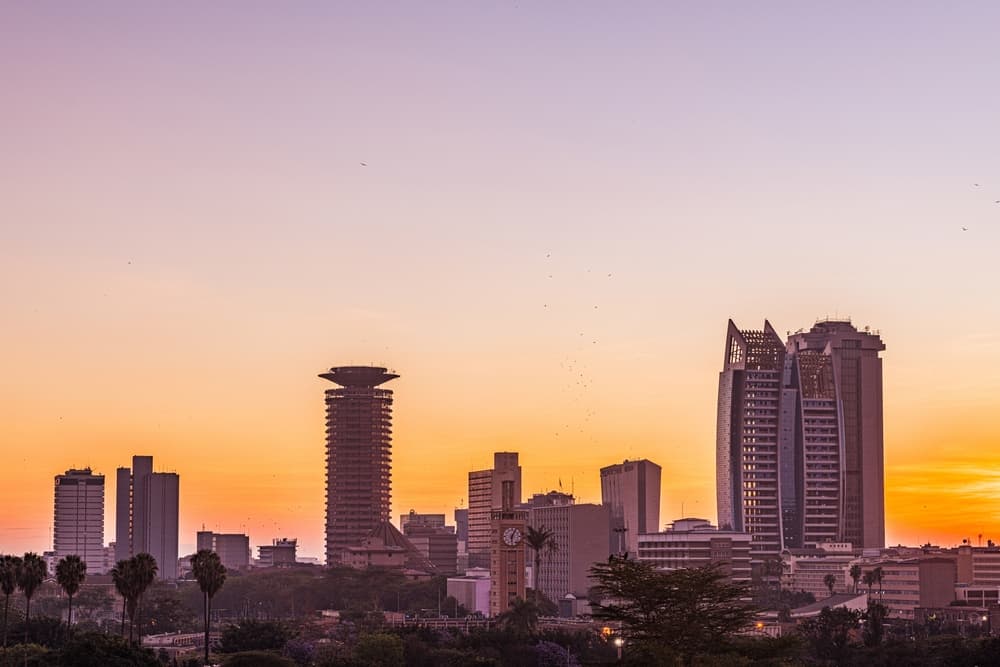
Living in Nairobi: what it costs and what to watch for
Monthly budgets, the neighborhoods newcomers choose, safety advice for Americans, and the mild highland weather in Kenya's capital.
- 5,545,000
- Population (2016)
- $1,800/mo
- Monthly budget · single
- 66°F / 19°C
- Avg temperature
A single person in Nairobi spends about $1,800 a month in U.S. dollars, and most solo budgets land between $1,500 and $2,100. A couple should figure on around $2,700, and a family of four around $3,900. Rent drives the spread: a one-bedroom in a central area runs about $800 (roughly $650 to $950), and about $500 farther out.
Nairobi fits people with a reason to be in East Africa's business hub: NGO and development staff, diplomats, founders, remote workers, and retirees who want a big city with a mild climate. It's the UN's official headquarters in Africa, and the global home of UNEP and UN-Habitat. At about 5,450 feet, it averages 66F across the year, and Nairobi National Park sits on the edge of town.
Safety is the part to take seriously. The State Department rates Kenya Level 2, exercise increased caution, and tells Americans not to go to the Eastleigh and Kibera neighborhoods at all (July 2026 advisory). Most newcomers settle in Westlands, Kilimani, Karen or Gigiri and keep careful habits after dark.

Reviewed and updated October 15, 2026 · 4 min read
At a glance
$1,800
Monthly budget · single person
$800/mo 1-bed rent, center
38/100
Safety index
$40
Internet / month
66°Fannual average
Jul 63° · Feb 69°
Climate
5,545,000
Population (2016)
Expatsi estimates, updated Oct 2026, based on rental listings, government statistics, and local reporting.
Cost of living
What it costs to live in Nairobi
Single person
$1,500–$2,100/mo
about 40% below Austin, TX
Couple
$2,200–$3,200/mo
about 40% below Austin, TX
Family of four
$3,200–$4,600/mo
about 50% below Austin, TX
Compared with Austin, TX (Expatsi estimate, 2026).
- $5 −75%
- Inexpensive meal
- $650–$950/mo −59%
- 1-bed rent, center
- $400–$600/mo −63%
- 1-bed rent, outside
- $40/mo −38%
- Internet
- $167/sq ft −74%
- Buy price, center
Expatsi estimates, updated Oct 2026, based on rental listings, government statistics, and local reporting.
Daily life
How Nairobi lives
- B grade, 47th percentile among the cities we track
- Dining & caféstypical
- B grade, 47th percentile among the cities we track
- Arts & culturetypical
- B grade, 46th percentile among the cities we track
- Parks & outdoorstypical
- B+ grade, 65th percentile among the cities we track
- Schools & educationstrong
- B+ grade, 61st percentile among the cities we track
- Healthcare accessstrong
- B grade, 41st percentile among the cities we track
- Bike infrastructuretypical
- B- grade, 31st percentile among the cities we track
- Public transittypical
- A grade, good physical accessibility
- Accessibilitygood
Graded on OpenStreetMap amenity density relative to the 369 cities we track. Accessibility is the exception: it's graded against a fixed standard (terrain steepness and sidewalk surfaces), not a curve.
Climate
Weather through the year
Annual average 66°F (19°C) · 26 in of rain a year · Source: Open-Meteo Historical Weather API (temps: ERA5-Land 0.1°; precip/sunshine: ERA5 best-match; 1991-2020 normals)
On the ground
Scenes from Nairobi
Getting around
Transport in Nairobi
Matatus carry most of Nairobi. They're privately owned minibuses seating 14 to 33 people, painted loud and driven fast, and they have a poor safety record from overcrowding and reckless driving. The State Department goes further and calls all public transport in Kenya unregulated, unreliable and generally unsafe, so most newcomers lean on ride-hailing instead. Uber, Bolt and the Kenyan app Little all operate here; Bolt raised its fares 6% in May 2026 after a fuel price jump.
The Nairobi Expressway, a toll road of about 17 miles that opened in May 2022, runs from the east side of the city through the center to Westlands and was built to ease traffic on Mombasa Road. It's the fastest way across town toward the airport when the roads below are jammed, which is often. Morning and evening commuter trains link the center with some suburbs, and the Standard Gauge Railway runs to Mombasa from a terminus at Syokimau, about 12 miles out.
Walking works within a compound or a mall, less so between neighborhoods. Sidewalks are often unpaved or missing and crossings are often unmarked. Many long-term residents end up buying a car or hiring a regular driver, but road accidents are a major risk in Kenya, so plenty skip driving themselves.
- 6.6/sq mi
- Transit stops
- 2.2/sq mi
- Bike infrastructure
- 3.7/sq mi
- Wheelchair-accessible places
Mapped features per square mile from OpenStreetMap.
Keep exploring
Places like Nairobi


Community
Community & practical notes
Community: Nairobi's international crowd orbits the UN complex in Gigiri, next to Karura Forest and across the street from the U.S. Embassy. Add the NGO world, regional company offices and a startup scene, and you'll find plenty of people who also just arrived. Families often look at the International School of Kenya, a pre-K to grade 12 school using North American standards with an IB Diploma option, governed jointly by the U.S. Embassy and the Canadian High Commission.
Black Americans: Kenya has drawn a small, visible wave of African Americans moving for heritage and belonging. AP reported in July 2025 that one relocation firm alone had brought 15 families. It's a younger and less organized community than Accra's, so expect to build your own network.
LGBTQ expats: Same-sex sexual activity is illegal under Kenya's Penal Code, with sections 162 and 165 carrying up to 14 and 5 years in prison. Prosecutions are rare but homophobia is common. Police harassment and extortion happen, and the State Department reports assaults on gay travelers who met people through dating apps. Nairobi does have LGBTQ-friendly social spaces and long-running groups such as GALCK and NGLHRC. Most LGBTQ expats stay private in public.
Healthcare: The State Department calls care in Nairobi adequate for most conditions and emergencies. Aga Khan University Hospital, Nairobi has held Joint Commission International accreditation five times in a row since 2013. Hospitals usually want payment up front and don't take U.S. insurance, so carry international coverage that includes medical evacuation.
Limited mobility: Nairobi is hard going in a wheelchair. Public transport and taxis don't accommodate wheelchairs, and sidewalks are often unpaved or missing. Newer malls, hotels and private hospitals are the easiest places to get around, so plan on a private car and check building entrances before you sign a lease.
Remote work: Home internet runs about $40 a month. Coworking spaces like Nairobi Garage in Westlands advertise 150Mb/s connections with a backup line and a 24-hour generator, which matters when the power drops.
Retirement: Kenya has no visa labeled for retirees. People living on Social Security, a pension or investment income usually use the Class K permit. Compare retirement visa options or read the full Kenya guide.
Housing
Renting and buying
- 1-bed rent (center)
- $650–$950/mo
- 1-bed rent (outside center)
- $400–$600/mo
- Buy price (center)
- $167/sq ft
- Buy price (outside center)
- $102/sq ft
Expatsi estimates, based on rental listings, government statistics, and local reporting.
Good to know
Frequently asked questions
How much does it cost to live in Nairobi?
A single person spends about $1,800 a month in Nairobi, with most solo budgets between $1,500 and $2,100. A couple spends around $2,700 and a family of four around $3,900. A central one-bedroom rents for about $800 a month, and about $500 outside the center.
How good is healthcare in Nairobi?
The State Department calls medical care in Nairobi adequate for most conditions and emergencies. Aga Khan University Hospital, Nairobi holds Joint Commission International accreditation. Hospitals usually require payment up front and don't generally accept U.S. health insurance, so the State Department strongly recommends coverage for medical evacuation.
What is the weather like in Nairobi?
Nairobi sits at about 5,450 feet, so it stays mild. The yearly average is about 66F. February is the warmest month, with average highs near 81F, and July is the coolest, with highs near 71F and lows near 54F. Rain peaks in April and again in November, and the city gets about 26 inches a year.
Is there an expat community in Nairobi?
Yes. Nairobi is the UN's official headquarters in Africa and home to the global headquarters of UNEP and UN-Habitat, so diplomats, NGO staff and their families are a big part of daily life, especially around Gigiri, Westlands, Kilimani and Karen. African Americans moving for heritage reasons are a smaller, growing group.
Do you need a car in Nairobi?
Not at first. Uber, Bolt and the local app Little all operate in Nairobi and are what most newcomers use. Matatu minibuses are the most common public transport but have a poor safety record. Longer-term residents often buy a car or hire a regular driver, and traffic is heavy, which is why the Nairobi Expressway toll road opened in May 2022.
Is Nairobi safe for LGBTQ expats?
It's difficult. Same-sex sexual activity is illegal in Kenya, with penalties of up to 14 years under section 162 of the Penal Code. Prosecutions are rare, but harassment and extortion happen, and the State Department reports assaults on gay travelers who met people through dating apps. Nairobi has LGBTI-friendly social spaces and advocacy groups, and most LGBTQ expats keep a low profile.
Is Nairobi safe for Americans?
It takes care. As of July 2026 the State Department rates Kenya Level 2, exercise increased caution, and tells Americans not to travel to Nairobi's Eastleigh and Kibera neighborhoods because of crime and kidnapping. It also notes that violent protests are most common in Nairobi and western Kenya. Most expats live in areas like Westlands, Kilimani, Karen or Gigiri, use ride-hailing at night, and follow U.S. Embassy alerts.
Can I retire in Nairobi?
Yes, though Kenya has no visa labeled for retirees. Americans living on Social Security, a pension or investment income usually apply for the Class K ordinary resident permit, which doesn't allow work in Kenya. Nairobi's mild weather and private hospitals appeal to retirees, but budget for international health coverage and evacuation insurance.
See how Nairobi fits your life
Take the free Expatsi Test and compare Kenya to over 100 countries on what actually matters: cost, healthcare, climate, and safety. About five minutes.
Why not you?