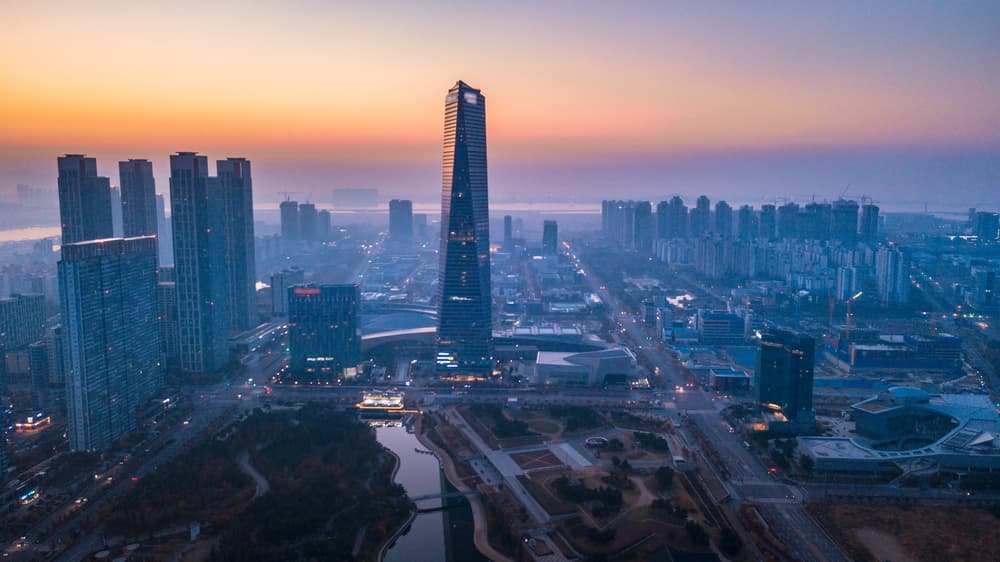
Living in Incheon: Songdo, the airport, and Seoul next door
What a month costs, which side of the city to live on, how safe it is, and what retiring or moving here looks like for Americans.
- 3,049,315
- Population (2025)
- $1,900/mo
- Monthly budget · single
- 55°F / 13°C
- Avg temperature
Plan on about $1,900 a month for one person in Incheon, with most single budgets landing between $1,600 and $2,200. A couple needs about $2,800 and a family of four about $4,000. A one-bedroom near the center rents for about $700, or about $500 farther out. Seoul, by comparison, runs about $2,200 for one person and $1,000 for a central one-bedroom.
Incheon suits Americans who want to be in the Seoul region without paying Seoul rent, families looking at international schools, and anyone whose life runs through the airport. Songdo, a planned district built on reclaimed land, is where most of the international life sits: American university campuses, an IB school and new apartment towers. The older port neighborhoods feel more like a working Korean city.
Here's the catch: Incheon is big and spread out. If your job is in central Seoul and you live in Songdo, the commute will shape your week, so pick the neighborhood before you pick the apartment.

Reviewed and updated October 22, 2026 · 4 min read
At a glance
$1,900
Monthly budget · single person
$700/mo 1-bed rent, center
75/100
Safety index
$20
Internet / month
55°Fannual average
Jan 29° · Aug 79°
Climate
3,049,315
Population (2025)
Expatsi estimates, updated Oct 2026, based on rental listings, government statistics, and local reporting.
Cost of living
What it costs to live in Incheon
Single person
$1,600–$2,200/mo
about 40% below Austin, TX
Couple
$2,300–$3,300/mo
about 40% below Austin, TX
Family of four
$3,300–$4,700/mo
about 50% below Austin, TX
Compared with Austin, TX (Expatsi estimate, 2026).
- $7 −65%
- Inexpensive meal
- $550–$850/mo −64%
- 1-bed rent, center
- $400–$550/mo −63%
- 1-bed rent, outside
- $20/mo −69%
- Internet
- $45/mo +9%
- Transit pass
- $483/sq ft −26%
- Buy price, center
Expatsi estimates, updated Oct 2026, based on rental listings, government statistics, and local reporting.
Daily life
How Incheon lives
- B grade, 48th percentile among the cities we track
- Dining & caféstypical
- B- grade, 35th percentile among the cities we track
- Arts & culturetypical
- B- grade, 35th percentile among the cities we track
- Parks & outdoorstypical
- B+ grade, 63rd percentile among the cities we track
- Schools & educationstrong
- B- grade, 37th percentile among the cities we track
- Healthcare accesstypical
- C- grade, 0th percentile among the cities we track
- Bike infrastructuremodest
- A grade, 88th percentile among the cities we track
- Public transitstandout
Graded on OpenStreetMap amenity density relative to the 436 cities we track. Accessibility is the exception: it's graded against a fixed standard (terrain steepness and sidewalk surfaces), not a curve.
Climate
Weather through the year
Annual average 55°F (13°C) · 50 in of rain a year · Source: Meteostat station normals (47112, 1991-2020; sunshine from 1981-2010)
On the ground
Scenes from Incheon
Getting around
Transport in Incheon
Incheon has its own subway, and it plugs into Seoul's. Incheon Line 1 runs from Geomdan Lake Park in the north down through Bupyeong and into Songdo, ending at Songdo Moonlight Festival Park. Line 2 crosses the west side between Geomdan Oryu and Unyeon. Change at Bupyeong for Seoul Line 1, at Bupyeong-gu Office for Seoul Line 7, at Woninjae for the Suin-Bundang Line, and at Gyeyang for the airport railroad. Our data puts a month of transit at about $45.
The airport railroad, AREX, is the line you'll ride for every trip home. The all-stop train takes about 59 minutes from Terminal 1 to Seoul Station, and the express about 43.
Songdo is the tricky part. Getting from Songdo to central Seoul by subway means several transfers, so many commuters take the red express buses that run straight into the city. Songdo was also designed around the car, and critics point to its wide roads and limited walkability. Incheon Bridge links it to the airport by road.
Do you need a car? Not if you live near a subway stop and work in Incheon. If you live in Songdo and commute to Seoul, a car or a reliable express bus route becomes part of the plan.
- 60/sq mi
- Transit stops
- 0.0/sq mi
- Bike infrastructure
- 2.2/sq mi
- Wheelchair-accessible places
Mapped features per square mile from OpenStreetMap.
Keep exploring
Places like Incheon
Living here
Community and practical notes
The expat scene: Songdo is the international pocket. SUNY Korea, George Mason University Korea and the University of Utah's Asia Campus all teach there, which brings American faculty, students and families. The IFEZ Global Center in Songdo's G-Tower offers one-stop help for foreign residents of the free economic zone. Citywide, the Incheon Help Center for Foreigners in Namdong-gu offers counseling on housing, legal and work questions, plus Korean classes from beginner through TOPIK prep. Outside Songdo, plan on using Korean for landlords, clinics and offices.
Healthcare: Inha University Hospital has run an International Healthcare Center for foreign patients since 2009, with multilingual coordinators, and its emergency center is open around the clock. Call ahead to ask which languages are covered that day. Once you've lived in Korea six months, you're enrolled in the National Health Insurance Service, the same public plan Koreans use, so plan on private coverage for your first six months.
Schools: Chadwick International in Songdo is a PK-12 school teaching the International Baccalaureate. It opened in 2010 and is named after Chadwick School in Palos Verdes, California. Ask the school directly about current tuition and who can enroll.
Remote work: Home internet runs about $20 a month. The real constraint is the clock: Korea doesn't use daylight saving, so Incheon sits 13 to 14 hours ahead of Eastern, depending on the season. One visa detail matters here. Korea's digital nomad visa halves its income floor for applicants aged 18 to 34 who live outside Seoul, Incheon and Gyeonggi Province, so Incheon doesn't qualify for the lower bar.
LGBTQ expats: Incheon's first Queer Culture Festival took place in September 2018 and met organized opposition from church and conservative groups, with scuffles that delayed the event. A second festival followed at Bupyeong Station in 2019. Expect a visible community that still meets pushback, and a quieter public life than you may be used to.
Black Americans: One Black American student in Seoul wrote in 2023 about constant staring, questions about her hair and strangers touching it without asking. She also said she felt far safer than at home, calling her time there very positive. Clothing in larger sizes can be hard to find, so bring what you need.
Limited mobility: The airport railroad is a bright spot, with elevators at every station and level boarding. Across the Seoul region, most subway stations have elevators and the rest use stair lifts, but check your specific station before you sign a lease. Songdo sits on flat, reclaimed land with newer buildings, which makes it the easier side of the city to get around.
Retirement: Incheon offers good hospitals and an airport on your doorstep, but South Korea has no retirement visa. Korean American retirees can usually use the F-4 overseas Korean visa; most others will need an investor route. Compare options in our guide to retirement visas and the full guide to moving to South Korea.
Housing
Renting and buying
- 1-bed rent (center)
- $550–$850/mo
- 1-bed rent (outside center)
- $400–$550/mo
- Buy price (center)
- $483/sq ft
- Buy price (outside center)
- $334/sq ft
Expatsi estimates, based on rental listings, government statistics, and local reporting.
Good to know
Frequently asked questions
Is Incheon cheaper than Seoul?
Yes. Our data puts a single person's monthly budget at about $1,900 in Incheon versus about $2,200 in Seoul, and a central one-bedroom at about $700 versus about $1,000. The trade-off is distance: from Songdo, reaching central Seoul by subway takes several transfers.
How much does it cost to live in Incheon, South Korea?
A single person spends about $1,900 a month in Incheon, with most budgets between $1,600 and $2,200. A couple needs about $2,800 and a family of four about $4,000. A one-bedroom apartment near the center rents for about $700 a month, and about $500 farther out. Korean leases usually also require a large refundable deposit up front.
How do you get from Incheon to Seoul?
Incheon's subway connects to Seoul's at Bupyeong (Seoul Line 1), Bupyeong-gu Office (Seoul Line 7) and Woninjae (Suin-Bundang Line). The AREX airport railroad runs from Incheon Airport to Seoul Station in about 59 minutes on the all-stop train and about 43 on the express. From Songdo, red express buses run directly into Seoul.
What is the weather like in Incheon?
Incheon has four distinct seasons. August averages highs near 84F, and January averages lows near 23F. July and August are the rainiest months by far, and spring and fall are the most comfortable times of year. The annual average temperature is about 55F.
Can Americans retire in Incheon?
Not on a retirement visa, because South Korea doesn't have one. Korean American retirees can usually qualify for the F-4 overseas Korean visa. Other retirees need an investor visa or must stay within 90-day visa-free visits, which immigration officers increasingly question when they're back to back.
Is Incheon safe for Americans?
Yes, by most measures. Incheon scores 75 out of 100 on our safety index, which points to low reported crime. Americans should also know that tensions with North Korea are a background fact of life across the Seoul region, even though daily life carries on normally.
Is Songdo a good place for expats to live?
For many, yes. Songdo is a planned district on reclaimed land with American university campuses, an IB school, a support center for foreign residents and new apartment towers. Critics say it's car-centric and less walkable than it looks, and the subway ride to central Seoul takes several transfers.
See how Incheon fits your life
Take the free Expatsi Test and compare South Korea to over 100 countries on what actually matters: cost, healthcare, climate, and safety. About five minutes.
Why not you?