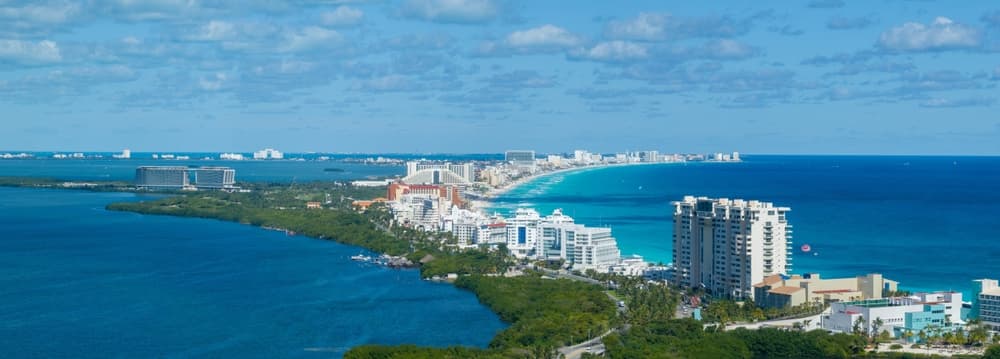
Riviera Maya: pick your beach town on the road from Cancun to Tulum
What it costs to live on Mexico's Caribbean coast, how safe it is, and which stretch of Highway 307 fits a retiree, a remote worker or a family.
- $2,100/mo
- Monthly budget · single
- 79°F / 26°C
- Avg temperature
A one-bedroom near the beach on the Riviera Maya rents for about $1,000 a month in U.S. dollars, and one farther from the sand for about $650. All in, a single person spends around $2,100 a month here, with most landing between $1,700 and $2,500. A couple runs about $2,900 and a family of four about $4,200 (2026 figures). Our numbers track Tulum, the region's anchor town, so price out the specific town you're eyeing.
The Riviera Maya isn't one city. It's a string of towns along Highway 307, from Puerto Morelos just south of Cancun's airport down through Playa del Carmen, Puerto Aventuras and Akumal to Tulum, with the reef offshore and cenotes in the jungle behind. It suits people who want the water in their daily routine: divers and snorkelers, remote workers on U.S. hours, and retirees who'd rather live in a beach town than a big city.
It's a poor fit if you want a deep cultural calendar, cool weather, or prices set by local wages. Tourism sets the rents, and sargassum seaweed piles up on the beaches most springs.

Reviewed and updated October 2, 2026 · 4 min read
At a glance
$2,100
Monthly budget · single person
$1,000/mo 1-bed rent, center
50/100
Safety index
$25
Internet / month
79°Fannual average
Jan 75° · Aug 82°
Climate
Expatsi estimates, updated Aug 2026, based on rental listings, government statistics, and local reporting.
Cost of living
What it costs to live in Riviera Maya
Single person
$1,700–$2,500/mo
about 30% below Austin, TX
Couple
$2,400–$3,400/mo
about 35% below Austin, TX
Family of four
$3,300–$5,100/mo
about 45% below Austin, TX
Compared with Austin, TX (Expatsi estimate, 2026).
- $9 −55%
- Inexpensive meal
- $800–$1,200/mo −49%
- 1-bed rent, center
- $550–$750/mo −52%
- 1-bed rent, outside
- $25/mo −62%
- Internet
- $232/sq ft −64%
- Buy price, center
Expatsi estimates, updated Aug 2026, based on rental listings, government statistics, and local reporting.
Daily life
How Riviera Maya lives
- C grade, 8th percentile among the cities we track
- Dining & cafésmodest
- C grade, 5th percentile among the cities we track
- Arts & culturemodest
- C grade, 7th percentile among the cities we track
- Parks & outdoorsmodest
- C- grade, 2nd percentile among the cities we track
- Schools & educationmodest
- C- grade, 4th percentile among the cities we track
- Healthcare accessmodest
- C+ grade, 19th percentile among the cities we track
- Bike infrastructuremodest
- C grade, 9th percentile among the cities we track
- Public transitmodest
Graded on OpenStreetMap amenity density relative to the 298 cities we track. Accessibility is the exception: it's graded against a fixed standard (terrain steepness and sidewalk surfaces), not a curve.
Climate
Weather through the year
Annual average 79°F (26°C) · 46 in of rain a year · Source: Open-Meteo Historical Weather API (temps: ERA5-Land 0.1°; precip/sunshine: ERA5 best-match; 1991-2020 normals)
On the ground
Scenes from Riviera Maya
Getting around
Transport in Riviera Maya
Highway 307 is the spine of the Riviera Maya, and most of daily life happens somewhere along it. Inside each town you can walk the center, and the coast is flat, so bikes work well for short errands. Between towns, colectivos carry most of the load. These shared white vans leave Playa del Carmen for Cancun and for Tulum as soon as they fill, and you can flag one down or hop off anywhere along the highway.
Taxis are run by local unions. Agree on the fare before you get in. Uber's app does open in Tulum, but drivers rarely accept rides there, so don't build your week around it.
The Tren Maya now runs the length of the coast, from Cancun Airport through Puerto Morelos and Playa del Carmen to Tulum. Here's the catch: the stations sit outside town. Playa's is about 3.7 miles from downtown with no bus link, so you'll take a taxi at that end. Tulum also has its own international airport, about 12 miles southwest of town, open since December 2023 with a train station next door.
Do you need a car? If you live in central Playa or central Tulum, you can manage without one. In Akumal, Puerto Aventuras, or a house off the highway, a car turns a grocery run from a half-day outing into a quick trip.
- 0.4/sq mi
- Transit stops
- 0.0/sq mi
- Bike infrastructure
- 0.3/sq mi
- Wheelchair-accessible places
Mapped features per square mile from OpenStreetMap.
Keep exploring
Places like Riviera Maya
 Coming soon
Santo Domingo
Dominican Republic
2.2M people · $2,100/mo

Tulum
Mexico
33.4K people · $2,100/mo
Canggu
Indonesia
7.1K people · $2,100/mo
Puerto Vallarta
Mexico
224.2K people · $2,300/mo
 Coming soon
Sharjah
United Arab Emirates
1.2M people · $2,200/mo
Panama City
Panama
1.5M people · $2,100/mo
Community
Community & practical notes
Who you'll meet: Each town has its own crowd, so visit a few before you sign anything. Puerto Morelos is a small, laid-back fishing town that Canadians in particular have adopted, with a national reef park a short swim offshore and a quiet residential side across the highway. Playa del Carmen is the busiest, with the widest mix of nationalities and the most going on. Akumal and Puerto Aventuras are quieter stops in between, and Tulum pairs jungle-edge living with its new airport and train.
Healthcare: Private care is spread along the coast rather than concentrated in one place. Costamed alone has locations in Puerto Morelos, Playa del Carmen and Tulum, where its hospital lists 27 specialties plus emergency care. Medicare generally won't pay for care in Mexico, so budget for private insurance or an international plan before you move.
Internet and remote work: Home internet averages about $25 a month. Service varies building by building, so run a speed test before you sign a lease and keep a phone hotspot as backup for important calls. Mexico's Caribbean coast runs on Eastern Standard Time all year, which keeps East Coast meetings easy.
Limited mobility: The flat terrain helps, but access is uneven. Town centers and newer condo buildings with elevators are the easiest to manage. Elsewhere, sidewalks can be narrow, broken or missing, beach access usually means soft sand, and colectivo vans have high steps and no lifts. Taxis and a carefully chosen building make the biggest difference.
Retiring here: Retirees come for the winters, with January highs averaging about 79F, and for a slower beach-town pace. The trade-offs are a humid summer, the Atlantic hurricane season from June through November, and resort-level prices. For the paperwork, start with Mexico's temporary residency, compare it with other retirement visas, and read the full Mexico guide.
Housing
Renting and buying
- 1-bed rent (center)
- $800–$1,200/mo
- 1-bed rent (outside center)
- $550–$750/mo
- Buy price (center)
- $232/sq ft
- Buy price (outside center)
- $172/sq ft
Expatsi estimates, based on rental listings, government statistics, and local reporting.
Good to know
Frequently asked questions
What is the weather like in the Riviera Maya?
Warm all year, averaging about 79F. January highs average about 79F and August highs about 86F. The region gets about 46 inches of rain a year, heaviest in June and from September through October, and February is the driest month. Sargassum seaweed tends to wash up on beaches most springs.
Is the Riviera Maya safe for Americans?
The U.S. State Department rates Quintana Roo, the state the Riviera Maya sits in, at "Exercise Increased Caution." It notes that violent crime has increased in Tulum and advises extra care after dark in Cancun, Playa del Carmen and Tulum, sticking to well-lit tourist areas. Expatsi's safety index scores the area 50 out of 100. Residents take ordinary city precautions: keep valuables out of sight and use known taxis at night.
Is the Riviera Maya a good place to retire?
It can be, if you want warm winters and a beach-town routine. Private hospitals and clinics are spread along the coast, including in Puerto Morelos, Playa del Carmen and Tulum. The downsides are humid summers, hurricane season from June through November, tourist-driven prices, and the fact that Medicare generally won't cover care in Mexico. Most retirees file for Mexico's temporary residency first.
Do you need a car to live in the Riviera Maya?
Not if you live in central Playa del Carmen or central Tulum, where you can walk, bike, and use colectivo vans and taxis. Uber rarely works in Tulum because of the local taxi unions. In the smaller towns and the developments between them, a car makes daily life much easier. The Tren Maya links Cancun Airport, Puerto Morelos, Playa del Carmen and Tulum, but its stations sit outside town centers.
How much is rent in the Riviera Maya?
A one-bedroom apartment in a central, beach-side area averages about $1,000 a month, with most between $800 and $1,200 (2026). Move away from the beach and the average drops to about $650, usually between $550 and $750. High season pushes short-term rents up, so long leases signed in person tend to get better terms than listings found from abroad.
How much does it cost to live in the Riviera Maya?
Expatsi's 2026 estimates put a single person at about $2,100 a month in U.S. dollars, a couple at about $2,900, and a family of four at about $4,200. Single budgets typically range from $1,700 to $2,500, depending mostly on how close to the beach you rent. The figures are based on Tulum, so prices in other towns along the coast can differ.
Which Riviera Maya town is best to live in?
It depends on the life you want. Puerto Morelos is small and quiet, with a reef park offshore and Cancun airport about 30 minutes away. Playa del Carmen has the most services, restaurants and people. Tulum has its own international airport and a Tren Maya station. Akumal and Puerto Aventuras are quieter, but you'll want a car there. Spend a week in two or three before choosing.
See how Riviera Maya fits your life
Take the free Expatsi Test and compare Mexico to over 100 countries on what actually matters: cost, healthcare, climate, and safety. About five minutes.
Why not you?