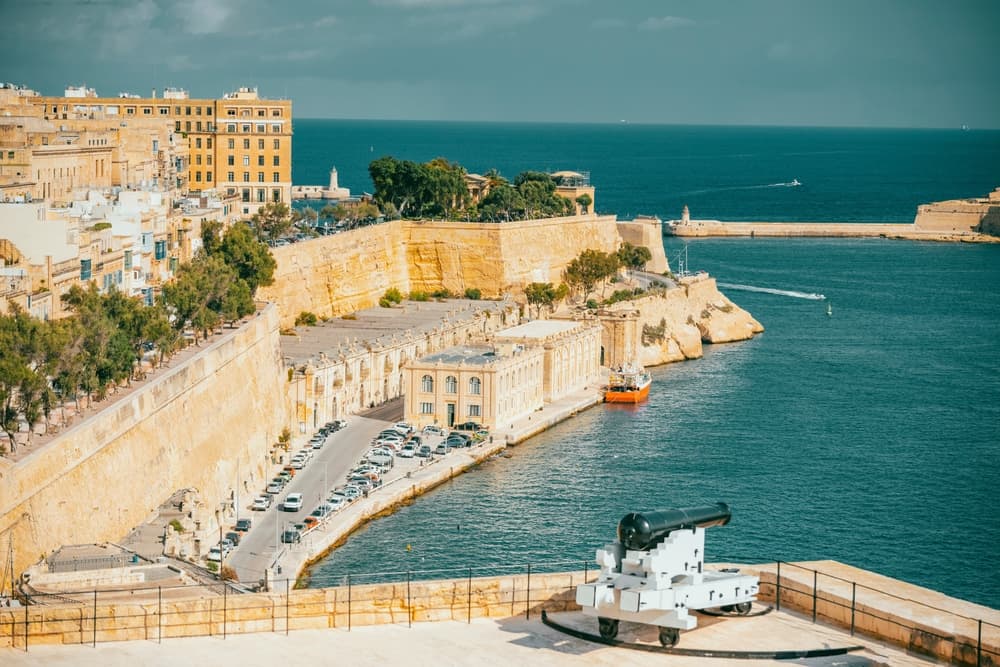
Valletta, Malta: a walled capital for people who'd rather walk than drive
What it costs, how safe it feels and what daily life is like in a small Baroque city of about 5,200 residents between two harbors.
- 5,197
- Population (2021)
- $2,600/mo
- Monthly budget · single
- 67°F / 19°C
- Avg temperature
A single person living in Valletta spends around $2,600 a month in U.S. dollars, and most solo budgets land between $2,100 and $3,100. A couple should plan on roughly $3,700, and a family of four on about $5,400. Rent is the swing factor: a one-bedroom inside the walls averages $1,400 a month, while $1,100 is more typical outside the center (2026 estimates).
Valletta is Malta's capital, home to about 5,200 people on a fortified peninsula between the Grand Harbour and Marsamxett Harbour. By day it fills with office workers, tour groups and cruise passengers. In the evening the crowds thin out and it turns into a quiet place to live.
It fits people who want to walk everywhere, love old buildings and don't need much space: remote workers, retirees without a car, couples without kids. The trade-offs are real, though. Apartments come up rarely, older buildings often have stairs and no elevator, and there's no sandy beach in town.

Reviewed and updated October 9, 2026 · 4 min read
At a glance
$2,600
Monthly budget · single person
$1,400/mo 1-bed rent, center
76/100
Safety index
$35
Internet / month
67°Fannual average
Feb 55° · Aug 81°
Climate
5,197
Population (2021)
Expatsi estimates, updated Oct 2026, based on rental listings, government statistics, and local reporting.
Cost of living
What it costs to live in Valletta
Single person
$2,100–$3,100/mo
about 15% below Austin, TX
Couple
$3,000–$4,400/mo
about 20% below Austin, TX
Family of four
$4,400–$6,400/mo
about 30% below Austin, TX
Compared with Austin, TX (Expatsi estimate, 2026).
- $16 −20%
- Inexpensive meal
- $1,150–$1,650/mo −28%
- 1-bed rent, center
- $900–$1,300/mo −19%
- 1-bed rent, outside
- $35/mo −46%
- Internet
- $0/mo −100%
- Transit pass
- $650/sq ft ±0%
- Buy price, center
Expatsi estimates, updated Oct 2026, based on rental listings, government statistics, and local reporting.
Daily life
How Valletta lives
- B+ grade, 65th percentile among the cities we track
- Dining & cafésstrong
- B+ grade, 68th percentile among the cities we track
- Arts & culturestrong
- B+ grade, 64th percentile among the cities we track
- Parks & outdoorsstrong
- B grade, 45th percentile among the cities we track
- Schools & educationtypical
- B grade, 40th percentile among the cities we track
- Healthcare accesstypical
- B- grade, 35th percentile among the cities we track
- Bike infrastructuretypical
- B+ grade, 58th percentile among the cities we track
- Public transitstrong
- A grade, good physical accessibility
- Accessibilitygood
Graded on OpenStreetMap amenity density relative to the 298 cities we track. Accessibility is the exception: it's graded against a fixed standard (terrain steepness and sidewalk surfaces), not a curve.
Climate
Weather through the year
Annual average 67°F (19°C) · 21 in of rain a year · Source: Meteostat station normals (16597, 1991-2020)
On the ground
Scenes from Valletta
Getting around
Transport in Valletta
Most people who live in Valletta get around on foot. Republic Street and Merchants Street run the length of the peninsula, shops, cafés and offices sit within a few blocks of each other, and much of the center is pedestrianized.
For anywhere else on the island, Malta's bus network meets at the terminus just outside City Gate, so many routes start or end on your doorstep. Buses are free with a personalized Tallinja card; you still tap it every time you board. The express Tallinja Direct routes and on-demand services aren't part of the free scheme, so keep some credit on the card for those.
The same card gets you onto the harbor ferries to Sliema and to the Three Cities across the Grand Harbour, and onto the Upper Barrakka Lift, which links the waterfront with the gardens at the top of the city.
A car is mostly a burden here. Valletta runs a Controlled Vehicular Access system, with cameras at the entry points charging most private cars that come in during weekday working hours, and parking inside the walls is scarce. If you do drive, remember Malta drives on the left.
- 34/sq mi
- Transit stops
- 1.5/sq mi
- Bike infrastructure
- 18/sq mi
- Wheelchair-accessible places
Mapped features per square mile from OpenStreetMap.
Keep exploring
Places like Valletta
Living here
Community & practical notes
Community: Valletta has a much smaller foreign crowd than Sliema or St. Julian's across the water, and most of your neighbors will be Maltese. Parish feasts and band clubs still shape the calendar on some streets. English is an official language, so leases, banks and doctors' offices all work in English, though you'll hear Maltese around you every day.
LGBTQ expats: Malta has scored at or near the top of ILGA-Europe's Rainbow Map of LGBTQ laws and policies for years. In the 2026 edition Spain took first place and Malta stayed in the top five. Same-sex marriage has been legal since 2017.
Black Americans: There's little published data on how Black Americans in particular experience life in Malta. The most reliable gauge is to talk with Black expats already living on the island, in person or through online groups, before you commit to a lease.
Healthcare: Mater Dei Hospital in Msida is Malta's main public hospital and emergency department, a short bus ride from Valletta. In an emergency, dial 112. Non-EU residents are generally expected to hold private health insurance for their residence permit, so price coverage before you move.
Remote work: Home internet runs about $35 a month. Spaces has coworking centers in Valletta, and Grand Central on Strait Street sells day passes. Malta is six hours ahead of New York, so East Coast calls land in your afternoon and evening. If you're keeping a U.S. job, look at Malta's Nomad Residence Permit.
Limited mobility: Hard going in places. The main streets along the top of the peninsula are paved and fairly gentle, but many side streets drop toward the harbors in long flights of steps, sidewalks are narrow, and older buildings often lack elevators. The Upper Barrakka Lift helps between the waterfront and the upper city. Check for an elevator and a step-free route to the nearest bus before you sign anything, and contact Malta's Commission for the Rights of Persons with Disability (CRPD) for practical help.
Retirement: Valletta suits retirees who want culture within walking distance, from St. John's Co-Cathedral to the Manoel Theatre, and who don't want to drive. Winters are mild, with January highs averaging about 60°F; August highs average about 89°F, and July is close to rain-free. Compare Malta's Global Residence Programme and Permanent Residence Programme, see other countries on our retirement visa page, and read our full Malta guide.
Housing
Renting and buying
- 1-bed rent (center)
- $1,150–$1,650/mo
- 1-bed rent (outside center)
- $900–$1,300/mo
- Buy price (center)
- $650/sq ft
- Buy price (outside center)
- $353/sq ft
Expatsi estimates, based on rental listings, government statistics, and local reporting.
Good to know
Frequently asked questions
How much does it cost to live in Valletta, Malta?
A single person in Valletta spends about $2,600 a month in U.S. dollars as of 2026, a couple about $3,700 and a family of four about $5,400. Rent is the biggest cost: a one-bedroom apartment in the center averages about $1,400 a month.
What is the weather like in Valletta?
Valletta has a Mediterranean climate with an average temperature of about 67°F across the year. January highs average about 60°F, August highs average about 89°F, and summers are nearly dry, with most rain falling from September through February.
Do you need a car to live in Valletta?
No. Valletta is compact and walkable, the island's bus network meets just outside City Gate, and ferries run across the harbors to Sliema and the Three Cities. Private cars entering Valletta during weekday working hours are charged under the city's Controlled Vehicular Access system, and parking inside the walls is scarce.
Is Valletta safe for Americans?
Valletta scores 76 out of 100 on Expatsi's 2026 safety index, with a crime index of 24, where lower is better. The city is busy with visitors during the day and quiet at night, and ordinary city precautions with bags and phones in crowded spots cover most situations.
Can Americans move to Valletta, Malta?
Yes. U.S. citizens can visit Malta for up to 90 days in any 180-day period without a visa, but living there needs a residence permit. Remote workers usually look at the Nomad Residence Permit, while retirees and people with passive income compare the Global Residence Programme and the Permanent Residence Programme.
Is Valletta a good place to retire?
It can be, if you want to live without a car and like a small, historic city. Buses and harbor ferries are free with a personalized Tallinja card, and Malta's main public hospital, Mater Dei, is a short bus ride away in Msida. The drawbacks are stairs, few elevators in older buildings and a small rental market. Malta's Global Residence Programme and Permanent Residence Programme are the main routes retirees compare.
Is it better to live in Valletta or Sliema?
Valletta is quieter at night, more Maltese and full of historic buildings, but it has fewer apartments to rent and higher rents than the island average. Sliema has a larger expat community, more modern apartments and a seafront promenade. The two are a short ferry ride apart, so many people live in one and spend time in the other.
See how Valletta fits your life
Take the free Expatsi Test and compare Malta to over 100 countries on what actually matters: cost, healthcare, climate, and safety. About five minutes.
Why not you?