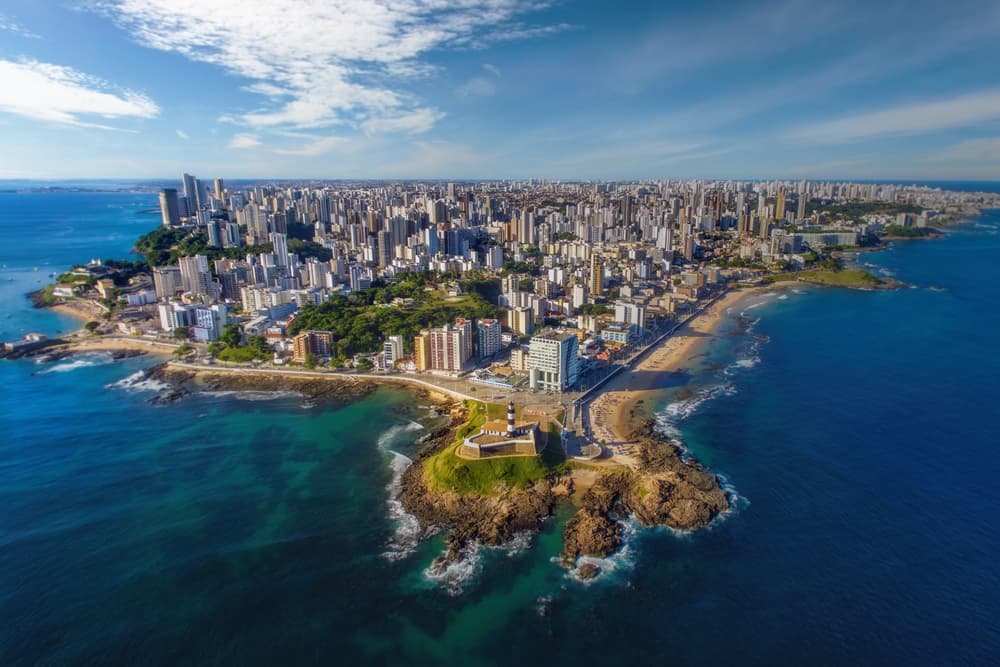
Salvador: Afro-Brazilian life and year-round warmth, with a safety trade-off
Bahia's capital pairs city beaches, the colonial Pelourinho and living Afro-Brazilian traditions with crime you'll need to plan around.
- 2,417,678
- Population (2022)
- $1,100/mo
- Monthly budget · single
- 78°F / 26°C
- Avg temperature
One person can live in Salvador on about $1,100 a month, and most single budgets in our 2026 data land between $900 and $1,300. A couple needs around $1,600 and a family of four around $2,400. A one-bedroom in the center rents for about $500, or about $350 farther out. All of those are U.S. dollars.
Salvador suits people who want Afro-Brazilian culture as part of daily life, not a museum visit: Bahian food, drumming and capoeira, Candomblé, and the colonial Pelourinho on the hill. It's warm all year, the beaches are inside the city, and at about 2.4 million people it's big enough to have private hospitals and an English-language international school.
Here's the catch: crime. In the Atlas da Violência 2026, Salvador had the highest estimated homicide rate of any Brazilian state capital in 2024, at 52.7 per 100,000 people. Expect to think about where you walk at night, and to handle most of daily life in Portuguese.

Reviewed and updated October 9, 2026 · 4 min read
At a glance
$1,100
Monthly budget · single person
$500/mo 1-bed rent, center
28/100
Safety index
$15
Internet / month
78°Fannual average
Jul 75° · Feb 82°
Climate
2,417,678
Population (2022)
Expatsi estimates, updated Oct 2026, based on rental listings, government statistics, and local reporting.
Cost of living
What it costs to live in Salvador
Single person
$900–$1,300/mo
about 65% below Austin, TX
Couple
$1,400–$1,900/mo
about 65% below Austin, TX
Family of four
$2,000–$2,800/mo
about 70% below Austin, TX
Compared with Austin, TX (Expatsi estimate, 2026).
- $6 −70%
- Inexpensive meal
- $400–$550/mo −74%
- 1-bed rent, center
- $300–$400/mo −74%
- 1-bed rent, outside
- $15/mo −77%
- Internet
- $40/mo −3%
- Transit pass
- $158/sq ft −76%
- Buy price, center
Expatsi estimates, updated Oct 2026, based on rental listings, government statistics, and local reporting.
Daily life
How Salvador lives
- B- grade, 40th percentile among the cities we track
- Dining & caféstypical
- A- grade, 82nd percentile among the cities we track
- Arts & culturestrong
- A- grade, 73rd percentile among the cities we track
- Parks & outdoorsstrong
- A- grade, 78th percentile among the cities we track
- Schools & educationstrong
- A- grade, 82nd percentile among the cities we track
- Healthcare accessstrong
- B grade, 43rd percentile among the cities we track
- Bike infrastructuretypical
- B grade, 52nd percentile among the cities we track
- Public transittypical
- B grade, moderate physical accessibility
- Accessibilitymoderate
Graded on OpenStreetMap amenity density relative to the 298 cities we track. Accessibility is the exception: it's graded against a fixed standard (terrain steepness and sidewalk surfaces), not a curve.
Climate
Weather through the year
Annual average 78°F (26°C) · 74 in of rain a year · Source: Meteostat station normals (83229, 1991-2020)
On the ground
Scenes from Salvador
Getting around
Transport in Salvador
The metro is the quickest way across Salvador. It runs from Lapa, near the center, out toward Águas Claras, and up the east side past the Rodoviária bus terminal, Imbuí and Pituaçu to the international airport, so you can land and ride straight into town. Trains run every day from 5 a.m. to midnight.
Buses cover the rest of the map. The fare is R$5.90 in 2026, the same on regular buses and the BRT, and with a Salvador Card you can transfer between bus and metro on an integrated fare. Our data puts a monthly transit budget at about $40.
Whether you need a car comes down to where you rent. Near a metro station, you can skip one. Farther out, or if you plan regular trips around Bahia, a car starts to make sense.
One trip to plan around is the ferry across the bay to Itaparica island, which backs up on holidays. On Ash Wednesday 2024, drivers waited 4 hours to board and foot passengers about an hour and a half.
- 27/sq mi
- Transit stops
- 4.4/sq mi
- Bike infrastructure
- 15/sq mi
- Wheelchair-accessible places
Mapped features per square mile from OpenStreetMap.
Keep exploring
Places like Salvador
Community & practical notes
Settling in on the bay
Neighborhoods and leases: Barra, at the tip of the peninsula, has city beaches and the Farol da Barra lighthouse, and it's a common pick for people new to Brazil. Rio Vermelho is upper-middle class with lively nightlife. Pituba, Itaigara, Graça and Corredor da Vitória are other well-off areas. To rent, you'll usually need a fiador (a Brazilian guarantor) or a bigger deposit. Deposits run one to three months' rent, and a standard lease lasts about 30 months.
Healthcare: Hospital Aliança Rede D'Or earned Joint Commission International accreditation in June 2024, joining two other Rede D'Or units in Bahia that already held it, Hospital Cárdio Pulmonar and Oncologia D'Or. Our Brazil healthcare report explains how private plans and the public SUS work for foreigners.
U.S. services and remote work: A U.S. consular agency reopened in Salvador in November 2024 and handles some documentation services for citizens. Check what it offers before you count on it. Home internet runs about $15 a month in our data, and remote workers can look at Brazil's digital nomad visa.
Schools: The Pan American School of Bahia, founded in 1960, teaches pre-K through grade 12 in English, apart from Brazilian and Spanish subjects. It offers American, Brazilian and IB diplomas and is accredited by NEASC and the Council of International Schools.
Black Americans: Bahia has long drawn African American roots travelers, who seek out capoeira schools, Candomblé temples and Afro-Brazilian justice groups, and many describe wanting to live among a Black majority. Go in clear-eyed, too: racism is part of Brazilian life, including in how police treat poor Black residents.
LGBTQ expats: Grupo Gay da Bahia, founded in 1980 and headquartered in Pelourinho, is the oldest Brazilian group of its kind still running and tracks violence against LGBTQ people across Brazil. It organizes Bahia's Pride parade, whose 23rd edition was set for September 6, 2026, starting at Farol da Barra on the Barra-Ondina route.
Limited mobility: Getting around takes planning. The historic center has added ramps, lowered curbs and elevators on some of its steep streets and stairways. In 2023, the city widened and leveled the sidewalks on Barra's Rua Afonso Celso after tree roots had taken them over. Fixes like these come street by street, so walk your daily routes and check building elevators before you sign a lease.
Retirement: Salvador fits retirees who want warmth, beaches and a deep culture on a modest budget and accept the security trade-off. It's a harder fit if you want to get by in English. Our retirement visa guide compares the options, including Brazil's VITEM XIV, and our Brazil moving guide covers the rest of the country.
Housing
Renting and buying
- 1-bed rent (center)
- $400–$550/mo
- 1-bed rent (outside center)
- $300–$400/mo
- Buy price (center)
- $158/sq ft
- Buy price (outside center)
- $102/sq ft
Expatsi estimates, based on rental listings, government statistics, and local reporting.
Good to know
Frequently asked questions
Do you need a car to live in Salvador?
Not if you live near a metro station. Salvador's metro reaches the international airport and runs daily from 5 a.m. to midnight, and city buses cost R$5.90 a ride in 2026. A car helps if you live farther out or travel around Bahia often.
Is Salvador a good city for Black Americans?
Many Black Americans are drawn to Salvador for its Afro-Brazilian culture, from capoeira and Candomblé to food and music, and Bahia has long been a destination for African American roots travel. Racism is still part of life in Brazil, including in policing, so visit for an extended stay before you commit.
How much does it cost to live in Salvador, Brazil?
Plan on about $1,100 a month in U.S. dollars for one person in 2026. Rent is the biggest line: a one-bedroom in the center runs about $400 to $550 a month, and $300 to $400 outside the center. An inexpensive restaurant meal costs around $6.
Can Americans retire in Salvador, Brazil?
Yes. Brazil has a retirement visa, the VITEM XIV, for people living on a pension or retirement income. Check the current income requirement with a Brazilian consulate before you apply. Salvador's warm weather and beaches appeal to many retirees, but daily life runs in Portuguese and crime is a real factor.
What is the weather like in Salvador, Brazil?
Warm all year, with an annual average of about 78F. Average highs run near 88F in January and near 80F in July, when lows average near 70F. April and May are the rainiest months, and the city gets about 74 inches of rain a year.
Is Salvador, Brazil safe for Americans?
It takes more care than most U.S. cities. According to the Atlas da Violência 2026, Salvador had the highest estimated homicide rate of any Brazilian state capital in 2024, 52.7 per 100,000 people, nearly double the 26.6 average for the capitals. Our data gives Salvador a safety index of 28 out of 100. Choose your neighborhood carefully and get local advice before you sign a lease.
Is there an American international school in Salvador?
Yes. The Pan American School of Bahia, founded in 1960, teaches pre-K through grade 12 in English and offers American, Brazilian and International Baccalaureate diplomas. It's accredited by NEASC and the Council of International Schools.
See how Salvador fits your life
Take the free Expatsi Test and compare Brazil to over 100 countries on what actually matters: cost, healthcare, climate, and safety. About five minutes.
Why not you?